
Is it worth investing in a treadmill under your desk?


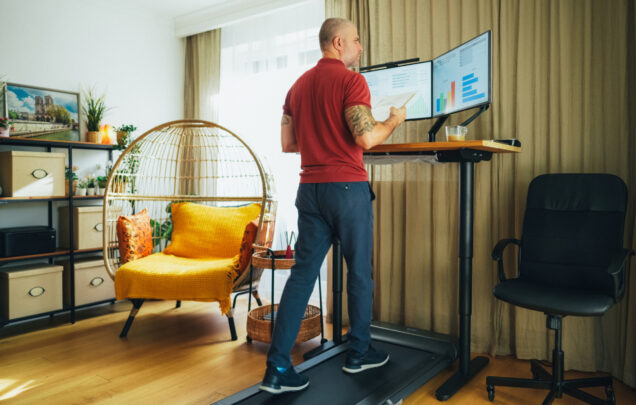
Working and studying from home is now part of daily life for millions of Australians, however concerns are growing about how much time people spend sitting.
Recent surveys estimate more than 6.7 million Australians – almost half of all workers, and the majority in Sydney, Melbourne and Canberra – work from home at least some of the time in paid or unpaid roles. While remote work offers flexibility, it can also mean long, uninterrupted hours at a computer, followed by more sitting once the workday ends.
Health experts increasingly warn prolonged sitting is harmful. By contrast, going into a physical workplace tends to involve more incidental movement, such as walking to public transport, standing during commutes, moving between meetings or heading out to buy lunch.
Against that backdrop, under-desk treadmills – also known as walking pads – have gained attention as a way to add movement back into the workday. The question is whether walking while working delivers meaningful health benefits, and whether those benefits justify the cost.
How much walking is needed?
Research has consistently shown walking improves health outcomes. Studies that increased participants’ weekly walking found improvements in measures such as blood pressure and glucose tolerance.
More recent evidence suggests around 7,000 steps a day is a useful target for reducing the risk of many diseases. The World Health Organisation has also updated its guidance, shifting from recommending physical activity in minimum 10-minute bouts to an “every move counts” approach.
Short, frequent walking or squatting breaks to avoid long periods of sitting may even be more beneficial than a single, longer walk. This research suggests physical activity does not need to be highly structured but can be accumulated through the day in small amounts.
From that perspective, a treadmill at a desk – encouraging regular walking breaks during hours that would otherwise be spent sitting – is likely to be beneficial.
What does the research say about treadmill desks?
There are relatively few studies specifically examining treadmill desks, but most have found positive effects.
Research has linked treadmill desk use with improvements in cholesterol, blood pressure, metabolism and body composition. Results vary, but findings include:
- Sedentary office workers increasing their daily steps by between 1,600 and 4,500 steps compared with those without a treadmill, with the greatest weight loss seen among people with obesity.
- A small study of overweight and obese physicians reporting a 1.9% reduction in body fat while using a treadmill desk.
- Another study averaging an additional 43 minutes of light walking per day, although participants reported difficulty fitting walking into demanding work schedules.
While the changes may appear modest, researchers note they are still likely to produce meaningful health benefits, particularly when maintained over the long term.
Can you still work effectively?
Practical concerns remain about whether people can work efficiently while walking. Some worry walking could distract from tasks requiring concentration.
One study found no significant difference in cognitive performance between people sitting and those walking at their own pace on a treadmill. However, treadmill and cycling desks can reduce typing accuracy and make precise mouse movements more difficult, limiting their suitability for mouse-intensive tasks.
For people who struggle to type while walking, voice-to-text options built into some operating systems may offer a workaround.
Cost versus simpler options
Entry-level walking pads typically cost about $180–200, while higher-end treadmills that can also be used for running can exceed $1,000. In many cases, a standing desk is also required.
Supporters argue treadmill desks can act as a visual reminder and motivator to move, especially for people short on time or unable to leave their desk during the day. Critics note similar benefits may be achieved by taking regular walking breaks away from the desk at little or no cost.
Health researchers emphasise that even small increases in physical activity can make a difference, particularly for people who are highly sedentary at work and at home. For some, an under-desk treadmill may be a useful tool. For others, simply standing up and walking more often could be the more practical and affordable solution.
IMPORTANT LEGAL INFO This article is of a general nature and FYI only, because it doesn’t take into account your personal health requirements or existing medical conditions. That means it’s not personalised health advice and shouldn’t be relied upon as if it is. Before making a health-related decision, you should work out if the info is appropriate for your situation and get professional medical advice.





 Proudly Australian owned and operated
Comments 0
Join the conversation. Comments are reviewed before they appear.
Be the first to comment.
Join the conversation
Tell us who you are to post a comment. We'll remember you next time.