
The blood donation fact most Australians get wrong


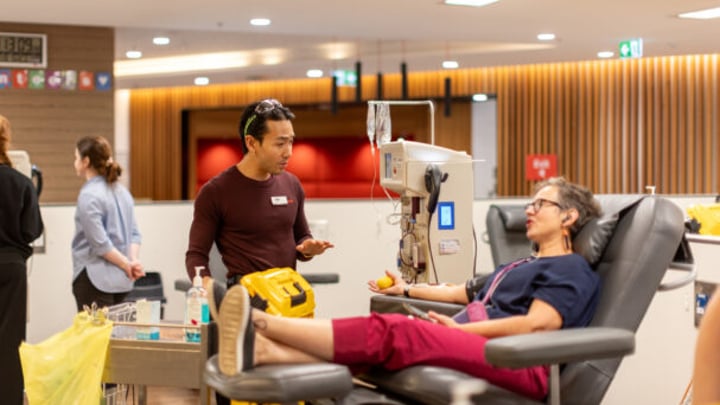
Cancer patients use far more donated blood than accident and trauma victims, prompting an urgent appeal for Australians to roll up their sleeves. Most Australians probably picture a serious car crash, emergency surgery or major accident when they think about where donated blood ends up.
Cancer patients are actually Australia’s biggest users of donated red blood cells and the Leukaemia Foundation and Australian Red Cross Lifeblood are using World Leukaemia Day to highlight how heavily thousands of cancer patients depend on blood donations during treatment.
New Lifeblood research found seven in 10 Australians believe people involved in accidents and emergencies are the biggest users of donated blood products.
But 34 per cent of donated red cells are used by people with cancer and blood diseases. By comparison, just 2 per cent are used for road incidents and other trauma.
For people living with blood cancers including leukaemia, lymphoma and myeloma, transfusions can be essential during treatment.
“Over one in three blood transfusions in Australia occur in people living with cancer, including blood cancers like leukaemia, lymphoma and myeloma,” Leukaemia Foundation CEO Chris Tanti said.
“For thousands of patients, donated blood, plasma and platelets are not simply part of treatment – they are a crucial lifeline that keeps them alive long enough for the treatment to work.”
One Australian diagnosed every 26 minutes
The Leukaemia Foundation estimates 20,044 Australians will be newly diagnosed with a blood cancer this year: about 55 people every day, or one person every 26 minutes.
Cancer and treatments such as chemotherapy can affect the body’s ability to produce sufficient red blood cells, while people with leukaemia can develop dangerously low platelet counts.
Platelets help blood clot and prevent bleeding, but donated platelets have a shelf life of just seven days.
Hospitals therefore need a constant supply.
Blood cancer patients use around two-thirds of Australia’s donated platelets.
According to the Leukaemia Foundation and Lifeblood, a person being treated for acute leukaemia may require up to 36 bags of platelets in a month. With four blood donors needed to produce each bag, providing that many platelet transfusions can require the equivalent of up to 144 donor contributions.
Without regular transfusions, some patients may be unable to continue treatment or could face potentially life-threatening bleeding.
Only one in 30 eligible Australians donates
Despite the demand, Lifeblood says only about one in 30 eligible Australians donates blood or plasma.
Lifeblood CEO Stephen Cornelissen AM said donated blood products were helping Australians through some of the most difficult periods of their lives.
“Because of the short shelf-life of platelets, we need a constant stream of generous donors to ensure hospitals have the blood products they need when patients need them most,” he said.
“Every blood donation could be the reason someone can continue treatment, avoid life-threatening complications, and spend more time with the people they love.”
Australians interested in donating blood or plasma can contact Australian Red Cross Lifeblood on 13 14 95, visit the Lifeblood website or use the Lifeblood app.
Anyone affected by blood cancer can contact the Leukaemia Foundation’s blood cancer support service on 1800 620 420.





 Proudly Australian owned and operated
Comments 3
Join the conversation. Comments are reviewed before they appear.
Donated blood for years. Got to 100 donations then Blood Bank went to Plasma only!!! And this is in a city of 200,000+! The Townsville Blood Bank needs to return to whole Blood as well as plasma!
I gave Blood for nearly 40 years.
I started in Melbourne when a friend said Geelong Blood bank gave a tinnie if you donated blood (this was in the late '60s). So I started donating in Geelong until I went to TPNG. I gave Blood there in Moresby and Rabaul for several years then I was posted to the Highlands. Neither Mendi (Southern Highlands) nor Kundiawa (Chimbu) had Blood Banks.
I finally got back to Australia and in Canberra trooped into the BB to resume operations and during normal questions, after I told them I had had Malaria and Dengue Fever, I was firmly ushered out the door.
I was then posted to the Cocos (Keeling) Islands in the Indian Ocean in the late '70s. There arose a medical issue and I had the right Blood Group, so I trooped into the Clinic. More Qs this time Malaria or Dengue wasn't an issue, the Dr said "You've got the right Blood, she needs it". So it was back on the couch again.
Back to Canberra and they didn't want to know me. So a decade or so later, the mid '90s when working in Sydney. I trooped up to the old Blood Bank in York St (?) and offered my services. By now Malaria and Dengue Fever wasn't so much of an issue. So it was back on the couch. They had a great food layout with 6 flavours of fruit drinks. On the way out I hear some of the staff talking about the dropping Plasma levels, so I volunteered for that.
So for the next 7 or so years I gave Plasma at the normal time frames. Along with Plasma, from time to time I also gave "pikelets" (Platelets).
The most interesting episode occurred when after a Plasma session the BB Lady dealing with said the Dr in charge would like to talk to me. This was a change as usually it was me wanting to talk to the Dr. So puzzled, I wandered into his office presented myself.
He thanked me for my Donations, then came the heart of the matter. It appears that the University of Sydney Medical School had been doing long term Blood work (since WWII) about Tropical Diseases, mainly Malaria and Dengue Fever and the Temperature Gradient for the Mosquitoes was inching South at so many km a decade. Currently (late '90s) that line was around either Townsville or Rockhampton (I don't recall). And I was the only person on the Blood Bank's books whose Blood had Antibodies to both Malaria and Dengue Fever. I was asked could I give 3 lots of Antibodies a week for 6 weeks, could I help?
I could but I would have to check with my Boss first. My Boss was okay with, so away I went. I kept giving Plasma and was posted to Perth just after the Olympics. I happily gave Plasma until sometime in 2004 I was again called into the Office. It appeared I had some Blood anomaly and I should see a Dr to get a referral to a Haematologist. So I did and it appeared I had CLL, so that was the end of a long term relationship with the Blood Bank across Australia and its Territories.
Don`t do blood (did for a lot of years) but donate plasma. Can do it more often. Last donation, they told me I could do blood in between. Heading there next week.
Join the conversation
Tell us who you are to post a comment. We'll remember you next time.