


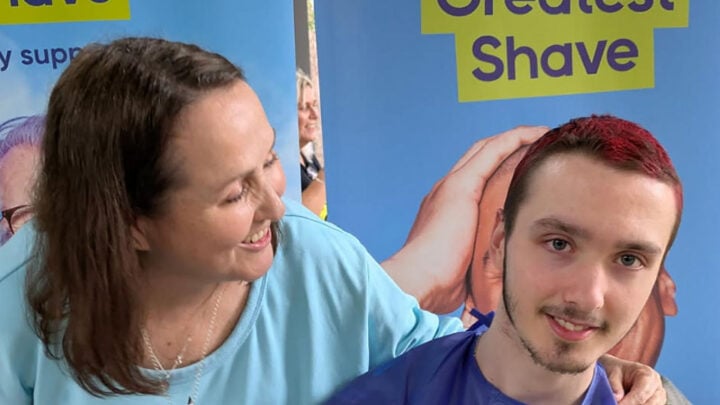
When Kylie Trueman’s teenage son Brandan was diagnosed with leukaemia, she packed up her life to move to Brisbane to be closer to specialist care.
At the time, she expected to be back home in Cairns, in Far North Queensland, with her husband and daughter within three months.
Instead, nearly three years later, the family has been forced to permanently relocate to access ongoing treatment for her now 18-year-old son.
Ms Trueman estimates the family has spent $350,000 all up, including in lost wages, flights and relocation costs, added to years of missed opportunities.
“It just took away all the dreams of the whole family,” she told AAP.
She is one of many Australians forced to pay what the Leukaemia Foundation refers to as the “postcode penalty”.
It describes the added costs regional patients are forced to pay to access care only available in major cities, including travel and accommodation.
In a national scorecard launched on Monday, the foundation ranked states and territories by how the subsidies they offer compare to real-world costs.
In Victoria, which placed last, accommodation subsidies meet an estimated 28 per cent of real world costs.
This means that a regional patient relying on that subsidy to fund a night’s stay in Melbourne can expect to pay almost three-quarters of that out-of-pocket.
It also placed last for its car travel subsidy, offering about 21 cents per kilometre driven, less than half the estimated real-world cost.
Relative to the average cost of a night’s stay in major cities within each state or territory, the ACT placed second-last, behind Queensland and NSW.
South Australia ranked first, where patients can expect to recoup about 70 per cent of accommodation costs and 34.44 cents per kilometre driven.
The subsidies are not intended to entirely cover access costs, but the findings suggest patients in certain states are significantly worse off.
The costs can compound when patients are forced to stay away from home for extended periods, Bill Stavresky, head of research at the foundation said.
“Most patients are in hospital for at least a few weeks, and if you’re having a transplant, the average stay is probably close to two to three months,” he said.
“That quickly adds up.”
Ms Trueman said her situation became so dire that her husband was at one point forced to live in a tent with the family dog.
While Medicare helped with treatment costs, she said government support was otherwise hard to access and tapping her superannuation was nearly impossible.
But she considers herself lucky that their travel, accommodation and living expenses were partially funded by private charity and community support.
“If we didn’t have that, I honestly don’t know where we’d be,” she said.
ALSO CHECK OUT ‘YOU’RE JUST AWESOME MUM’: LYNDEY MILAN ON LOVE, LOSS AND LIVING FULLY





 Proudly Australian owned and operated
Comments 1
Join the conversation. Comments are reviewed before they appear.
we spent at least 4 months in Brisbane (we lived in Bundaberg) so daughter could get surgery on both feet. It was a nightmare emotionally and financially., accommodation that was wheelchair accessible, items needed e.g. moon boot /wheelchair/dressings etc. all of which we had to purchase (public system not private). Transport expenses so the family back home out in the country could use the car to get around. when allowed to go home to Bundy, patient transit scheme said they would fund a bus ride (8 hours) for a kid with both feet strapped who could barely get across a motel floor, with tv antennas sticking out of her feet, (don't know if they would fit under the bus seats.) so mum used her Mastercard to buy plane tickets (wonder why there is so much Mastercard debt?? accessing health care in Qld is one reason. surgeon said no to staying in Macdonald house so had to stay in a motel which aren't equipped for long term stay. hospital accommodation isn't always wheelchair accessible Had to feed daughter from outside of the hospital, we mentioned an allergy to cow's milk and the hospital couldn't cope with it. $$$$$$$$$$$$$$$$$$$$$$$$$ it cost a fortune, all while keeping a home going back in Bundaberg. I said it then and I will say it again, Queensland doesn't go any further north than Brisbane. The fights and battles to get what we were supposed to be entitled to, accommodation /transport etc. Trouble is I discovered if u use the government system you apply in your hometown to go to Brisbane, but all decisions on what they will fund are made by your hometown, they decided we didn't need plane rides, we didn't need motel accommodation, surgeon said we did because of a risk of infection from communal baths n showers n such. years ago I met a mother daughter and grandmother, mum n daughter were down for cancer treatment had to be in two separate hospitals, government wouldn't pay for nanna to care for her granddaughter. Mum couldn't do it while undergoing surgery and cancer treatments.
Join the conversation
Tell us who you are to post a comment. We'll remember you next time.