

By Katelyn Catanzariti in Sydney
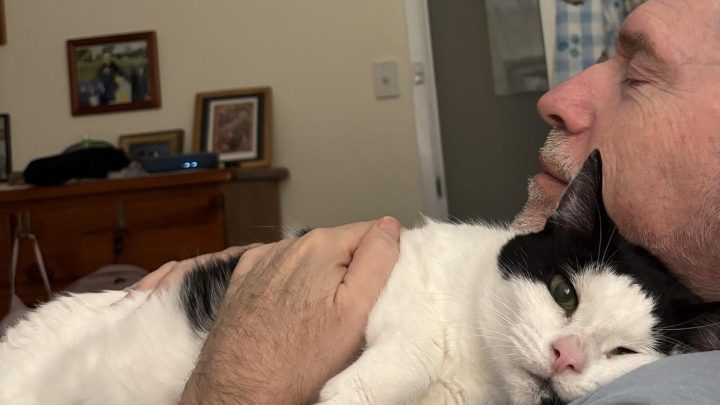
Roy Hazelwood did what anyone about to have holes drilled into their skull while fully conscious would do and stopped to take a selfie with his surgeon. The Sydney grandfather was remarkably relaxed about the prospect of brain surgery, treating the operation as something of an adventure.
But what followed was not for the faint-hearted.
With a metal “halo” frame fixed to his head to guide the instruments, surgeons peeled back his scalp and began drilling.
“I had to keep my teeth apart so my teeth didn’t shatter from the vibrations,” the 65-year-old tells AAP.
At one point, the local anaesthetic began to wear off and he felt a hot sting across his head. Doctors topped it up before continuing to insert electrodes deep into his brain, testing their placement with electrical impulses while he remained awake.
The procedure, known as deep brain stimulation, was designed to control the symptoms of Parkinson’s disease, a condition Mr Hazelwood had been living with for eight years.
And for a man whose confidence, career and independence had been increasingly challenged by the progressive neurological disorder, the results would be life-changing.
Roy’s journey to diagnosis and surgery
His journey began in 2012 when a tremor developed in his left hand after he spent 12 hours operating a jackhammer while helping his daughter renovate her home. He initially dismissed it as a muscle strain but his GP, who had known him for about 20 years, noticed something else – his face had lost some of its usual expression, developing the characteristic mask-like appearance that can be an early sign of Parkinson’s.
She immediately suspected the disease, a diagnosis subsequently confirmed by a specialist.
For the next seven years, Mr Hazelwood tried different medications, eventually taking tablets four or five times a day. The treatment was becoming less effective, while the demands of managing his symptoms were increasingly difficult.
Working in a senior role involving contact centres and presentations, he found himself struggling with the strain of keeping his condition under control.
“No one can tell I had Parkinson’s but it was quite a strain internally on me,” he says, explaining why he opted for the deep brain stimulation in 2020.
The surgery involved implanting electrodes into targeted areas of his brain, connected by wires beneath the skin to a rechargeable stimulation device in his chest. Mr Hazelwood was placed under general anaesthetic for the final stage of the procedure.
The treatment would not cure his Parkinson’s but it offered a way to better manage some of its debilitating symptoms.
And the difference was remarkable.
Mr Hazelwood says he felt clearer-headed after surgery, having previously experienced a persistent mental fog. His confidence returned, allowing him to resume presentations at work without the same self-consciousness.
He joined a community choir and returned to leading singing at church, while taking part in a Parkinson’s exercise program involving large movements, treadmill sessions and weights to help maintain his mobility.
But the operation did not erase every challenge of living with the disease. His voice has become quieter, requiring exercises to help him project it, while his handwriting has deteriorated.
He describes how words start at a normal size before becoming progressively smaller, a symptom for which he has sought occupational therapy.
There have also been more subtle social and professional consequences. At work, a manager once mistook his slower processing of information for resistance when he was challenged about something.
“I think people get disadvantaged by it through no fault of their own and if they don’t know how to manage the relationships it can make things complicated,” he says.
Interpersonal relationships, he believes, can be among the most difficult aspects of Parkinson’s. “It’s actually a lot easier to be the person experiencing Parkinson’s than it is to be the partner watching,” he says.
Mr Hazelwood credits his wife, three children and wider community with helping him navigate those changes.
Understanding Parkinson’s and spreading the word
Parkinson’s Australia chief executive Olivia Nassaris says such experiences highlight a fundamental misunderstanding of the disease. While tremors are its most recognisable symptom, they represent only a fraction of its impact.
“A tremor is a very, very small detail, you know, a motor symptom of the condition, and the non-motor symptoms are really what makes living with the condition quite difficult,” she tells AAP.
“Things such as anxiety and depression and apathy actually are the big hurdles that you need to get over to live well with Parkinson’s.”
She says the tendency to dismiss the disease as little more than shaking can leave people struggling with invisible symptoms colleagues, friends and even family members fail to recognise.
Greater awareness could help prevent people from being misunderstood or becoming isolated.
That understanding is increasingly important as the number of Australians living with Parkinson’s continues to rise.
About 50 Australians are diagnosed with the condition every day, and Parkinson’s Australia expects the number of people affected to triple by 2050.
Ms Nassaris says the growing burden will require greater investment in research, education and multidisciplinary care, particularly in regional and rural areas where access to specialist services can be limited.
She also wants greater public understanding of what people living with Parkinson’s might be experiencing, including fatigue, changes in mood and difficulties communicating.
For Mr Hazelwood, who is preparing to retire after years of work at Anglicare, the message to others facing a diagnosis is to remain engaged with life and seek the support they need.
“Don’t let it determine your future,” he says. “Get speech therapy, get physical therapy, be open about it. There’s no need to hide, you know. It doesn’t mean you’ve changed as a person.”
If you want to read more stories about health, conditions and diseases, you might want to read our story on whether you should correct someone with dementia.







 Proudly Australian owned and operated
Comments 0
Join the conversation. Comments are reviewed before they appear.
Be the first to comment.
Join the conversation
Tell us who you are to post a comment. We'll remember you next time.