
‘The fish will still be there another day’ – John ‘Stinker’ Clarke’s five hours at sea


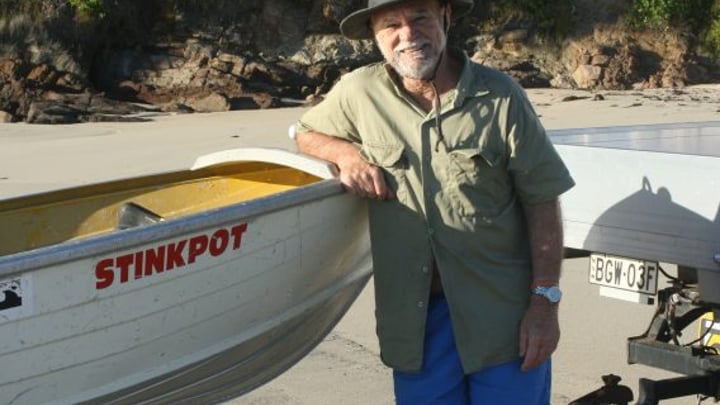
At 77, John ‘Stinker’ Clarke had been fishing off Fingal Bay for 52 years. Then his boat capsized in rough seas. As he waited for help, he thought about his family and the everyday things he wanted to get home to.
John ‘Stinker’ Clarke was floating in the dark off Port Stephens when he remembered he’d forgotten to put in his footy tips. His boat had capsized near the lighthouse off Fingal Bay that June afternoon. An old lifejacket was keeping him afloat, and he had two oars and an upturned bucket to help him stay above water. He was counting on his wife, Ella, to realise something was wrong when he missed his usual return at sunset.
“Swimming towards the rocks would have been dangerous, so I stayed out in deeper water,” John recalls. “I knew Ella would realise something was wrong when I wasn’t home by dark, and I kept hoping help would come.”
John had spent more than half a century fishing those waters. He knew where he was and what the sea was doing that afternoon. He also knew, even before he launched, that it was too rough to go. That’s the part of his story he most wants people to hear as he shares it for GME’s National Rescue Awareness Week.
Waiting for a light in the dark
In the water, John concentrated on staying afloat and saving his energy. His lifejacket was in poor condition, he says, but it kept him up. He felt something nudge his shoulder in the dark and realised it was an oar. He grabbed it and then the other one.
The bucket came next. He turned it upside down to trap air inside and held on. As the hours passed and the cold set in, he began to shiver. He realised he was getting dangerously cold and kept thinking about Ella and the rest of his family.
“There wasn’t one grand moment of revelation,” he says. “I was concentrating on surviving, with thoughts of home coming and going.”
On shore, Ella found his truck still parked at the beach and raised the alarm. Friends knew where John liked to fish, and word reached Port Stephens Water Police Sergeant Clint Brown. John had taught Clint at school and coached him in rugby. Now his former student was among the people looking for him.
Nearly five hours after the capsize, a doctor aboard the Westpac Rescue Helicopter spotted John in the dark with a handheld light. The helicopter crew radioed his position to the Water Police, who brought their boat through the rough water and pulled him out.
“To have someone I’d taught and coached in rugby involved in saving my life was extraordinary,” John says. “Years earlier, I’d been his teacher, and there he was helping bring me home.”
He remembers little of what happened immediately after he saw the helicopter. What he remembers of the hospital is how good it felt to get warm again.
He’s quick to give credit to everyone who helped, from Ella and the friends who knew where to look to the crews who found him and got him back to shore. “How do you properly thank people for giving you your life back?” he says.
Make the call before you leave
John went out alone that afternoon, but having company can bring its own pressure. In research released by Australian safety equipment company GME, 35 per cent of Australians surveyed said they would be reluctant to call off an outdoor activity after a weather warning if their mates still wanted to go.
Half said they push through physical discomfort to avoid slowing the group down.
Tony Crooke, a safety expert with GME, says it helps to agree beforehand that anyone can ask to turn back. That might mean picking a shorter bushwalk if the day is hotter than expected or giving the fishing a miss when the swell is up.
Anyone who’s tired or uncomfortable should feel able to speak up while the group still has time to change plans.
“Safety starts before you leave home,” Crooke says. “Research where you’re going, check the conditions and choose a trip that suits everyone’s fitness and experience.”
For a day on the water, check the Bureau of Meteorology’s marine forecast and warnings, including the wind and swell. Find out what the tide is doing and check conditions again before launching and while you’re out.
A sunny morning at the ramp can tell you very little about what you’ll encounter offshore or on the way home. For a walk, check the forecast and any park alerts, and leave enough time to get back before dark.
If you’ve been looking forward to a trip for weeks, it can be hard to be the one who suggests a change. Agree on a fallback while everyone’s still at home. It’s easier to switch to a sheltered spot or pick another day when everyone already knows the options.
John puts it more simply. “If you’re doubtful, leave the boat where it is. The fish will still be there another day.”
Give someone a way to find you
Ella knew when John would normally be home. Before you head out, give someone your intended route, your expected return time and a clear plan for what to do if they haven’t heard from you.
If you change your route, let your contact know as soon as you can so they have current information. If you’re boating in NSW, you can also log on with Marine Rescue NSW using VHF channel 16 or the MarineRescue app. Log off when you’re safely back.
Wear a properly fitted lifejacket in good condition and check the safety equipment required for your boat and the waters you’ll be in. Keep the marine radio and distress beacon within reach, and make sure anyone coming with you knows how to use them.
On land, Crooke recommends packing extra food and water, a first aid kit, navigation tools, a torch and clothing for a change in the weather. For remote trips, carry a personal locator beacon (PLB) so you have a way to raise the alarm beyond mobile coverage.
A charged mobile phone is worth taking, but check where you’re likely to lose reception before you set out.
For boating, check your state or territory’s rules on carrying an emergency position-indicating radio beacon (EPIRB). In NSW, an EPIRB is required on open waters more than two nautical miles from shore.
A PLB can supplement the boat’s EPIRB. Register your beacon with the Australian Maritime Safety Authority (AMSA) and keep your emergency contact details current.
Crooke points to GME’s MT620GR personal locator beacon as an example of a model with Return Link Service. The feature lets the person who activated the beacon know that the distress alert has been received. AMSA says the acknowledgement confirms receipt. Rescue coordination is a separate step.
Another day on the water
Before the capsize, John had never got around to buying a rescue beacon. A friend helped arrange one through GME after the rescue, and now it goes with him every time he takes out his new boat, Stinkpot 3. There’s still fishing to be done, he says. He’s also happy to leave the boat at home when the sea is too rough.
The hours off Fingal Bay gave him plenty of time to think about what he wanted to get back to. It was the ordinary things that mattered most.
“Time with the people you love, good mates and another day doing something you enjoy – that’s worth an awful lot,” John says.
If you enjoyed this feature, you might want to read our story on how walking football can keep you fit while being social.





 Proudly Australian owned and operated
Comments 0
Join the conversation. Comments are reviewed before they appear.
Be the first to comment.
Join the conversation
Tell us who you are to post a comment. We'll remember you next time.