
At 94, Everald Compton still has a plan


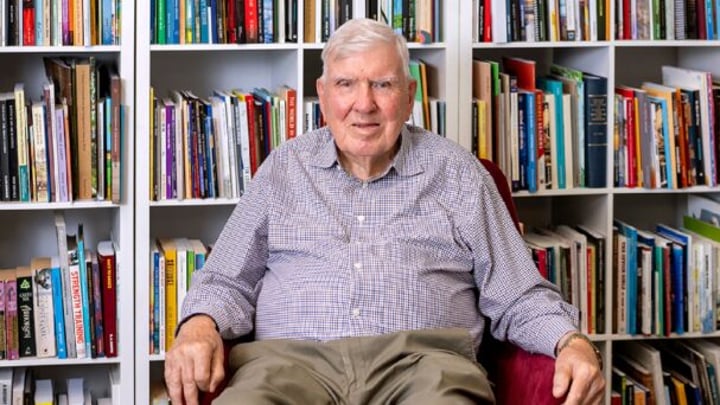
THE BIG READ: Starts At 60’s Scott Podmore spends half an hour with legendary Australian author and philanthropist Everald Compton.
“When you wake up every day, do something for humanity.”
Everald Compton doesn’t hesitate when he says it.
There is no lengthy pause while he searches for the right words, and no carefully crafted soundbite designed to inspire. At 94, he has had decades to think about what gives a life meaning, and his answer arrives as naturally as breathing.
“Don’t spend the whole day just looking after yourself and earning the money you need. Do something for humanity every day, and humanity will do something for you,” he says.
It is a philosophy that has guided him from a childhood in Depression-era Queensland to becoming the founder of National Seniors Australia, an international fundraiser, company chairman, author and advocate for older Australians.
It is also the reason he plans to spend part of his 95th birthday walking 11km around Uluru.
Most people would be happy with a cake.
Compton wants to raise $100,000 for charity.
A walk with purpose
Five years ago, to mark his 90th birthday, Compton completed a 14km charity walk through the Brisbane Valley region where he grew up. The effort raised about $35,000 for Dorcas, a charity that provides emergency financial assistance to people facing crisis.
This time he wants to go further, and the upcoming Uluru walk will again support Dorcas. There is another important reason he chose one of Australia’s most significant landmarks.
Compton describes Uluru as the spiritual heart of Australia.
Not because of any one religion.
Not because of any particular belief system.
Rather, because it offers something increasingly rare in modern life: space to reflect.
“I regard Uluru as the spiritual heart of Australia for anybody of any religion. I don’t care whether you’re Christian, Jewish, Muslim, Indigenous, Buddhist – it doesn’t matter. It’s a spiritual place.”
He plans to begin the walk at dawn, a time he says Indigenous Australians regard as particularly significant. As he makes his way around the base of the rock, he intends to do more than count kilometres.
“I’m telling people who are coming to walk some of the way with me that they should turn this into a spiritual experience. It may not be religious – it might just be a deeply personal reflection where you assess your life as you walk around the rock. I’ll look at my life and ask how I can improve it. That’s what I’m going to do as I walk around Uluru.”
Even as he approaches 95, he is still looking for ways to grow.
The boy from Linville
Compton was born in 1931 and raised in Linville, a small timber town in Queensland during the Great Depression, where his father worked as a labourer and the local school had barely 20 students.
Opportunities that many Australians now take for granted were scarce.
When he finished school, university was out of reach. Post-war Queensland had only one university and places were limited.
Rather than see that as the end of the road, he began educating himself. He studied accounting at night, read constantly and developed a habit of curiosity that never left him.
Looking back, he believes that commitment to lifelong learning shaped much of what followed.
“I’ve tried to learn something new every day,” he says.
The sentence slips past almost casually, yet it explains a great deal.
This is a man who still chairs organisations, remains involved in major projects and is currently writing his seventh book.
Remarkably, he didn’t begin writing novels until he turned 80.
The word he hates
There is one word that crops up repeatedly during our conversation, and every time it does, Compton sounds mildly offended by it.
Retirement.
For many Australians, retirement represents freedom, offering the chance to travel, pursue hobbies and enjoy a different pace of life after decades in the workforce.
Compton understands that.
He simply has no desire to retire himself.
“I believe retirement is a repugnant word,” he says plainly, suggesting he’s had this discussion many times.
Today he still chairs companies, serves on boards, writes books and speaks publicly. His current plans stretch all the way to his 100th birthday.
“I’ve always had a five-year plan for my life. Right now, I have a plan that takes me to 100. I know the things I want to achieve – with Inland Rail, with National Seniors, as an author.
“If I don’t wake up one morning, there’s not much anyone can do about that. But until then, I’m planning what I’m going to do to get to 100.”
There is no grandiosity attached to the statement. It sounds more like someone discussing what they hope to get done over the next few years.
That sense of purpose also shapes his thinking about healthy ageing.
As an Associate Professor attached to the Thompson Institute at the University of the Sunshine Coast, Compton has spent years supporting dementia research and education. He is convinced that staying mentally engaged is one of the most important things older Australians can do.
“There are several things you must have: physical exercise, plenty of sleep, the right diet – but above all, your brain has to work,” he says.
“Your brain doesn’t really work just because you watch television, or even just read books or go to concerts. Your brain works when you have a hobby or activity that forces you to use it.”
For him, writing books became part of that strategy.
Researching, drafting, editing and publishing demands concentration and discipline. More importantly, it keeps his mind active.
Far from winding down, he already has another three books planned before he reaches 100.
The regret he still carries
For someone who has achieved so much, I ask whether there is anything he would do differently.
His answer arrives quickly.
Family.
The hardest part of his life, he says, wasn’t building organisations, raising money or taking on ambitious projects. It was the time those pursuits took away from his family.
As an international fundraising consultant, Compton spent decades helping universities, hospitals, schools, museums and charitable organisations raise money for major projects. The work was rewarding and often significant, but it came at a personal cost.
“I was very lucky with my wife, Helen. She was enormously supportive and a wonderful mother, and she filled in many of the gaps,” Compton says.
“But when I look back, I think that spending so much time away was not a good thing. That’s my main regret.”
The answer arrives without self-pity or embellishment.
After spending much of our conversation discussing future plans and new challenges, this is one of the few moments when Compton pauses to look back. The couple have now been married for more than 66 years and when I ask him the secret, he laughs.
“It doesn’t just happen – you have to work at it,” he says. “You’ve got to be understanding, and you must never end the day on a bad note. If you’ve had a fight, someone has to apologise before the end of the day. Usually it’s me, because I’ve probably caused the problem.”
Then comes the line that instantly reveals his sense of humour.
“People who say we’ve been married 60-plus years and never had an argument… they’re bloody liars.”
Caring and sharing
Throughout our conversation, Compton kept returning to one theme: service to others.
The roots of that belief can be traced back to his childhood and the influence of his mother.
“My mother taught me that you cannot be a follower of Jesus, the man, unless you are generous and caring,” he says. “She used to say, ‘Caring and sharing.’ That stuck with me all my life.”
Over the decades, that lesson became something of a personal compass which helped shape his work with charities, community organisations and National Seniors. It also informs the way he sees modern Australia. Compton worries that communities have become more fragmented and that people are spending less time looking beyond their own circumstances.
“I’ve never known society to be so divided and so distrustful of politicians – and that’s worldwide, not just in Australia,” he explains. “When people have arguments now, they’re not just disagreements; they become bitter and hurtful.”
Yet despite those concerns, he remains optimistic about the role ordinary people can play in strengthening their communities.
“You’re a non-person, in my view, unless you’re out in the community caring and sharing.”
Looking ahead, not behind
What struck me most about Everald Compton was not his age, or even the fact he is preparing to walk around Uluru at almost 95.
It was that he still speaks about life in the future tense.
Throughout our conversation he talked about the books he still wants to write, the causes he wants to support and the goals he hopes to achieve before he turns 100. While many people naturally spend more time reflecting on what they have done, Compton remains energised by what he believes is still left to do.
Perhaps that is why he has never embraced the idea of stepping back from life. He still sees himself as a contributor. Someone with a role to play… someone who can still make a difference.
Not everyone wants to chair companies, write novels or tackle an 11-kilometre walk around Uluru in their mid-90s. That isn’t really the point.
The message running through his story is that purpose remains important at every stage of life. Whether it is helping a neighbour, volunteering in the community, mentoring younger people or supporting a cause close to your heart, having a reason to get out of bed still counts for something.
As our conversation drew to a close, Compton returned to the philosophy that has guided him throughout his life.
“When you wake up every day, do something for humanity,” he says. “Don’t spend the whole day just looking after yourself and earning the money you need. Do something for humanity every day, and humanity will do something for you.”
And if his plan works, there are still more books to write, more causes to support and another birthday milestone waiting around the corner.
After nearly 95 years, those words carry a certain weight.
They are not simply advice from a man who has lived a long life.
They are the principles of someone who has spent almost a century trying to live a useful one.
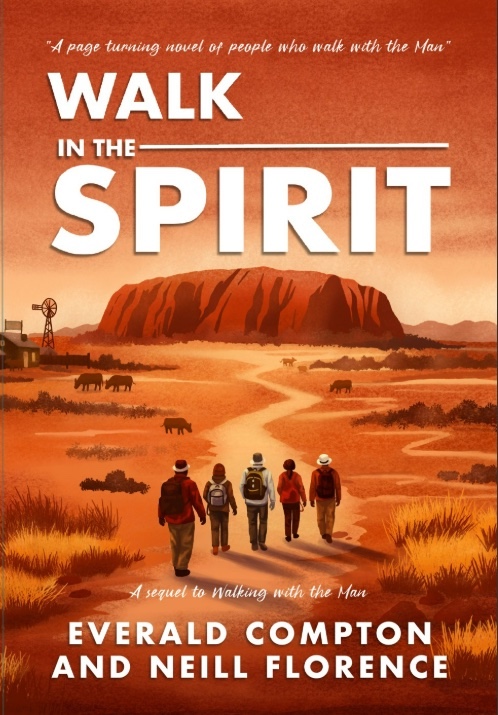
Everald Compton’s latest novel, Walk in the Spirit, was written with longtime friend Neil Florence and explores how people from different faiths and backgrounds can build stronger communities through generosity and understanding. Signed copies of Walk in the Spirit and Compton’s previous books are available through his website: www.everaldcompton.com
Did you know?
Everald Compton may be one of the few Australians with a burger named after him. The Royal on the Park Hotel in Brisbane created the “Everald Burger” to celebrate the launch of his novel Walking with the Man – but not to Church. The burger features a signature single-malt whisky sauce, a nod to Compton’s well-known love of whisky, with proceeds supporting Dorcas ACTS.
IMPORTANT LEGAL INFO This article is of a general nature and FYI only, because it doesn’t take into account your personal health requirements or existing medical conditions. That means it’s not personalised health advice and shouldn’t be relied upon as if it is. Before making a health-related decision, you should work out if the info is appropriate for your situation and get professional medical advice.





 Proudly Australian owned and operated
Comments 0
Join the conversation. Comments are reviewed before they appear.
Be the first to comment.
Join the conversation
Tell us who you are to post a comment. We'll remember you next time.