


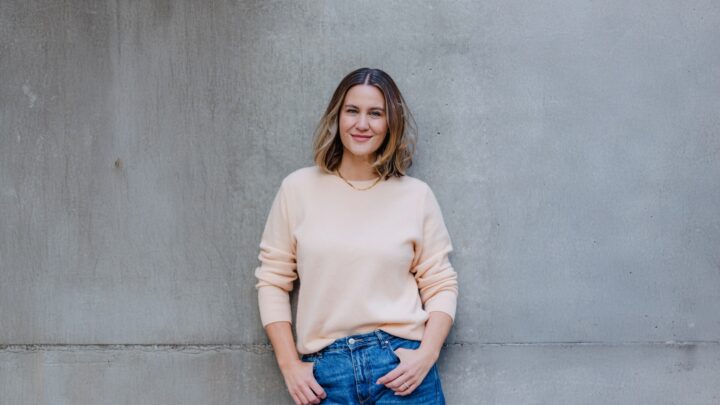
When TV presenter and health communicator Casey Beros learned her Dad was terminally ill, she moved her family across the country to become his carer. Casey’s new book, Next of Kin: What to Expect When You’re Expecting to Care for Someone You Love (Wiley $34.95, 27 August 2025), shares her personal story and provides a heartfelt and practical guide to navigating the complicated world of care. In this edited extract from the book, Casey recalls the heartbreak that is the sometimes conflicting roles a carer finds themselves in when trying to support someone they love.
One of the myriad challenges of being a carer is that there are times you get to be good cop and times you have to be bad cop, sometimes both at once to different people.
Your job as the patient advocate is to help them communicate their wants, but when their wants go against their clinical need (for example), you’re put in a difficult situation and – as the closest person to them – can find yourself in the firing line.
Dad was fearful that going into hospice meant he was dying imminently. It’s what we think we know: palliative care is for people who are dying, and hospice is where people go to die.
But palliative care has had a rebrand. It’s now called supportive care, and the evidence is clear that engaging supportive care earlier can lead to more time and better quality of life, whether someone is dying or not.
Our amazing death doula taught me that hospice isn’t a one-way street (as in, you can go in and come out again) and that the aim with end-of-life care is to ensure symptoms (such as pain and breathlessness) are well controlled. Hospice, she said, would help us achieve that.
When we first walked into the hospice, it was startlingly clean, light and bright, like the interior designer had been given the brief of ‘hospital, but make it upbeat’. The staff were smiley, the rooms opened onto gardens with tranquil water fountains, and on Friday afternoons there was a happy hour and musicians that would play piano or harp. Dad wasted no time jumping onto the harp for a photo, suggesting in his trademark dark humour we send it to his friends to suggest he’d been let into heaven after all.
In my head, Dad going into hospice would allow me to gather myself, get some sorely needed sleep and reset for what I knew was going to be the hardest leg of the journey so far. While it gave me comfort knowing he was one press of a button away from help if needed, I still didn’t feel like I could leave him there alone for more than a few hours, and I made sure I or someone was there with him pretty much every minute of the day and night.
Trouble ahead
I can’t remember who suggested fentanyl as a potential opiate for Dad. It’s very possible it was me. I’d read about the fentanyl crisis overseas, particularly in the US, where folded-over ‘zombies’ roamed the streets and occasionally ate people’s faces off (I might’ve conflated that last bit, but it might also be true). But – I reasoned to myself – this was clean fentanyl. Medical-grade. Doctor-approved. And in the beginning, it was kind of a miracle drug, putting wind in his sails where there was none. I could see the lift in him when he was ‘on’; it was obvious fentanyl made him feel like he could get out and about, have conversations with people and live his life a little bit – and no one would deny him that, even if it was artificial.
If you didn’t know he was dying, you’d just assume he was a slightly dishevelled, slow-walking man in too-big pants. Over a short period of time, Dad had doubled, then tripled, his fentanyl use. It was always with his doctor’s approval, but likely off-label (the term doctors use to describe prescribing a drug or treatment that’s approved but then applied outside of its typical, recommended way).
The drugs hospice doctors used to get Dad’s symptoms under control made him sleepy, which felt to Dad like the beginning of the end and made him fight sleep like it was the enemy. I could smell the fear on Dad, with strong notes of distrust in his doctors and even in me whenever I tried to gently get him on board with something they were suggesting, because I thought it might help him.
After an impassioned plea to the doctors that the new drugs were making him too ‘out of it’, we reverted to fentanyl for additional symptom control. Before I knew it, he was taking it on the hour, every hour during the day: the Trojan horse in an armoury of drugs to get Dad up, down and everything in between.
Like a nutty professor, Dad obsessed over getting the delicate mix and timing of these medications just right, favouring the fentanyl above all else and making no attempt to hide his disdain for anyone – personal or professional – who suggested anything other than more and more fentanyl being the answer to whatever symptom we were trying to manage. Pain? Fentanyl. Breathlessness? More fentanyl. Anxiety? Surely more fentanyl would help. It felt kind of like using water to quench your thirst, fuel your car, feed your cat and pay your phone bill. Effective, just not for all.
The most frequent bad cop
Fentanyl and other drugs with high potential for abuse and addiction are tightly regulated and controlled in care settings.
In order for Dad to get his dose, he had to press the call bell, wait for a nurse to come and take the request, then wait while the nurse went to find another nurse to complete the process. The two nurses would have to unlock the cupboard protecting the fentanyl, get it out, do the paperwork and bring it to Dad.
This process could take between 15 and 45 minutes depending on what else was happening on the ward, which made it very difficult for Dad to stay in ‘the pocket’ given he was taking it hourly. If they took too long, I’d watch him get more and more agitated, silently cursing the nurses, their children and their children’s children. God help any poor soul who dared imply it could be the enough-to-lift-a-small-cow-off-the-ground levels of fentanyl that were making him feel anxious, speedy and panicked.
And the most frequent bad cop? Me. All of a sudden, Dad started having moments of feeling like I wasn’t on his side because I was gently encouraging him to lessen his use – I was the one metaphorically standing between him and his precious drug.
Every day felt like a dozen tiny heartbreaks as I watched him realise the once-miracle drug was no longer effective against the silent assassin that was his disease, and it was time to change tack.





 Proudly Australian owned and operated