
Having cataract surgery? 5 questions to ask first


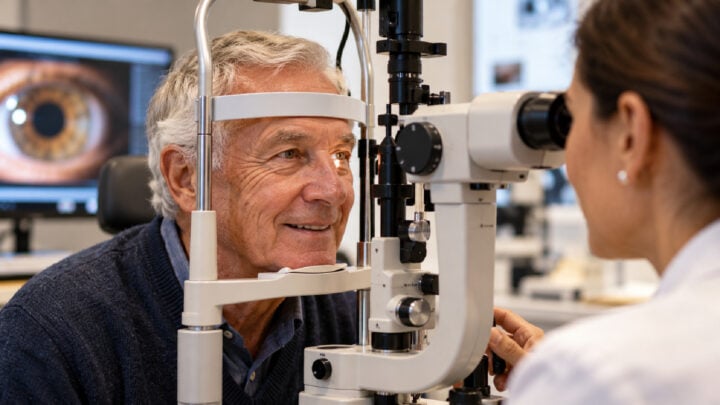
New research reveals many Australians are having cataract surgery without fully understanding their lens options. Leading ophthalmologist Professor Andrew Chang explains what patients should know, while 71-year-old John Goggins shares how surgery transformed his eyesight.
For years, John Goggins thought the changes in his eyesight were simply something he had to live with.
The 71-year-old retired engineer from Ulladulla, on the NSW South Coast, had been severely short-sighted since childhood. He attended regular eye examinations and knew he had early signs of cataracts, but was repeatedly reassured there was no immediate need for treatment.
Then, in February this year, a visit to a different optometrist changed everything.
His cataracts were advanced, and the optometrist was surprised they had been allowed to progress so far.
“The diagnosis did come as a surprise,” John recalls.
Looking back, there had been warning signs. His depth perception and ability to focus had deteriorated, particularly when driving at night, but after decades of worsening short-sightedness, he had assumed it was more of the same.
What followed was cataract surgery that not only restored his vision but revealed something he hadn’t realised he was missing: colour.
“The surprising outcome is that I can now see and distinguish vivid white from soft yellowish white,” he says.
“Also, all lighter colours are much more distinguishable. Prior to surgery, yellows, light brown, beiges and white all took on a ‘dirty’ brown-yellow colour, simply with different tones.”
He no longer needs glasses, although he laughs that he still instinctively reaches for them in the morning.
His experience is a reminder that changes in eyesight shouldn’t automatically be dismissed as an inevitable part of getting older. It also raises an important question for the thousands of Australians facing cataract surgery each year.
How much do we really know about the lenses being implanted in our eyes?
The decision many patients don’t realise they’re making
New research commissioned by eye-care company Alcon and conducted by Ipsos has uncovered a significant knowledge gap among Australians undergoing cataract surgery.
According to the company’s whitepaper, 58 per cent of people surveyed who had undergone the procedure were unsure what type of replacement lens they received. Another 72 per cent reported that their doctor chose the lens without presenting alternatives, while 78 per cent were happy to follow their doctor’s advice without conducting their own research.
Professor Andrew Chang AM, a leading Australian ophthalmologist and vitreoretinal surgeon, says the findings are concerning, although perhaps understandable.
“Patients quite reasonably trust their ophthalmologist,” he says.
“But trusting your doctor and participating in the decision aren’t mutually exclusive.”
During cataract surgery, the eye’s cloudy natural lens is removed and replaced with an artificial intraocular lens, known as an IOL. While the procedure is well established, the range of replacement lenses has expanded considerably.
A monofocal lens generally provides clear vision at one distance, often leaving patients needing reading glasses. Toric lenses can correct astigmatism, while extended depth-of-focus lenses offer a broader range of vision, particularly for intermediate tasks such as using a computer.
Multifocal and trifocal lenses may reduce dependence on glasses across several distances, although they can also introduce problems such as halos or glare around lights.
There is no universally superior option.
“The patient doesn’t need to become an expert in IOL technology,” Professor Chang says.
“But they should understand what we’re recommending, why we’re recommending it, and what they can realistically expect afterwards.”

Better eyesight doesn’t always mean goodbye to glasses
One finding from the research may surprise people hoping cataract surgery will eliminate their need for spectacles. Seventy per cent of surveyed patients continued to rely on glasses or contact lenses for reading or close-up activities after surgery.
Professor Chang says expectations need to be discussed well before an operation.
“Cataract surgery doesn’t mean that everybody will stop wearing glasses,” he points out.
Nor does the procedure correct every condition affecting vision. Problems involving the retina, macula, optic nerve or cornea may still influence the outcome.
For some patients, reducing dependence on glasses is a major priority and others might place greater importance on night driving, reading comfortably or minimising visual disturbances.
Those differences should guide the conversation, and a more expensive lens is not necessarily a better lens, either.
“If I pay more for this lens, what will it allow me to do that the other option won’t?” Professor Chang suggests patients ask.
“And equally importantly: What are the trade-offs?”
John’s experience: From apprehension to amazement
John admits he was initially nervous about surgery, having undergone major hip replacement operations in recent years. His ophthalmologist, Dr Smita Agarwal, took time to explain three lens options appropriate for his eyes, including their likely outcomes and the possibility of halos around lights at night.
That discussion helped him make an informed choice and his fears about pain and recovery proved unfounded in his particular case.
“There was no pain and I experienced only the mildest of blurry vision for an hour or so after the post-operative eye cover was removed,” he recalls.
His experience was remarkably positive, although recovery and results can differ between patients. Asked what advice he would give others approaching cataract surgery, John is enthusiastic: “The sooner you have the surgery, the better!”
It’s a reflection of his personal experience rather than a rule for everyone. The appropriate timing of surgery should be determined with an eye-care professional, taking into account symptoms, eye health and the effect on everyday life.
Five questions to ask before cataract surgery
Professor Chang says these are the five questions he would want his own parent to ask an ophthalmologist before proceeding.
- What lens are you recommending for me, and why? Understand the reasons behind the recommendation and whether other options are appropriate.
- What will I be able to see without glasses, and what will I still need glasses for? Be clear about likely results for reading, driving and everyday activities.
- What are the potential downsides of this lens, particularly for night vision, glare or halos? Every option involves potential compromises.
- Is this lens appropriate for the health of my eyes and for the way I use my vision? Existing eye conditions and lifestyle can influence which lens is suitable.
- What will it cost me, and what additional benefit am I getting by choosing this option? Ask about out-of-pocket expenses and whether any additional cost is likely to deliver a meaningful benefit.
Professor Chang also urges older Australians to take changes in vision seriously, including blurred sight, difficulty driving at night, increased sensitivity to light, faded colours or frequent changes in their glasses prescription.
Sudden or significant changes in vision should be assessed promptly, as they may indicate conditions other than cataracts.
His broader message is straightforward.
“Cataract surgery has never been better, but the conversation about cataract surgery needs to be better too.”
For patients like John, that conversation can be the beginning of seeing the world in an entirely different light.
The research cited in this article comes from an Alcon-commissioned whitepaper, Cataract solutions and consumer awareness – optimising cataract outcomes in Australia. Cataract surgery carries risks, and outcomes vary. Anyone considering surgery should discuss their individual circumstances and treatment options with a qualified eye-care professional.





 Proudly Australian owned and operated
Comments 0
Join the conversation. Comments are reviewed before they appear.
Be the first to comment.
Join the conversation
Tell us who you are to post a comment. We'll remember you next time.