
Why Googling an investment is no longer enough


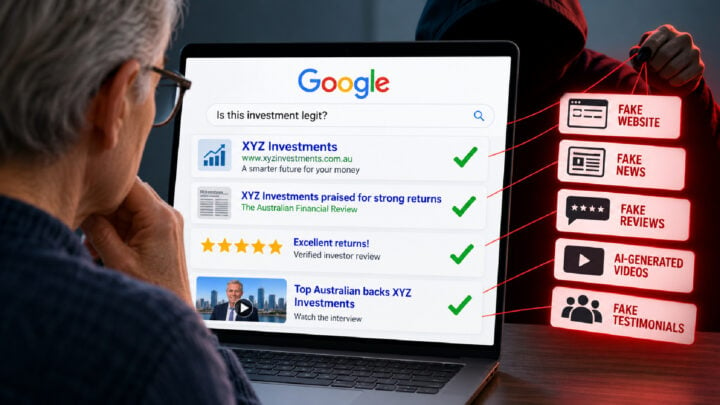
Australians are being warned that one of the most common ways of checking whether an investment is legitimate – Googling it – may no longer be enough as scammers use artificial intelligence to create elaborate fake online worlds around their schemes.
The Australian Securities and Investments Commission (ASIC) says criminals are using generative AI to produce professional websites, fake news reports, fabricated reviews and testimonials, social media content and convincing videos, all designed to make fraudulent investments appear legitimate.
It means someone suspicious enough to research an investment before handing over their money could find what appears to be independent confirmation across multiple websites and platforms.
In reality, much of what they are seeing may have been created by the scammers themselves.
“The presence of polished content, familiar branding or convincing testimonials does not mean an investment is legitimate,” ASIC Chair Sarah Court said.
“AI is making investment scams more convincing and harder to detect. A simple online search is not enough to verify whether an opportunity is legitimate.”
The warning comes as ASIC revealed it removed more than 19,400 online scams during the 2025-26 financial year, up 182 per cent on the previous year.
Among them were 7051 fake investment platforms, a rise of 151 per cent.
The regulator is particularly concerned about Australians approaching retirement, who may have substantial superannuation and savings and are increasingly being targeted by criminals.
ASIC Commissioner Alan Kirkland has previously warned that scammers appear to be deliberately targeting this group because they know many are looking for investment opportunities.
The development has forced a rethink of familiar scam-prevention advice.
Searching for an investment online can still be useful, but ASIC says consumers now need to go further and verify who they are dealing with through independent, authoritative sources before sending any money.
When the search results are part of the scam
What makes the new generation of investment scams particularly dangerous is the amount of work criminals are putting into making them appear legitimate.
ASIC says scammers can create a bogus investment brand and then build an online footprint around it.
That can include professional-looking websites, advertisements, positive reviews, fabricated news stories and AI-generated videos.
Instead of encountering one suspicious advertisement, a potential investor can find what appears to be independent confirmation from several different sources.
The problem is those sources may have been created by the same criminals.
ASIC says victims can be taken from an advertisement on a familiar online platform to a fake news article containing a celebrity endorsement and fabricated comments from supposed investors.
Once someone provides their details, the operation can move offline.
Victims may receive carefully scripted phone calls, be given access to convincing fake investment platforms and, in some cases, even receive small apparent profits designed to establish trust before larger amounts of money are requested.
Cyber safety expert Bora Seker, host of the Dumb Ways to Get Hacked podcast, said AI had undermined something consumers had long regarded as a sensible second line of defence.
“We were all taught to get a second opinion before handing over money, and for years Google was that second opinion,” Seker said.
“The trouble now is the scammer can write the second, third and fourth opinion too, so the search that’s meant to protect you ends up making you feel safer than you should.”
Australians approaching retirement are in the firing line
The warning has significance for older Australians, with ASIC Commissioner Alan Kirkland warning that criminals appear to be deliberately targeting Australians nearing retirement.
“We suspect scammers are deliberately targeting Australians nearing retirement because they know many people in this age group have accumulated retirement savings and are looking for investment opportunities,” he said.
For somebody who has spent decades building superannuation, savings or an investment portfolio, the consequences can be devastating.
Australians lost $837.7 million to investment scams in 2025, according to figures cited by ASIC from the National Anti-Scam Centre’s Targeting Scams Report.
ASIC removed more than 19,400 online scams during the 2025-26 financial year, an increase of 182 per cent on the previous year.
That included 7051 fake investment platforms, up 151 per cent, 5476 phishing scam links and 3106 cryptocurrency investment scams.
Since ASIC launched its scam takedown capability three years ago, more than 33,400 scam websites, social media advertisements and phishing scams have been removed.
Even familiar faces can be faked
Images, voices and videos featuring prominent Australians are also being manipulated or generated to make fraudulent investments appear credible.
According to reports made to Scamwatch, the most impersonated Australians in online scams during the past financial year included Prime Minister Anthony Albanese, financial commentator Alan Kohler, market analyst Tom Piotrowski, Dick Smith, Gina Rinehart, Pauline Hanson and John Laws.
ASIC says reported losses associated with scams impersonating prominent Australians on its list totalled $7.4 million.
The person apparently recommending an investment in a video may therefore never have said a word about it.
ASIC says scammers are also quick to respond to the news cycle, changing the people they impersonate depending on who is attracting public attention.
Seker said the old assumption that seeing and hearing someone was evidence they had actually made an endorsement no longer held.
“Seeing and hearing someone you trust used to be proof enough, but a convincing video of anyone can now be made in minutes,” he said.
“You won’t pick a good fake by looking harder, so if a well-known Australian turns up in an ad telling you where to put your money, treat the ad itself as the warning sign.”
What should you do instead of simply Googling it?
ASIC isn’t telling Australians to stop researching investments online. It is saying a Google search should no longer be treated as verification.
A search may help you gather information, but the next step should be checking that information through sources the person promoting the investment does not control.
If an investment requires an Australian Financial Services Licence, ASIC recommends finding its AFSL details and then independently checking the licence holder’s name and number through ASIC’s Professional Registers.
Don’t simply trust a licence number displayed on a website.
Scammers can claim to hold a licence, use another company’s legitimate licence number or impersonate a genuinely licensed financial services business.
The name, licence details, website and business offering the investment need to match.
Contact details should also be found independently rather than relying on a phone number or link supplied in an advertisement, email, text message or investment website.
ASIC also points consumers towards Moneysmart’s Investor Alert List, which identifies suspected scam companies.
If the information doesn’t match, can’t be independently verified or somebody is pressuring you to invest quickly, don’t send the money.
The new investment safety check
Before transferring money to an unfamiliar investment, take a few minutes to step outside the information you’ve been given.
1. Stop. Don’t allow an advertisement, salesperson or supposed limited-time opportunity to rush you.
2. Find ASIC yourself. Go independently to ASIC’s official website rather than following a link supplied by the person promoting the investment.
3. Check the licence. Search ASIC’s Professional Registers for the business and its Australian Financial Services Licence details.
4. Match the information. Check that the licence holder, business name and other identifying information correspond with the company offering you the investment. A genuine AFSL number copied from another business proves nothing.
5. Make independent contact. Find the company’s contact details yourself from a trusted source. Don’t use the phone number, email address or link provided by the person trying to get your money.
6. Check scam warnings. Look at Moneysmart’s Investor Alert List and Scamwatch for further information.
7. Walk away if anything doesn’t add up. A legitimate investment will still be there after you’ve checked it.
Seker said he would add one simple safeguard to ASIC’s checks.
“ASIC’s checks are all about the company, and I’d do every one of them,” he said.
“Then I add my own rule, which is to sleep on it and tell one person I trust before a dollar moves, because a scammer needs you alone and in a hurry.”
For years, spotting an online scam often meant looking for something that didn’t look right: a poorly designed website, strange wording, an implausible testimonial or an online search that produced little evidence the business existed.
Artificial intelligence is helping criminals remove many of those warning signs.
They can now manufacture the website, reviews, supposed news coverage and apparent public conversation surrounding an investment.
Google can still be part of your research. ASIC’s message is clear: it should no longer be where your checks end.
ALSO CHECK OUT THE COMPUTER THAT WOULDN’T TAKE NO FOR AN ANSWER





 Proudly Australian owned and operated
Comments 1
Join the conversation. Comments are reviewed before they appear.
Just paste the URL of the suspicious site into ChatGPT and ask for a full analysis.
Join the conversation
Tell us who you are to post a comment. We'll remember you next time.