
Effective at-home strength training exercises for staying fit and healthy



Strength training is important for all people of adult age to do, however, it becomes even more important as we get to middle age and beyond.
As we get older, we naturally experience a decline in muscle mass. Strength training helps to slow down this process by stimulating the muscle and promoting muscle growth. By maintaining or increasing muscle mass, we can preserve strength, mobility, and functional independence. As award-winning personal trainer Shawn Maftounian puts it, “we don’t stop exercising because we get old, we get old because we stop moving.”
Additionally, osteoporosis can become a big problem in older adults. This is because ageing is associated with a decrease in bone mineral density, making bones more fragile and susceptible to fractures. Strength training, especially weight-bearing exercises, helps to stimulate bone remodelling and increase bone density. This reduces the risk of osteoporosis and fractures, promoting overall bone health.
Strength training can also improve your metabolism and speed it up. As we age, our metabolism tends to slow down, which can lead to weight gain and an increased risk of chronic conditions. Strength training also helps us improve our balance and stability, which is so important, as the older we are, the more dangerous falls become. As Maftounian explains, “most falls don’t happen because someone suddenly loses balance, they happen because they no longer have the strength to recover when they lose it.”
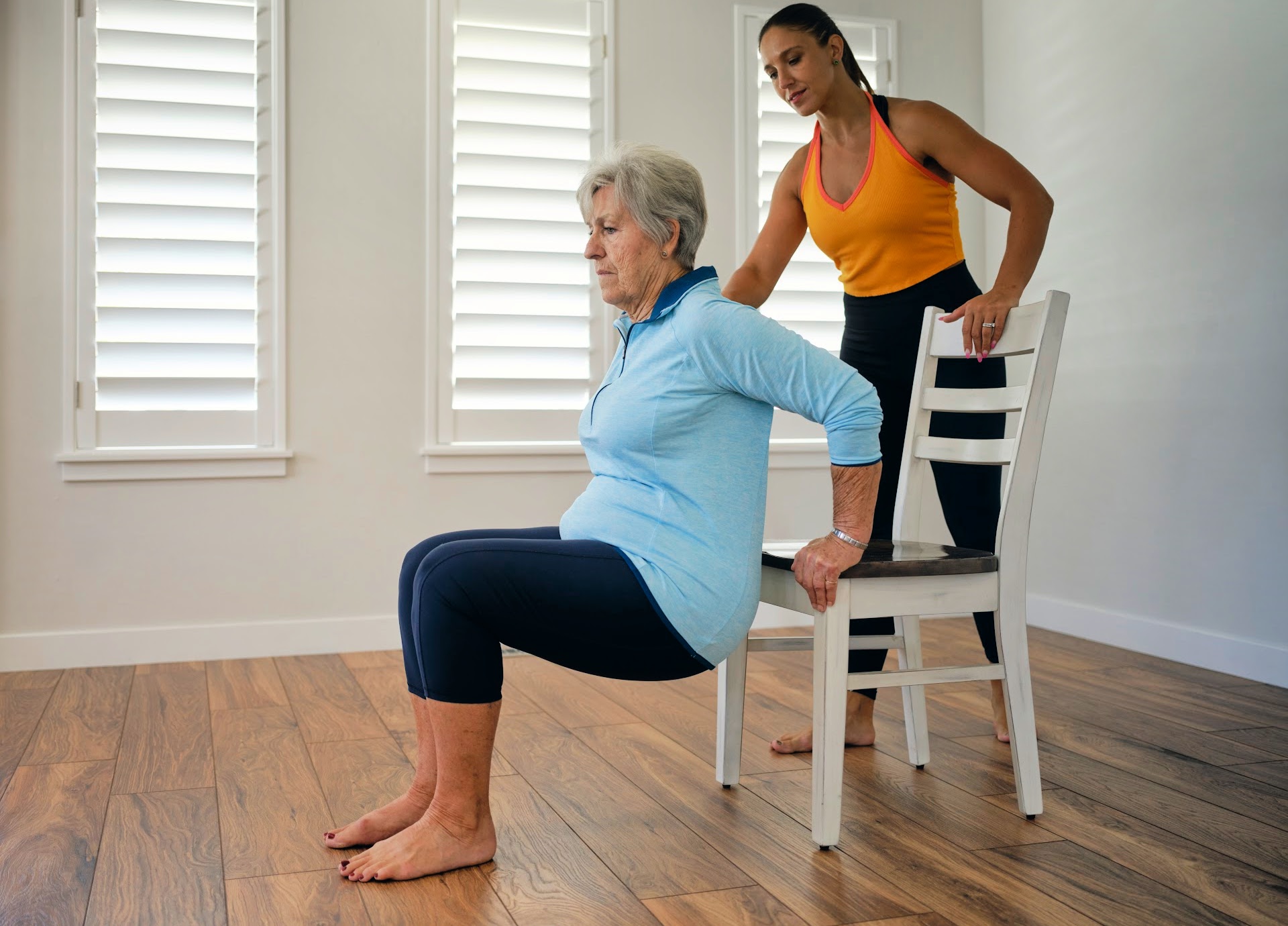
New to strength training? Start here, no equipment required
If you’re just getting started, or don’t have any equipment at home, you don’t need a resistance band to begin building strength. These simple bodyweight exercises are a genuinely effective starting point, and can be done in your lounge room with nothing more than a sturdy chair and a wall.
Sit-to-stand (chair squat) — Sit toward the front of a sturdy chair with your feet flat on the floor. Lean slightly forward and stand up without using your hands, then lower back down with control. This is one of the single best exercises for maintaining the strength needed to get up from a chair, car seat or the floor unassisted.
Wall push-ups — Stand facing a wall, slightly further than arm’s length away. Place your palms flat on the wall at shoulder height, then bend your elbows to bring your chest toward the wall before pushing back out. A gentler way to build upper body strength than a floor push-up.
Calf raises — Standing behind a chair for balance if needed, rise up onto your toes, then lower back down slowly. Simple, but effective for ankle strength and balance.
Step-ups — Using a low, stable step or the bottom stair, step up with one foot, bring the other to meet it, then step back down. Alternate which foot leads.
Once these feel comfortable, adding light equipment like a resistance band, as below, is a natural next step.
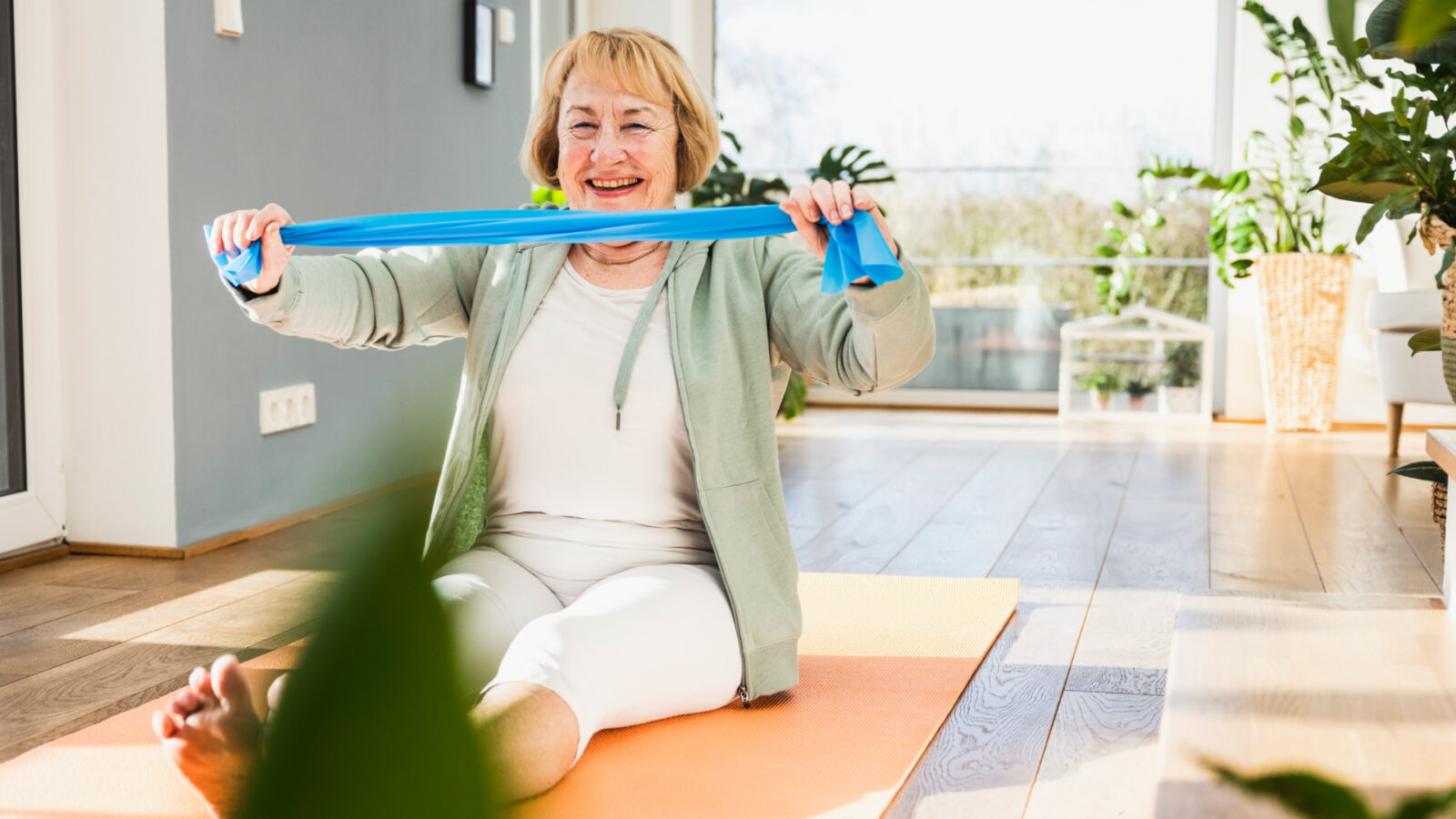
Resistance band exercises
All you will need for these is an active band, which you can pick up from any good chemist or discount department store. Do 3 sets of 10–12 reps for each exercise.
Lat Pull
- Grab the active band with both hands, hands facing up toward the roof.
- Tuck your elbows in next to your waist, and have your arms out at 90 degrees, parallel to the floor.
- Keeping your elbows in at your waist, rip the band apart, as you pull it out to your sides.
- Resist the band back to the starting position.
Lat Pull, Long Arms
- Start in the same position as with the lat pull.
- When you pull the band out to the side this time, straighten your arms, so they are in a T shape in line with your shoulders.
- Bend your elbows, and resist the band until your elbows are back in at your waist.
Diagonal, Lateral Pull
- Step on the end of the band with your left foot. Make sure it is secure. Hold onto the other side of the band with your right hand.
- Pull the band, and bring your elbow up so it is in line with your shoulder.
- Now straighten your forearm so that it is outstretched toward the edge of your ceiling.
- Bend your arm back in so your elbow is in line with your shoulder.
- Straighten the right arm, out past your left hip.
- Once you finish all your reps on one side, swap sides.
Active Band Deadlift
- Lengthen the band on the floor. Step onto it with your feet hip width apart, but so you are centred. Squat down and grab the sides of the band and stand up straight.
- To come down into a deadlift, push your butt back, lean your body forward slightly, but keep your chest proud.
- Lower down with the band while pushing your butt back, once you are at your lowest point, push into your feet, and stand back up straight.
Active Band Squat
- Your starting position will be the same as the deadlift, but instead of moving forward, sit back as if you are sitting back into a chair, keep your knees tracking over your ankles.
- Push into your feet and stand back up straight.
How often should you do this?
Consistency matters more than intensity. Aim for two to three strength sessions a week, ideally combined with regular walking, some balance work, and a few minutes of stretching or mobility most days. As Maftounian notes, “consistency beats intensity every time” — you’re far better off doing a manageable session regularly than pushing hard once and avoiding it for the next fortnight.
A note on safety
If you’re living with arthritis, osteoporosis, a previous joint replacement, or any other condition that affects your movement, it’s worth starting at a lower intensity than you think you need, and progressing gradually rather than pushing hard early on. Ironically, becoming weaker from doing too little is one of the greatest injury risks there is, so the goal isn’t to avoid exercise out of caution, but to begin at the right level for your current fitness and build from there. If you’re unsure where that starting point should be, a chat with your GP or an accredited exercise physiologist before you begin is a sensible first step, particularly if you’re returning to exercise after a long break or managing an existing health condition.
IMPORTANT LEGAL INFO This article is of a general nature and FYI only, because it doesn’t take into account your personal health requirements or existing medical conditions. That means it’s not personalised health advice and shouldn’t be relied upon as if it is. Before making a health-related decision, you should work out if the info is appropriate for your situation and get professional medical advice.
IMPORTANT LEGAL INFO This article is of a general nature and FYI only, because it doesn’t take into account your personal health requirements or existing medical conditions. That means it’s not personalised health advice and shouldn’t be relied upon as if it is. Before making a health-related decision, you should work out if the info is appropriate for your situation and get professional medical advice.





 Proudly Australian owned and operated
Comments 0
Join the conversation. Comments are reviewed before they appear.
Be the first to comment.
Join the conversation
Tell us who you are to post a comment. We'll remember you next time.