
“You’re not addicted to your phone – you’re addicted to the anticipation”: David Gillespie on why smartphone dependency isn’t just a teenager problem



It is easy to assume smartphone addiction is a problem for teenagers. The endless scrolling, the social media loops, the inability to put the phone down all feel like a younger generation issue. But according to David Gillespie, the reality is far broader and far closer to home.
Speaking about his new book, The Attention Recovery Plan, Gillespie says the same brain chemistry driving a 15-year-old’s habits is also at work in a 65-year-old.
“The dopamine reward pathways that make a smartphone addictive to a teenager are the same pathways operating in older adults,” he explains. “Older Australians are spending more time online for banking, news and connection and they are just as susceptible.”
At the centre of the issue is dopamine, often misunderstood as the brain’s pleasure chemical. Gillespie is quick to correct that.
“Dopamine is actually the seeking chemical,” he says. “It drives you to look for rewards.”

Every time you check a notification, scroll a news feed or open an app, your brain gets a small hit. Over time, the brain adjusts by reducing its sensitivity. The result is a cycle many people will recognise, checking your phone more often, for less satisfaction, simply to feel normal.
That pattern does not always look like social media addiction. For older users, it often shows up differently.
“Teenagers might be hooked on social validation,” Gillespie says. “Older adults are more likely to fall into doomscrolling the news, getting stuck in Facebook echo chambers, or playing seemingly harmless games.”
Those games are far from innocent. Many use the same psychological design as poker machines, with unpredictable rewards that keep people coming back.
That unpredictability is key. When you scroll, you do not know what is coming next. It might be something mundane, something meaningful or something alarming. That anticipation is what keeps people engaged.
“The dopamine spike is actually highest just before the new information appears,” Gillespie says. “You are not addicted to the content, you are addicted to the anticipation.”
Over time, this constant stimulation begins to change how we function. Tasks that once felt normal, reading a book, watching a film, even having a long conversation, can start to feel difficult.
“We are training our brains to expect a reward every few seconds,” he explains. “Anything that requires sustained attention starts to feel boring.”
For some, the impact goes further. Gillespie points to a growing number of adults being diagnosed with ADHD later in life, raising the question of whether something else could be at play.
“The symptoms of screen addiction, poor focus, restlessness, difficulty with memory, are almost identical,” he says. “Before jumping to a lifelong diagnosis, it is worth asking whether the brain is simply overstimulated.”
So how can people tell if their phone use has crossed the line?
Gillespie suggests a simple test, leave your phone in another room for a few hours.
“If that creates anxiety, or an overwhelming urge to check it, that is a sign of dependency,” he says. Other warning signs include reaching for your phone first thing in the morning, struggling to sit through a movie without checking it, or losing interest in hobbies you once enjoyed.
Sleep disruption is often one of the earliest indicators. A constant stream of stimulation can keep the brain in a heightened state of alertness, even long after the screen is turned off.
The good news is that change does not require drastic measures, but it does require intention.
“Start with your environment,” Gillespie says. “Turn off all notifications except calls and texts. And keep your phone out of the bedroom.”
It is a simple shift, but one that can have a meaningful impact.
For those who make the change, the benefits are often immediate.
“People are shocked by how much time they get back,” he says. “But more importantly, they regain a sense of calm and focus.”
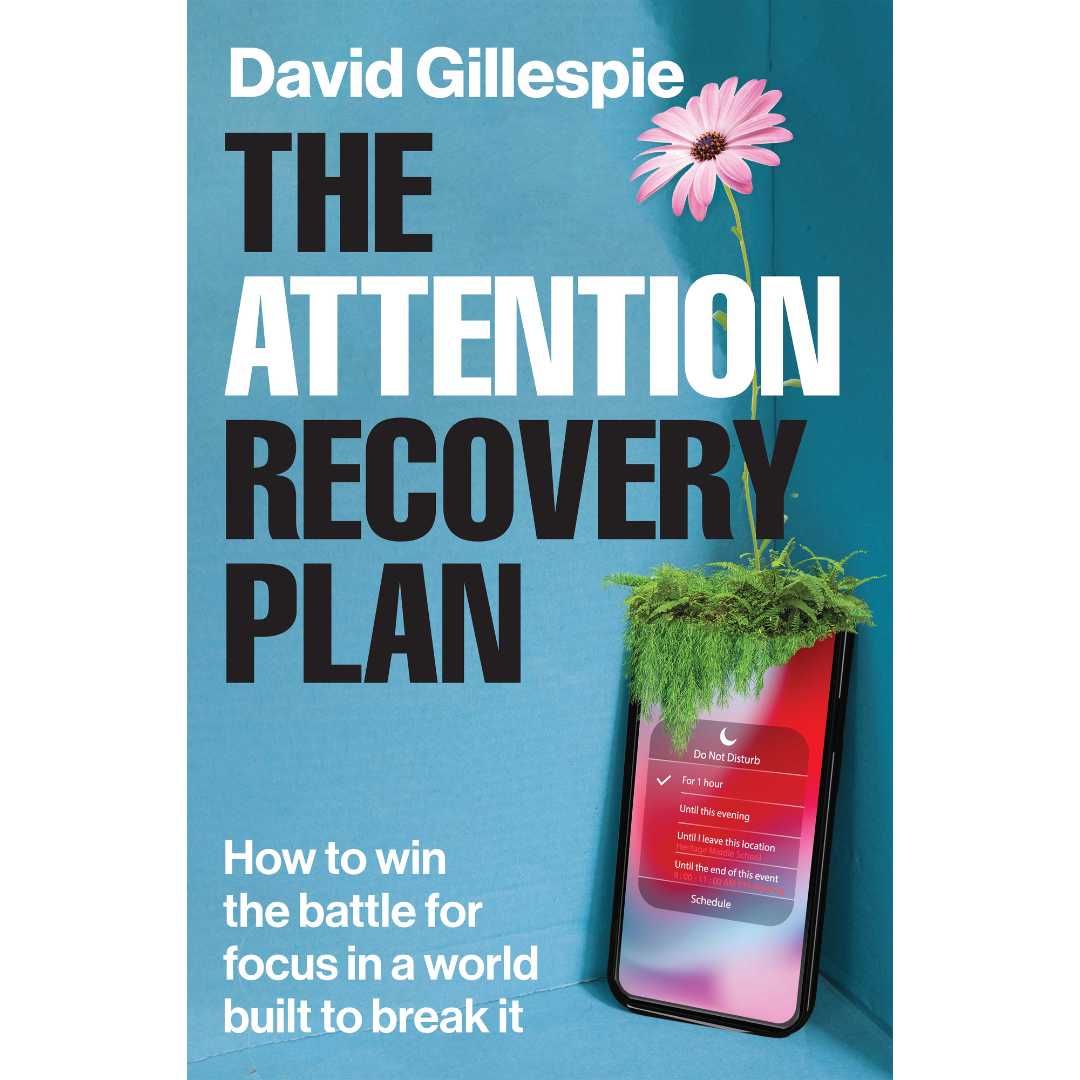
Gillespie’s The Attention Recovery Plan goes deeper into the science behind phone dependence and how to reverse it. The book outlines practical steps to reset habits, rebuild focus and regain control of your time without relying on willpower alone. For anyone who has found themselves reaching for their phone more often than they would like, it offers a clear and realistic path forward.
Buy it here





 Proudly Australian owned and operated
Comments 0
Join the conversation. Comments are reviewed before they appear.
Be the first to comment.
Join the conversation
Tell us who you are to post a comment. We'll remember you next time.