
The Orkney Islands – home of the Orcadians


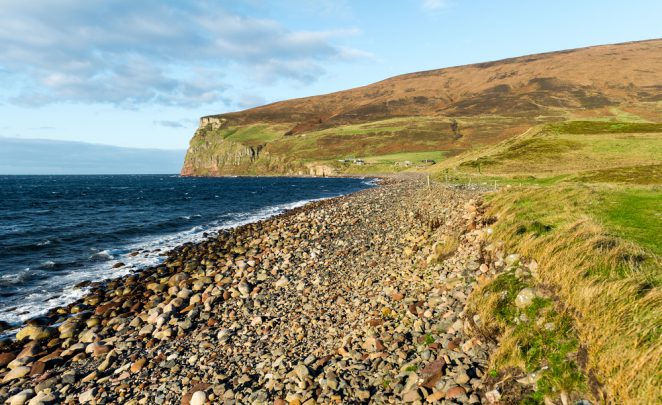
Hundreds of years ago there existed, in the minds of men, an imaginary line that ran from near the Orkney Islands off the north-east coast of Scotland to Iceland. This was thought to be the end of the earth. Nowadays, most of us know the earth is in fact, round, but if you ever feel the need to visit a region that has the feel of being at the ends of the earth, either flat or round, the Orkney Islands are a great jumping point.
This remote and sparsely populated archipelago, just over an hour’s ferry ride from the very far north-east coast of Scotland consists of several islands of varying sizes, with most being inhabited. These fiercely independent islanders proudly call themselves the Orcadians first and Scottish next. They even have their own flag – a hybrid version of the Scottish and Nordic flags. This is Viking territory and many of place names and many spoken words are Viking in origin.
It’s a place of great historical significance both of the pre-historic and the more contemporary period. Here, we can travel back in time around 6,000 years and walk amongst mysterious pre-historic stone circles that dot the remote landscape, and whose purpose still defies explanation.
Imagine yourself walking amongst, touching even, the Standing Stones of Stenness or the magic Ring of Brodgar – I did. The latter being several meters higher than Stonehenge, yet just as mysterious and more accessible, with no entry fees.
There are no crowds here and you can sit in the great silence and ponder what it must have been like so many thousands of years ago. You might even come up with answers as to why they exist, and what was their purpose? Good luck.
Starting around 150 years ago whole bronze-age villages are continually being discovered and excavated. Some of these villages are now open to the public wherein we can experience some of what life was like at that time. The village of Scara Brae was firstly discovered after a violent storm partly exposed its walls, buried beneath a line of sand dunes.
There are countless opportunities to take cruises amongst the islands. A striking feature on several of them are the scores of abandoned stone farm houses, still standing like ghostly monuments to the hardy farming families who finally surrendered to the elements, and the economy of it all.
Peppered amongst all this history are the World War I and World War II gun embattlements… in readiness still, to repel any invaders. During both these wars these Islands held great military significance as the British Naval fleet would hide at anchor, here in Scapa Flow – a massive natural and relatively safe harbour. The sea battles, the sinking of ships and the heavy loss of life in the surrounding waters are of epic proportion and too voluminous to include in this travelogue, but we are encouraged to visit the Scapa Flow Visitor Centre and Museum on the Island of Hoy, where they tell the stories so well.
I spent two weeks on the islands in the month of August. The daytime temperatures reached 18C on several days but were mostly around 15C, with overnight minimums around 14C. It was not exactly cold, and there was very little rain. But I hope you like a stiff breeze now and then.
Getting there is easy. I caught a bus from Inverness to John o’ Groats (the very tip of north-west Scotland), which then connects to their ferry – a one hour journey to the main island of Orkney and finally arriving at the main city of Kirkwall – a truly beautiful picture postcard sort of place.
Accommodation is plentiful and from Kirkwall you can access ferries, cruises, tours, taxis and plane trips to just about anywhere on the islands. There is even a hop-on, hop-off bus and an excellent visitor information centre in the middle of town, offering endless opportunities for sightseeing and more.
There are great cafes, restaurants and even supermarkets in Kirkwall but on some of the smaller islands there are none of the above, so plan accordingly.
I found the Orkneys to be a truly romantic sort of place – the isolation, the friendly people, the art-scene, the wind-swept terrain and the abundant wildlife make it so.
If you have a United Kingdom work permit the unemployment rate is less than 1 percent and almost everyone is hiring.
Enjoy your haggis!
What do you think? Does Garry’s adventure to the Orkney Islands interest you?





 Proudly Australian owned and operated
Comments 0
Join the conversation. Comments are reviewed before they appear.
Be the first to comment.
Join the conversation
Tell us who you are to post a comment. We'll remember you next time.