
The great airline baggage shakedown: why your carry-on bag is now their most profitable piece of real estate


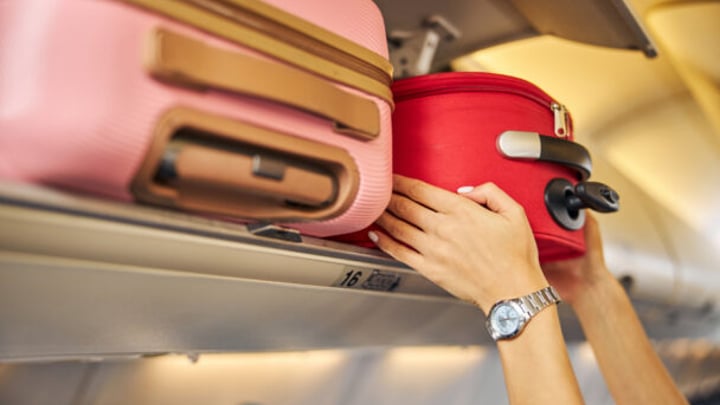
I want to tell you about something I witnessed recently at Gold Coast Airport that made me put my boarding pass in my pocket and stand very still, trying not to attract attention.
I was in the queue to board a Jetstar flight to Adelaide – which is already, let’s be honest, not the most spiritually elevating experience available to a person on a Thursday morning – when the gate staff began pulling people out of the line. Not randomly. Purposefully. With scales.
Hand luggage was being weighed. Those whose bags exceeded Jetstar’s 7-kilogram carry-on limit were directed to a lady with a cash card machine, where they paid an excess fee and then – and this is the part I want you to sit with for a moment – they put their bags back in the overhead locker. The same bag. On the same flight. In the same aircraft.
The bag did not go into the hold. It did not get checked. It went into the overhead locker exactly where the passenger had always planned to put it. The only thing that changed was that the airline now had more money.
I stood there doing that thing where you look around to see if anyone else is as bemused as you are, and several people were making exactly the same expression, which is the face of someone watching a confidence trick performed in broad daylight and having to admire its audacity even as they resent it.
Because here is the thing. If there were a genuine safety concern about the weight in the overhead locker, the bag would go into the hold. That it stays on board, in the cabin, in the overhead locker, with the only change being a transaction at a desk – tells you everything you need to know. This is not safety management. This is revenue collection with a measuring tape.
The Australian picture
As Australia’s flag carrier, Qantas allows economy passengers one main cabin bag of up to 7kg. From 9 June 2026, the cost of additional checked baggage on Australian domestic and international flights increased.
Jetstar, as a budget carrier, has stricter carry-on limits than full-service carriers. On all domestic and international Jetstar flights from January 2026, the available airport baggage allowance is 20kg, with excess charged at $15 per additional kilogram on domestic flights and $25 per kilogram on international flights.
Virgin Australia charges for checked baggage on its Economy Lite fare from $35 per sector when booking online, with higher charges at the airport. Extra bags beyond the included allowance cost from $45 per sector.
The pattern is consistent across all three carriers: the price is always lower if you pay in advance online, always higher if you present at the airport with a problem, and always higher still if you present at the gate with a problem. The pricing architecture is specifically designed to punish the disorganised and reward the obsessively prepared. Which is to say, it rewards the airlines.
The broader Australian context is worth understanding. The Competition and Consumer Commission has periodically examined ancillary fees in the aviation sector, but the fundamental model – advertise a low headline fare, then charge separately for everything that makes flying tolerable – is entirely legal and increasingly standard.
The global picture
Zoom out and the numbers become genuinely staggering. US airlines brought in more than $7.4 billion in passenger baggage fees in 2025, a 162 per cent increase over five years. That is not a typo. One hundred and sixty-two per cent in five years. In the span of two weeks in April 2026, every major US airline raised its checked bag fees, all citing rising jet fuel prices in the wake of the war in the Middle East. When one carrier moves to raise prices, the rest quickly follow.
United raised its fee to $50 for the first checked bag and $60 for the second on flights within the US, Mexico, Canada and Latin America. American Airlines charges $50 for the first checked bag, with a $5 discount for online purchase at least two hours before departure. Delta charges $45 for the first checked bag for main cabin customers.
Globally, ancillary revenue – the industry term for fees collected on top of the base fare, including baggage, seat selection, food and wifi – was projected at $148.4 billion for 2024 across 61 airlines surveyed by the IdeaWorksCompany. To put that number in context, $148 billion is roughly the GDP of Hungary. The entire GDP of Hungary, generated by airlines charging people to put their suitcases in the hold and sit somewhere specific on the plane.
The highest-performing carriers concentrate on two categories: baggage fees and dynamic seat selection pricing. Overhead carry-on bag fees generate approximately $20 per passenger at the top performers.
Twenty dollars per passenger. For the overhead locker. Which was always free.
How we got here
The unbundling of the airfare began in earnest in 2008, when American Airlines introduced a $25 fee for the first checked bag – a decision the rest of the industry had adopted within months. The logic was transparent enough: as low-cost carriers competed aggressively on headline fares, legacy carriers needed ways to maintain revenue without raising the advertised price. Fees were the answer. Ancillary revenue is expected to be the single most significant contributor to nominal sales growth in 2025, according to IATA’s own economic outlook.
The airlines do not pretend otherwise. They call it “unbundling” or “a la carte pricing” — the idea being that passengers only pay for what they use. In practice, what it means is that the advertised fare now represents an increasingly small fraction of what the trip will actually cost you by the time you have paid to check a bag, selected a seat that is not in the middle of the back row next to the toilet, and bought something to eat on a flight longer than two hours.
What you can actually do about it
There are, in fairness, legitimate ways to reduce what you pay. Virgin Australia’s Economy Choice fare includes 23kg of checked baggage, making the headline fare comparison with Jetstar more complex than it appears. Qantas Frequent Flyer status from Gold tier upwards typically includes checked baggage allowances. Many airline credit cards – the Qantas Premier, the Velocity credit cards – include checked baggage benefits that can offset their annual fee for regular flyers.
The most effective strategy, unglamorous as it is, remains the same one it has always been: pack less. A 7kg carry-on bag, if you are disciplined about it, genuinely is sufficient for a week in most climates. The travellers being pulled out of the Jetstar boarding queue at Gold Coast with overstuffed cabin bags had, in a sense, made their own problem. But the system that turns every kilogram over the limit into a revenue opportunity – while keeping the bag on the same aircraft regardless – is one designed to extract money from inconvenience. That much, at least, is worth saying plainly.
The bag stayed in the overhead locker. It was always going in the overhead locker. The only question was how much it would cost.





 Proudly Australian owned and operated
Comments 19
Join the conversation. Comments are reviewed before they appear.
How old are these figures? Qantas lists carry-on allowance as 10kg (not 7kg) across a total of one bag for the overhead bin, one under the seat in front, and one small personal item.
They are talking about the bag in the overhead locker which is 7kg
With Jetstar your personal item (bag) is weighted together with your cabin bag. Total 7kg. max.
I flew Dublin to Carcassonne with Ryanair ( the inventors of the unbundled charge) last year. The flight was very cheap (€39) but the guy in front of me at book-in hadn't confirmed the flight online and was hit with another change of €50. If he had known or the Ryanair employee had told him, he could have dropped out of the queue for 5 minutes, used the free internet at the airport to login and confirm (2 minutes) and saved €50. Pure income generation again.
Check in online has always been optional here in Oz, with no cost for desk check in, with the exception of the defunct Tiger Air who once pinged us $25 each for not doing it online ( it had just been introduced).
I recently flew Jetstar from Sydney to Brisbane. They came and weighed everyone's bag in the departure lounge, carrying a pay point machine. I asked. They charge $85 for a bag weighing between 10-14 kgs. It stays as carry on. Then if your bag Is over the 14kg point, they'll charge you $125 and take it away to be checked on.
I couldn't believe what I was seeing.
Few years back after visiting my son who had almost passed with septic and pneumonia I got to the airport flying Jetstar. I didn't know they had changed the onboard weight limit, I was treated disgracefully, told I should have read the back of the ticket and when I asked what I was supposed to do with the things in my case I got told to bin them and then had to pay $50 and put my case in with the baggage. She was the nastiest b….. I have ever encountered and I ended up in tears because of all the stress.. Should have got her name but was too distressed about it all. Virgin staff are always helpful, polite people.
International airlines have had a carry on weight and size limit for at least 20 years otherwise excess fees apply. Carry on was just one piece. The same with your baggage going into the hold. On all four that I have used the policy is the same with Ryanair being the strictest. I knew before I left Austria that my baggage was going to be over the limit, so on my way to the airport I stopped at the P.O. and sent souvenirs and cloths home in a sturdy box bought at the P.O. It was far cheaper than paying their excess fees.
A couple of years ago we were able to pay a little extra at booking to increase our carry on limit to 10kg with Jetstar. Proves it’s the money not the weight.
Husband and I boarded Virgin airlines May 2026(Brisbane to Melbourne)and they started picking out bags (carry on luggage) to weigh them . The excuse was. There wasn’t enough room in the overhead luggage. Our bags had to go to the undercarriage luggage it was tagged and we didn’t have to pay any extra for it ( just inconvenience). The bags did not exceed the weight required.
I for one are over people boarding with multiple and/or over weight bags causing hold ups and not being able to place my bag close to my seat. Yes the rules/ charges are annoying but you get what you pay for - go full service and you will not have a problem.
Agree 100%. What I see people lug on to a plane absolutely ambers me and I can’t understand how they get away with it. I know I wouldn’t if I tried
Weigh your bag before you leave home.
Weigh your bags before you leave home!! Simple!
Well done to the airline , to many travellers have got away with overweight bags for ages
Well done the airlines , to many travellers have got away with overweight baggage for ages
Yep I had the same problem at the Gold Coast Airport some time back. I checked the weight in the entrance of the airport and was a tad under 1 kg over from the weighing machine which by the way was on a tiled floor. Then when I got to the part of Boarding the flight at the Departure Gate. Was pulled aside and weighted and it was 3 kgs over I mentioned that I had weighted it at the entrance. They did not want to know about it. And noticed the Machine was on a Carpet floor $75 $25 per kilo over. I thought machines had to be on a solid floor not carpet. But what do you do pay up or leave your bag there. Oh and they take Cash only credit card more charges. Total Rip Off. I agree some do try and take way more on than they should.
Just quote airfares INCLUDING BAGGAGE LIKE THEY USED TO DO. THEN YOU WILL REALISE HOW MUCH YOU HAVE BEEN RIPPED OFF. AIRLINE FARES ARE CURRENTLY THE HIGHEST THEY HAVE EVER BEEN ANYWAY. if you are over the specified limit then you pay for the excess NOT the total.
STOP AIRLINES QUOTING STUPIDLY CHEAP AIRFARES TO SUCK IN THE PASSENGERS. JUST QUOTE TOTAL AIRFARE INCLUDING 7KG AND 23KG LIKE THEY USE TO. IF YOU ARE A BIT OVER PAY THE EXTRA. AIRLINES ARE TOO EXPENSIVE ANYWAY WITHOUT BEING RIPPIED OFF WITH HIGH BAGGAGE CHARGES. THEN PASSENGERS WILL KNOW WHAT THE REAL AIRFARE IS.
Join the conversation
Tell us who you are to post a comment. We'll remember you next time.