
By Callum Godde
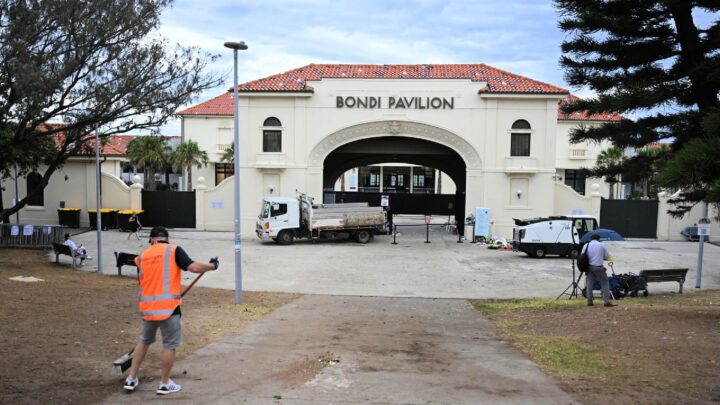
Residents and beach-goers have woken to find tributes for the Bondi terror victims gone after the surviving alleged gunman spent his first night behind bars.
Reams of flowers, photographs and messages have been cleared away from outside Bondi Pavilion and surrounding walkways following Sydney’s anti-Semitic terror attack on December 14.
Surviving gunman Naveed Akram, 24, and his dead father, Sajid Akram, 50, are accused of carrying out Australia’s worst mass shooting since 1996 that left 15 innocent people dead.
Police allegations about the Islamic State-inspired shooters’ flawed bombs, training in a regional area, arsenal left behind and reconnaissance of the massacre site were released by a court on Monday.
After parking near a footbridge on Campbell Parade, the men allegedly tossed three pipe bombs filled with steel ball bearings and a “tennis ball bomb” into the Hannukah celebration at Archer Park before opening fire.
None of the pipe bombs detonated despite preliminary police analysis finding they were “viable”, while a box-like bomb was also allegedly found in the boot of their car.
Footage recorded in late October showed each Akram training with long-arm guns and “moving in a tactical manner” in a countryside location, which police suspect to be in NSW.
Further vision from security cameras at Bondi Beach appears to show the Akrams scoped out the area about 48 hours before their attack.
After being shot by police, the younger Akram was discharged from a northern Sydney hospital and transferred to an undisclosed prison on Monday.
He will be held there ahead of his next court mention in April.
Prime Minister Anthony Albanese apologised to the Jewish community for the atrocity happening under his watch as he outlined legislation to tackle hate speech and beef up laws to cancel visas of non-citizens who preach hate.
He has resisted calling a national royal commission while backing a state-based inquiry and launching a more limited review into federal intelligence and law enforcement agencies despite urging from Labor backbenchers Ed Husic and Mike Freelander.
The federal opposition continues to hold the prime minister’s toes to the fire, releasing its own terms of reference for a federal royal commission.
Mr Albanese rubbished the coalition’s claim that a royal commission could report back within the space of six months, when they typically take a number of years.
“The idea that we would have multiple royal commissions, as well as a review, running at the same time is going to simply delay action,” he said.
Ms Ley labelled that argument a “cop out” and said Labor could not credibly claim to be acting in the name of unity while refusing to heed the community’s “clear call”.
“Urgency would mean recalling the parliament this week to act now,” she said.
NSW is pushing ahead with tough new laws prompted by the Bondi Beach massacre to restrict rallies following terrorism events amid vows of defiance from pro-Palestinian protesters.
About 200 people attended a pro-Palestine rally in Sydney late on Monday to oppose the proposals, which are expected to pass state parliament with the opposition’s support.
Parliament has been recalled to pass the measures – as well as laws capping gun ownership at four firearms and limiting ammunition capacity – following the mass shooting nine days ago that killed 15 people and wounded dozens.
Premier Chris Minns said on Monday the “extraordinary” measures were necessary to restore a sense of safety after the shooting, which targeted those attending a seaside celebration of Hanukkah, the Jewish festival of light.
“We can’t pretend that the world is the same as it was before that terrorist incident on Sunday,” he said.
“My government’s number one priority is to keep the people of NSW safe and that means making these changes.”
He said politics should be put aside to deliver “the toughest firearm reforms in the country” to safeguard the community.
Under the protest proposal, authorities could restrict gatherings under a 14-day “Public Assembly Restriction Declaration” that could be extended for up to three months.
The moves come after Mr Minns blamed pro-Palestine protests for sowing anti-Semitic rhetoric, which he said could develop into violence by “unleashing forces that the organisers of the protests can’t control”.
Monday’s rally in central Sydney took place under a heavy police presence as attendees waved Palestinian flags and placards, including one that read “Globalise the Intifada, Intifada means uprising”.
Mr Minns has pledged to ban the phrase “globalise the intifada” as part of a clampdown on slogans the government says are hateful.
Protest organiser Adam Adelpour, of activist group Stop The War on Palestine, said attendees gathered to “grieve in the wake of the horrific terrorist attack in Bondi, to stand in solidarity”.
“We’re also here to oppose the attempts to exploit this tragedy to attack our freedoms and silence criticism of Israel’s crimes.”
He said he was willing to defy future government restrictions on protests, describing himself as “committed to continuing to protest”.
Pro-Palestine protesters have rejected any link between peaceful demonstrations criticising Israel and the Bondi attack – Australia’s deadliest shooting in almost 30 years.







 Proudly Australian owned and operated
