
Retirement happiness rises in Australia – but cost-of-living fears still weigh heavily



Retirement should be a time to relax and enjoy life – but for many older Australians, rising costs are making that easier said than done.
New research shows that while overall happiness among people aged 60 and over is improving, concerns about inflation, financial security and outliving savings are continuing to cast a shadow over the so-called “golden years.”
The latest Challenger Retirement Happiness Index, released this week, paints a mixed picture of life in retirement across Australia.
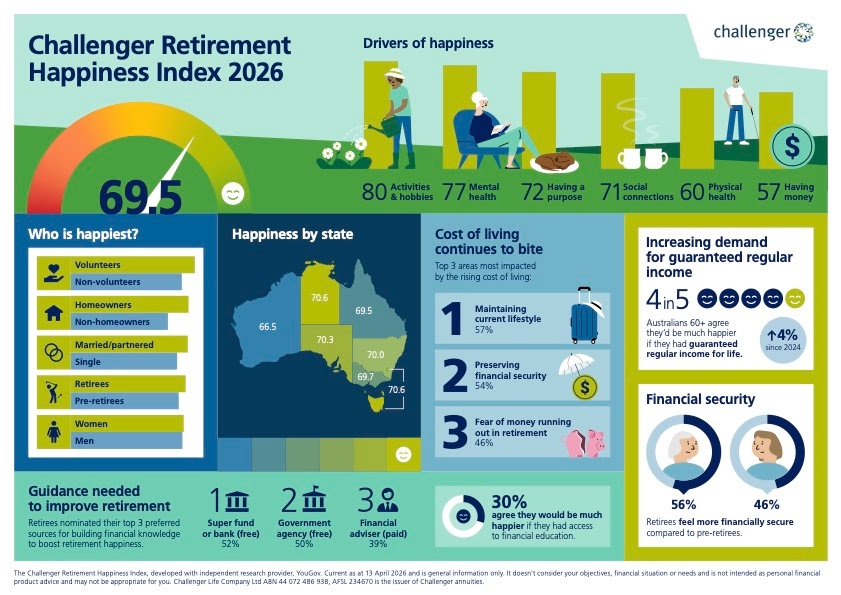
On the positive side, happiness levels are on the rise. The 2026 index score climbed to 69.5, up from 68.9 last year, suggesting many retirees are finding enjoyment and purpose in this stage of life.
But beneath that optimism lies a persistent concern: money.
More than half of Australians aged over 60 say the cost of living is impacting their lifestyle (57%) and financial security (54%), while nearly half (46%) worry about running out of money altogether.
Purpose and connection drive happiness
One of the clearest findings from the report is that retirement happiness isn’t just about finances.
Those who stay engaged – particularly through volunteering, hobbies and social connections – report significantly higher levels of wellbeing.
Volunteers were the happiest group surveyed, with a score of 77, compared to 69 for those who don’t volunteer.
Similarly, people who are married or own their own home also reported higher happiness levels.
Having a sense of purpose, staying active, and maintaining both physical and mental health were among the strongest contributors to a positive retirement experience.
The financial reality is harder
Despite this, financial concerns remain front of mind.
In fact, 44 per cent of older Australians say having enough money to enjoy retirement is a top priority, second only to physical health.
The biggest financial worries include:
- Ensuring savings last for life (72 per cent)
- Covering future health and aged care costs (65 per cent)
- Maintaining their current lifestyle (53 per cent)
- And many Australians believe they need more than expected to live comfortably.
On average, those surveyed said a single person over 65 would need around $70,398 a year – significantly higher than the commonly used benchmark of about $54,840.
Women and pre-retirees feeling the pressure
The research also highlights that some groups are feeling the strain more than others.
Women are more likely than men to worry about running out of money, reflecting the reality that many retire with lower superannuation balances.
Meanwhile, people approaching retirement are often more anxious than those already retired – suggesting uncertainty plays a major role.
The challenge of switching from saving to spending
A key issue identified in the report is something many retirees quietly struggle with: After decades of saving, it can feel uncomfortable – even risky – to start spending.
Many retirees remain cautious, unsure how much they can safely draw down without jeopardising their future.
This hesitation is compounded by inflation, which steadily erodes the value of savings over time.
A gap in knowledge and confidence
The report also uncovered a significant knowledge gap when it comes to retirement income strategies.
- 76% per centof Australians aged 60+ said they would feel happier with a guaranteed income for life
- Yet 59% said they were unaware of lifetime income options
- At the same time, nearly one in three said they would feel more confident with better financial education.
Free guidance from super funds, banks or government agencies was the most popular option, followed by advice from financial professionals.
The findings suggest retirement in Australia is still a positive experience for many – particularly those who stay active, connected and engaged.
But financial confidence remains the missing piece.
As living costs continue to rise, having a clear plan – and the confidence to use it – may be just as important as how much you’ve saved.
Because while retirement can be one of life’s most rewarding chapters, peace of mind is what truly makes it enjoyable.





 Proudly Australian owned and operated
Comments 0
Join the conversation. Comments are reviewed before they appear.
Be the first to comment.
Join the conversation
Tell us who you are to post a comment. We'll remember you next time.