


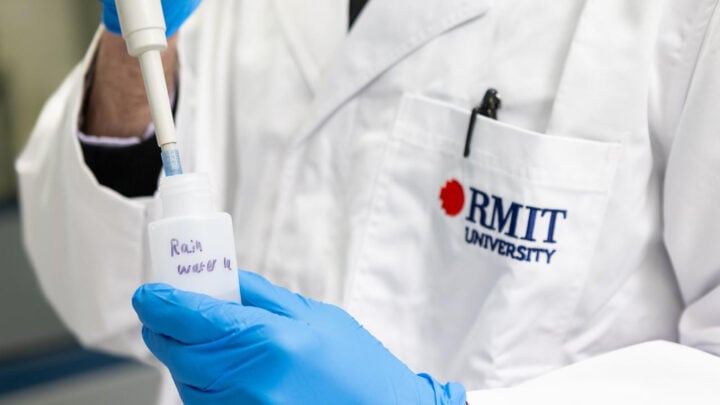
Toxic “forever chemicals” have been found in Australian rainwater for the first time, but not at levels dangerous to human health.
Eight PFAS compounds were detected in rainwater samples collected in Melbourne between 2024 and 2025, by researchers from RMIT University and EPA Victoria.
“All the concentrations we found were well below the (National Health and Medical Research Council) drinking water guidelines for PFAS,” Analytical chemist Oliver Jones told AAP.
“I don’t want to scare people thinking that our rain’s now full of PFAS … even if you were drinking the rain, you wouldn’t get anywhere near enough to cause any harm.
“It’s reassuring for people that might use rain as a source of drinking water.”
The research, based on three Melbourne rainfall samples, also offered clues about how PFAS chemicals reach waterways and catchments far from obvious sources of contamination.
“Sometimes there’s an obvious source where they’re coming from, but sometimes you find it in a remote area where you’ve got no industry,” Professor Jones said.
“Potentially atmospheric transport is one method of movement that hasn’t been accounted for.”
Prof Jones said PFAS could be swept into the atmosphere from urban and industrial areas attached to dust particles or tiny water droplets, travelling long distances before returning to the environment through rainfall.
It suggests rainfall could be an important pathway for PFAS entering waterways, along with better-known sources such as wastewater and landfill.
PFAS are a large group of human-made chemicals comprising thousands of individual compounds used in products ranging from firefighting foams and food packaging to textiles, cosmetics and non-stick cookware.
They have been found in the environment near industrial sources, such as airports, where aqueous film-forming foams have been used in aviation firefighting and training.
The researchers analysed rainwater collected on three occasions and tested for 30 PFAS compounds.
Prof Jones hopes policymakers consider the findings when making regulations for PFAS use in the future.
“PFAS are often called ‘forever chemicals’, but that term can be misleading because it suggests they never break down, which isn’t actually the case,” he said.
“A more accurate description is that they are highly persistent, or ‘lingering’, chemicals that can remain in the environment for a long time, which is why understanding their behaviour is so important.”
The study, called Concentrations of per- and polyfluoroalkyl substances in the rainwater of South-Eastern Australia, was published in the Environmental Chemistry and Toxicology journal.





 Proudly Australian owned and operated
Comments 3
Join the conversation. Comments are reviewed before they appear.
how high do the levels of "toxic" chemicals have to be?? any is too much.
The only time we are safe is when there is no PFAS chemicals traceable in our drinking water. PFAS chemicals build up slowly over time in your body. PFAS chemicals have been banned in the foam used for fire fighting. Cancer clusters have been detected in areas where the foam has been used for years e.g. Fishville where compensation has been paid. They are not called 'forever chemicals' for no reason. Once they get into the environment and our bodies they do not break down further.
Do home water filters get rid of these chemicals?
Join the conversation
Tell us who you are to post a comment. We'll remember you next time.