
The super account warning you should never ignore


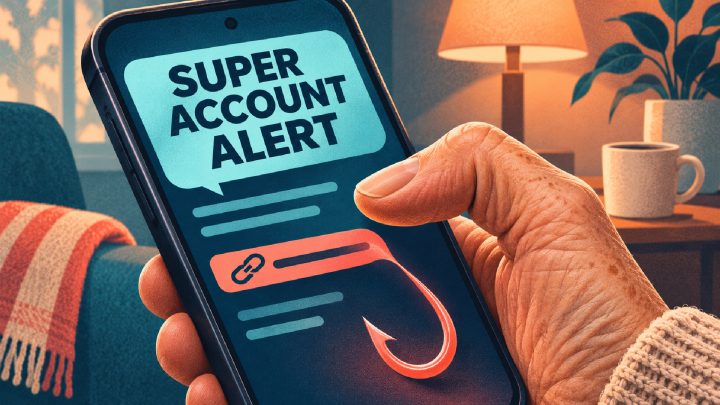
An unexpected message says your super account details have changed, or a withdrawal has been requested: you haven’t authorised either. It’s enough to make you reach for the phone or click a link for answers, but the message itself could be the scam.
Sarah Carney, Head of AI & Automation at AustralianSuper, says fraudulent approaches often begin with an email, text or phone call that appears to come from a trusted organisation.
“It could claim there’s a problem with your account, that a withdrawal has been requested, or ask you to validate a transaction,” Carney says. “It will look official but usually have an urgency to it.”
Whether it’s a real alert or an attempt to steal your details, contact your fund through its official app or a number you’ve independently checked.
A polished message can still be a scam
A familiar logo and professional wording don’t establish who sent a message.
“What makes these scams increasingly difficult to spot is how convincing they can look,” Carney says.
“AI can be used to create polished messages, websites, fake reviews and impersonations that manufacture trust and make something fraudulent appear legitimate.
“My advice is to stop, check and independently verify.”
Avoid links and contact details supplied in an unexpected message and instead, open your fund’s official app or use contact details from its official website or your statement.
If someone calls claiming to represent your fund, hang up and call the fund yourself. A caller knowing your name or account information is no reason to hand over passwords or security codes.
Watch for changes you didn’t make
An unfamiliar withdrawal or transfer request needs prompt attention; so does a notification that your personal details have changed without your permission.
AustralianSuper’s published guidance tells members to contact it if they receive confirmation of a change they didn’t make. ASIC’s Moneysmart also recommends checking for unfamiliar withdrawals, transfer requests and changes to personal details.
“It’s also worth making a habit of checking your super regularly,” Carney says. “Keeping your personal details up to date and monitoring your account can help you spot unusual activity sooner.”
Already clicked? Act quickly
If you’ve clicked a suspicious link or shared sensitive information, contact your fund through an official channel and explain what happened.
“The most important thing is to act quickly,” Carney says.
Protect your email account too, because access to it can help criminals get into other accounts. Use strong, unique passwords and enable multi-factor authentication, which requires more than one step to verify your identity.
If you’ve disclosed a password, change it, along with any other account password that uses the same one and let your bank and other affected financial providers know if their accounts or your personal information may also be at risk.
“And don’t let embarrassment stop you from speaking up,” Carney says. “Scams are becoming increasingly sophisticated, so if you think something has happened, report it as soon as possible.”
Would stolen super be reimbursed?
Starts at 60 asked AustralianSuper in what circumstances a member would be reimbursed for money stolen from their account.
The fund’s written response outlined security measures, including monitoring, identity verification and multi-factor authentication, but did not specify when reimbursement would apply.
“If a member believes they’ve been the victim of fraud or a scam involving their super account, they should contact us as soon as possible so we can investigate the circumstances,” Carney said.
Also check out What 5000 cyber experts want you to know





 Proudly Australian owned and operated
Comments 0
Join the conversation. Comments are reviewed before they appear.
Be the first to comment.
Join the conversation
Tell us who you are to post a comment. We'll remember you next time.