
Melinda Schneider: “I did a perfect impersonation of perfect for 40 years – and it nearly broke me”


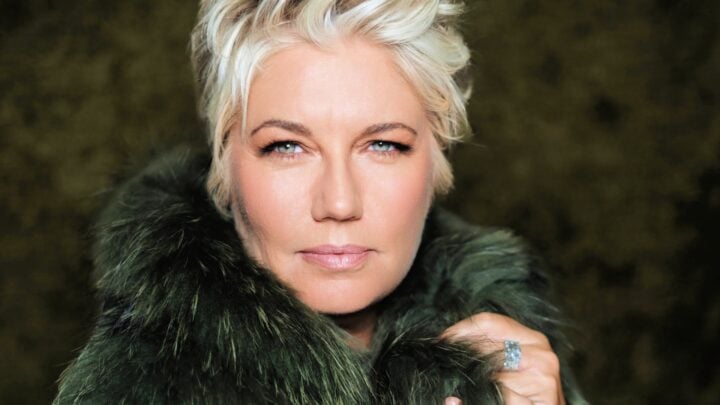
She answers the phone from the side of a road on the Central Coast of New South Wales, slightly breathless, having just pulled over to take the call. In the background, a small voice. Her son Sullivan, home early from school. There is a brief, warm flurry of introductions – “Sullivan, wave to Brian” — and then Melinda Schneider settles in, and the conversation that follows is one of the most candid, searching and quietly revelatory interviews she has given in a long career.
She is 54 years old. She has been performing since she was three. She has six Golden Guitars, multiple MO Awards, ARIA nominations, and songs recorded by John Farnham, Olivia Newton-John and Paul Kelly. She has played the Sydney Opera House multiple times and sold out Her Majesty’s Theatre in Melbourne. By any conventional measure, she is one of the most successful female artists in the history of Australian music.
She has also spent the better part of the last decade dismantling almost everything she once believed about what success required of her, recovering from a clinical depression that put her in bed for six weeks and nearly ended her career, rebuilding her relationship with a mother she both loved and found complicated, becoming a mother herself at 41, falling genuinely in love for what she considers the first time, and now – in the most unlikely professional pivot in an already improbable career – preparing to spend two hours a night being Barbra Streisand.
The Way We Were: The Music and Life of Barbra Streisand opens at Geelong’s Arts Centre on August 6 and concludes at the Sydney Opera House Concert Hall on August 30. By that point, Melinda Schneider will have inhabited one of the most technically demanding and emotionally cavernous singing voices in the history of American popular music in venues across the country for the better part of three weeks.
She sounds, despite everything, not remotely terrified. She sounds like a woman who has been through something harder – several things harder – and come out the other side with a clarity that makes Barbra Streisand feel, if not manageable, then at least appropriately sized.
“My therapist said to me the other day, you’re going to do the good enough version of this show, Melinda,” she says. “She said, your level of good enough is much higher than most other people’s level of good enough. But for you, it just has to be good enough. It doesn’t have to be perfect.”
She pauses.
“I’m a recovering perfectionist. That doesn’t mean I’m finished recovering.”
The ukulele and the tears
The connection to Barbra Streisand is not recent, not manufactured for the press release. It begins, like most of the significant things in Melinda Schneider’s life, before she was old enough to fully understand it.
“I was born into a show business family,” she says. Her mother is Mary Schneider, the renowned Australian yodelling singer, a performer of genuine technical distinction and very high expectations. “She had very high expectations of a three-year-old, teaching them the chords of The Way We Were, because they’re not easy chords.”
The image is striking: a toddler, her mother’s hands guiding her small fingers across a ukulele fretboard, learning a song about nostalgia and lost love and the bittersweet ache of memory. A song whose lyrics – “What’s too painful to remember, we simply choose to forget” – she cannot yet have fully understood.
And yet.
“My memories of it are the emotion of the song. I used to choke up when I’d sing it. I remember getting quite teary at certain points and I’d have to stop singing. Even at three.”
She has thought about this. What it means that a small child could be moved to tears by a song whose words she couldn’t fully comprehend. “I think all country songs are sad songs,” she says, and laughs when I agree. “Yeah. I think I’ve always been moved by sad songs. That might be one of the reasons why I’ve written so many sad songs in my life – because of the exposure to them so early.”
There is something in this that goes beyond childhood musical taste. The Barbra Streisand connection, she has come to believe, runs deeper than admiration for a great voice. It runs through grief, and pain, and the particular relationship that certain kinds of singers have with suffering – not despite it, but through it.
“She’s had quite a complicated relationship with her mother, as have I,” she says of Streisand, whose memoir detailed the emotional distance and difficulty that defined her childhood. “I think the reason she’s so good at singing these sad songs is because she really does understand pain. I like to think that about myself, too. When you are a deep-feeling person and you go to those places when you’re on stage, you can help people feel emotions that maybe they wouldn’t otherwise feel.”
The mother question
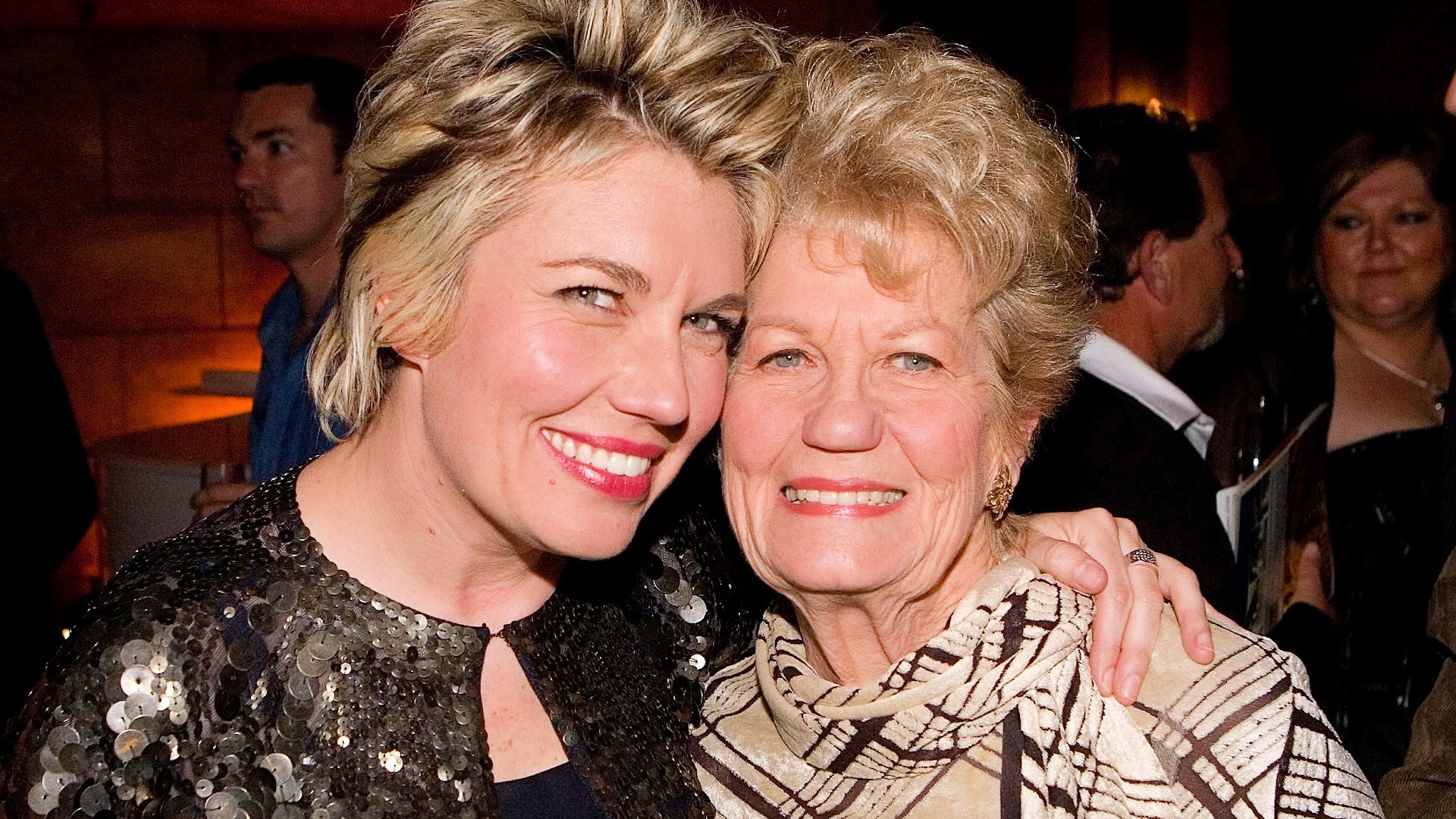
Mary Schneider is 93 years old, in care, and not well.
Every Tuesday, Melinda drives her to her house in Kilcare – up the fifty stairs, an act of quiet determination for a woman her age – where they paint together at the kitchen table. An art teacher comes. There is a roast pork with crackling, which is Mary’s preference. Then Melinda drives her back to the nursing home.
“It’s been really beautiful healing over the last twelve months,” Melinda says, and there is something in her voice that sounds simultaneously grateful and fragile, as though the healing is still in progress and she is careful not to disturb it. “Mum got really sick last June and nearly died and couldn’t live at home alone anymore. She’d lived at home until she was ninety-two and a half. It has brought us closer together, which is really great. I’m just trying to make the most of the time I might have left with her. She’ll be 94 in October, and she’s not that well.”
The complicated nature of the relationship – its pressure, its perfectionism, its expectations – runs through her new album, Tender, released in February, her first collection of original material in a decade. There is a song on it called Deep River, about a mother and a daughter and the space between them.
“It’s all about love and motherhood and family and everyday life,” she says of the album broadly. But it is also about the decade she spent quietly becoming someone different from the person she had trained herself to be.
The treadmill and the crash
For most of her adult life, Melinda Schneider ran at a pace that was, by her own description, unsustainable.
A new album every two years. Touring constantly. Golden Guitars accumulating. The obligations of being a country music star in Australia – the festivals, the Tamworth circuit, the industry relationships, the relentless forward momentum of a career that had been in motion since childhood. She was good at it. She was very good at it. Her songs were being recorded by artists she had grown up idolising. Her shows were selling out.
“I did a perfect impersonation of perfect for forty years,” she says.
And then, in 2018, it stopped.
“I had a really bad bout of depression. I was in bed for six weeks, unable to function.” It came back the following year, in 2019, after she returned to work too quickly and pushed too hard. “I got too cocky and started becoming a workaholic again and it came back.”
She went on medication for four years. She started therapy. She did something she had never done before in forty years of public life: she told the truth about it.
In 2020, she launched a website called Be Gentle on Yourself, partnered with the Rural Adversity Mental Health Program in NSW, and started keynote speaking – publicly, explicitly, repeatedly – about what had happened to her. About the depression. About the shame she had felt. About the years of pressure to be perfect that she had absorbed so completely she had stopped questioning whether it was reasonable.
“Going public with my story was the hardest thing I’ve ever done because I knew my mum wouldn’t like it. There was so much pressure for me to be perfect. But it freed me so much.” She pauses. “The shame, as soon as I went public with the story, the shame of my mental health diagnosis left me. I don’t feel any shame about it.”
She describes the first conversation she had at a school gate after it became public – the other mothers approaching her, telling her their own stories, the recognition in their faces.
“I had felt very isolated in my life, up until that point. Very filled with shame. I felt like a disappointment. A failure. I found it very hard to pick Sullivan up from his primary school. I didn’t want to be seen by the other mums.”
She swims most mornings. She no longer drinks caffeine, or much alcohol. She has lowered her expectations of herself – or recalibrated them, which is not quite the same thing. She has been off medication for two years.
“I’ve just got to do the work. Understand yourself and be gentle on yourself as much as you possibly can.”

The husband, the choir boy and the good enough version
She met Mark Gable – the lead singer of The Choirboys, of 80s rock anthem Run to Paradise – seventeen years ago. By her own account, it is the first genuinely healthy relationship she has had.
“I had three really difficult relationships before Mark. Very damaging,” she says plainly, without elaboration, in the manner of someone who has processed the detail in private and chosen which parts to share publicly. “Being in a peaceful and happy and kind and loving relationship with Mark, and having a beautiful little boy – I’ve just been enjoying that time of my life so much.”
It was Mark who gave her one of the most useful pieces of performance advice she has ever received, and he gave it sideways, standing in an audience watching her swallow an emotion on stage.
“He said, next time you want to cry, just cry. Just go there. The audience wants you to go there. Don’t swallow it and be stoic. Just let it happen.”
She took the advice. She is, she says, considerably more comfortable now with being seen – imperfect, moved, human, real – on stage and off it.
“Connection and vulnerability and letting people see the real me is much more important to me now than perfection.”
It is a significant thing for a perfectionist to say. It sounds, listening to her, like something she has had to earn.
The songs
She has been preparing for The Way We Were with the same systematic, almost analytical thoroughness she brings to all her tribute productions.
“I’m not becoming her. It’s not an impersonation,” she says firmly. She dislikes tribute shows where the performer rearranges the melody until the song is unrecognisable. “I find it really frustrating. The audience is going to hear the songs they want to hear. You’ve got to be respectful of the original versions.”
But the research she does goes well beyond learning the notes. She has been deep inside the Streisand archive – watching interviews, reading the memoir, discovering the lyricists Alan and Marilyn Bergman, whose collaborations with Streisand produced The Way We Were, The Windmills of Your Mind, You Don’t Bring Me Flowers, and the entire Yentl soundtrack. She found an album called Lyrically, in which Alan Bergman – now in his nineties – sings his own lyrics in a voice she describes with genuine love as “really old and weathered and wonderful”.
“Hearing him interpret those lyrics as the lyricist is really fantastic,” she says. “I’m really enjoying all of this research and delving into all this.”
Some of the songs she has dropped a semitone to accommodate her own voice. Streisand, she notes, has an exceptionally high instrument – “she moves from her head voice to her full voice very fluidly, as do I” – but the tessitura of some of the songs sits at the outer edge of what is comfortable even for a singer of Melinda’s range.
The show opens with the early Bon Soir material from when Streisand was eighteen, moves through Broadway, through the Barry Gibb disco era, through the film themes and the great ballads. “It can’t be all ballad. You’ve got to have up-tempos, a nice balance of tempos and different genres. I love being versatile. Not just the country music singer.”
There is one song she singles out. Not the one you would expect.
“There’s a song called What Matters Most, that the Bergmans wrote, which is just a beautiful ballad. The hook is, what matters most is that we loved at all. I’m doing it just with piano.”
She stops for a moment.
Her musical director, Stefan Novak, played Barbra’s version of the song at his mother’s funeral. He nursed his mother for several years before she died. When he played it to Melinda for the first time, she cried.
“I’m going through a lot with my mum at the moment,” she says, and the understatement of that sentence – its quiet weight – says everything about how carefully she has learned to carry the things that are most important to her.
“I will be lucky to get through that song without crying.”
She pauses again.
“But I’m more comfortable now with going to those places. The audience wants you to go there. Don’t swallow it.”

The Opera House, and after
The tour concludes on August 30 at the Sydney Opera House Concert Hall. She has performed there before, with the Doris Day productions that toured on and off for 12 years and became the template for everything that followed. Karen Carpenter. Joni Mitchell. And now Barbra.
“I always feel like a big star when I perform at the Opera House,” she says, and laughs in a way that makes it clear she does not say this carelessly, but means it as a statement of genuine gratitude. “There’s nothing like it, really.”
After Barbra, she is not sure what comes next. There is a lullaby album half finished. There is Tender, the new original album, still finding its audience. She suspects the Streisand show will run for years – the Doris Day production ran for 12 – because the music is inexhaustible and the audience for it is enormous and loyal.
But for the first time in a long time, the question of what comes next does not seem to be the most important question she is asking herself.
“Being Sullivan’s mum is why I’m here,” she says. “This is the most important thing in the world. Forget the Golden Guitars and the gold records and the touring. This is it.”
On the Central Coast road where she pulled over 30 minutes ago, the morning light is still climbing toward the water. Sullivan is in the back seat. There is a roast pork to think about, and a mother who paints at the kitchen table on Tuesdays, and a show about a woman who has spent sixty years turning pain into music.
Melinda Schneider understands more of that than most people would know.
The Way We Were: The Music and Life of Barbra Streisand tours nationally from August 6 to August 30, 2026, concluding at the Sydney Opera House Concert Hall. Tickets at thewaywewere.com.au





 Proudly Australian owned and operated
Comments 0
Join the conversation. Comments are reviewed before they appear.
Be the first to comment.
Join the conversation
Tell us who you are to post a comment. We'll remember you next time.