
Lessons That Last: The day the teacher wheeled in the TV


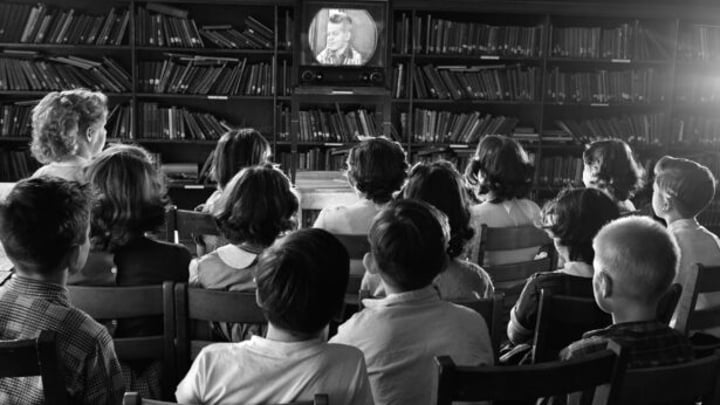
There were few sights capable of lifting the mood of an entire classroom faster than a television being wheeled down the corridor.
You could be halfway through maths and staring unhappily at a page of fractions when somebody sitting near the window would spot it coming.
“TV!”
That was usually enough.
Heads turned, concentration disappeared, smiles spread, and books seemed to close with suspicious speed, even though nobody had the faintest idea what we were going to watch.
It didn’t matter. For some reason, watching television at school felt like you’d beaten the system.
The teacher could have been preparing to show us a thoroughly educational program about irrigation, sedimentary rocks or the workings of Federal Parliament and we’d still have reacted as though maths had been cancelled and someone had declared a public holiday.
It was television, during school hours, and that was good enough for us.
Before the TV had wheels
As we all know, plenty of Australians went to school before there was a television sitting somewhere waiting to be rolled into the classroom.
School broadcasting had been around for decades, and for many children the first voice from the outside world to interrupt the normal school day came through a radio. Then there were the film projectors, which turned even the most ordinary educational film into something of an event.
Out came the screen, the curtains were drawn and the teacher began threading a reel of 16mm film through a machine that looked complicated enough to require an engineering degree.
Once it got going there was that distinctive mechanical clatter like a cattle truck, a beam of light across the darkened room and the flickering image on the screen. Dust floated through the light, everyone shuffled around trying to get a better view and, sooner or later, the picture would jump or the film would decide it had had enough.
If it jammed or broke, 30 children who had absolutely no idea how a film projector worked would immediately begin offering advice.
Funny how helpful we became when the alternative was returning to normal lessons.
Everybody ready…
Television arrived in Australia in 1956 and educational programs soon found their way into schools, but watching something back then involved a little more planning than clicking on a screen.
I wasn’t around then, but I was told the program was broadcast at a particular time, so the class had to be sitting there ready for it. Books were put away, chairs turned towards the television and, at plenty of country schools, someone then had to negotiate with the aerial.
Rabbit ears could require the delicate touch of a safecracker.
“A little to the left… no, back… there!”
Then came the most important instruction of all.
“DON’T MOVE!”
One tiny adjustment could be the difference between a perfectly watchable picture and a screen full of snow, and there was usually one kid who reckoned he knew exactly how to fix it.
Behind the News
Then came a program generations of Australian schoolchildren will remember.
Behind the News first went to air in 1968, explaining news and current affairs to younger Australians, and became part of the school week for generations.
Kids might have been learning about an election, a drought, something happening overseas or an issue you’d never heard of until that moment, but I suspect the educational merits weren’t necessarily what caused the excitement when the television appeared.
There was something about seeing the wider world suddenly arrive in the classroom.
It’s easy to forget how unusual that was. There was no internet sitting on the desk, no YouTube, no tablet and certainly no phone in your pocket capable of showing you almost anything within seconds.
For that little slice of the school day, the television took kids somewhere beyond the classroom walls.
And, yes, it still beat fractions.
The magnificent TV trolley
By the time many of us reached school, the television had become quite a piece of classroom machinery.
A great box of a thing sat high on a metal trolley – or on the bookshelf – that looked sturdy enough to carry an engine block. Those old CRT televisions weighed a tonne, or at least seemed to, and the trolley often had one wheel that refused to travel in the same direction as the other three.
The teacher would manoeuvre the whole contraption through the door with a long electrical cord trailing behind, while the class watched its arrival with considerably more interest than we’d shown in anything else that day.
Then, eventually, another piece of magic appeared on the shelf underneath.
The VCR.
Now the teacher could record something and show it whenever they wanted, although this introduced another ritual that anyone who lived through the VHS era will remember: finding the right place on the tape.
Fast-forward.
Too far.
Rewind.
Still too far.
Then forward again while 30 children watched the pictures race across the screen and somebody inevitably called out, “You’ve gone past it!”
I’m sure the teacher appreciated the assistance.
When you really hit the jackpot
Behind The News was good. An educational documentary was still preferable to long division. But every now and then word would spread around the room that you weren’t watching either.
You were getting a movie.
That was the jackpot, particularly towards the end of term when everyone, including the teacher, seemed to accept that enthusiasm for serious academic endeavour was beginning to fade.
The curtains were drawn, the lights went out and everyone shuffled their chairs into position. If somebody had managed to find a film someone actually wanted to watch, the afternoon had suddenly improved beyond recognition.
There was something slightly illicit about sitting in a dark classroom watching a movie while the rest of the world was apparently still at work.
You knew you were technically at school, but for the next hour or so it certainly didn’t feel like it.
When a screen was a treat
It’s probably difficult for a schoolkid today to understand why any of this caused such excitement.
Screens are part of the classroom now. A teacher can bring up a video, documentary, news report or live event almost instantly, pause it, replay it and move on to something else without anyone giving the technology itself much thought. And kids of the future will be introduced to hologram technology at some point.
For us, the technology was half the event.
I don’t remember many of the educational films we watched. Most of that has disappeared along with whatever I was supposed to understand about fractions.
But I remember the giant television perched on that trolley and the battle with the rabbit ears. I remember curtains being pulled across classroom windows, chairs scraping across the floor and that little ripple of excitement when someone spotted the TV making its way towards us.
And I remember the peculiar feeling that, whatever appeared on that screen, we’d somehow got away with something.
It could have been 40 minutes on the Murray-Darling Basin for all we cared.
We were watching television in maths time.
We won.
This article is part of ‘Lessons That Last’, a new Starts At 60 series exploring the memories, traditions and school experiences that shape Australians across generations, presented in partnership with Schoolblazer Limited, a specialist school uniform company that works with hundreds of schools internationally. Through Lessons That Last, Starts At 60 is exploring the memories and experiences of school life across generations of Australians.
Also check out Lessons That Last: What Was Hiding In Your Pencil Case?





 Proudly Australian owned and operated
Comments 0
Join the conversation. Comments are reviewed before they appear.
Be the first to comment.
Join the conversation
Tell us who you are to post a comment. We'll remember you next time.