
Lessons That Last: What was hiding in your pencil case?


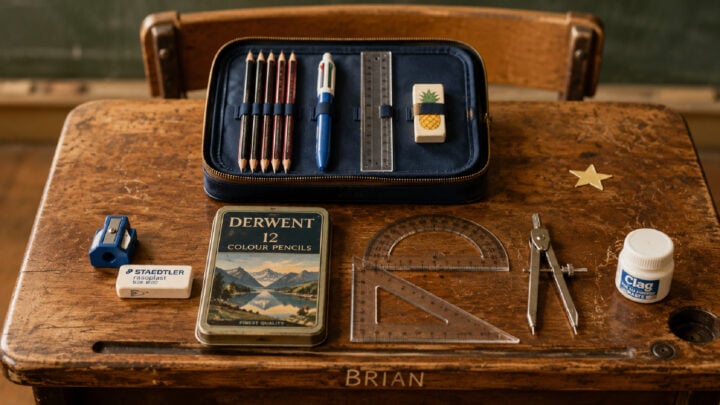
There was a time when you could learn quite a lot about a kid simply by looking inside their pencil case.
I remember a kid called Brian whose pencil case was astonishing.
Brian was that kid. Back straight, sitting quietly, hand almost launching through the ceiling whenever the teacher asked a question. He collected gold stars on his work with the sort of regularity the rest of us could only admire… or find mildly irritating.
And naturally, his pencil case was perfect. Pencils sharpened to exactly the same length. Pens where pens belonged. Ruler intact. Not a shaving or broken grey lead in sight.
He even had a pineapple-shaped rubber, which impressed me enormously because, as far as I could tell at that age, novelty fruit rubbers were usually the domain of the girls.
Brian had crossed that stationery divide with complete confidence.
Then there were pencil cases like mine.
Let’s just say Brian wasn’t asking to borrow anything from me.
When a pencil was just a pencil
Before stationery became something of a fashion statement, the requirements were pretty straightforward.
A grey lead pencil. A rubber. A ruler. A sharpener.
That covered a fair portion of the educational requirements.
Older generations will remember fountain pens, ink cartridges and blotting paper, while some went to school when wooden desks still had inkwells built into them.
Writing neatly actually was super important, and getting ink all over your fingers was simply an occupational hazard.
Then came the ballpoint pen, which made life considerably easier and gave generations of bored students something new to dismantle during maths.
Springs disappeared, ink tubes rolled onto the floor, and pens were clicked repeatedly until the teacher finally snapped.
“Will you STOP clicking that pen?”
Every classroom had one.
The mighty four-colour Bic
Then somebody invented what, to a schoolkid, felt like the Swiss Army knife of pens.
The Bic four-colour.
Blue, black, red and green, all in one chunky pen. Brilliant.
You could write in blue, underline something important in red and use green for reasons nobody was ever completely sure about.
But the real attraction was the mechanism.
Sooner or later, every kid attempted to push two colours down at once; there was absolutely no educational benefit to doing this, but that wasn’t the point.
And if you owned one, you guarded it.
Lending somebody your four-colour Bic carried the very real possibility that you’d never see it again.
We called them rubbers
They weren’t erasers.
They were rubbers.
And for a while there, the humble rubber became a serious piece of schoolyard merchandise. You could get them shaped like fruit, animals, cars and just about anything else. Some were brightly coloured. Some smelled like strawberries, grapes or bubblegum.
Brian, of course, had his pineapple.
The strange thing was, the better they looked and smelled, the less effective they seemed to be at actually rubbing anything out.
The boring white rubber worked beautifully.
The magnificent strawberry-scented one you’d been showing everyone at recess tended to smear the pencil across the page and occasionally threaten to tear a hole through the paper.
Didn’t matter, because it smelled fantastic.
The Derwent kid
Then there were coloured pencils.
A basic packet did the job.
But a proper set of Derwents was different. Hello, Brian, you again.
Opening that tin and seeing all those beautifully sharpened pencils sitting in perfect colour order was something else. If somebody arrived with one of the big sets, there was always a little moment of admiration.
And heaven help the classmate who borrowed one and pressed too hard.
“Don’t break it!”
There was an unwritten understanding that somebody else’s good coloured pencils were to be treated with respect. Of course, every new school year began with a full collection.
By Easter, several had vanished.
By winter, you had two reds, no blue and a mysterious orange pencil bearing the name of a kid from another class.
Nobody knew how this happened.
It simply did.
The geometry arsenal
At some point, the pencil case became home to more sophisticated equipment.
Think the protractor, set square, steel ruler, and compass.
That last one was supposedly designed for drawing circles.
Teachers understood this. Parents understood this.
Children, however, immediately recognised that somebody had attached a very sharp metal point to a small hinged device and handed it to an eight-year-old.
There were also those little metal pencil sharpeners that worked perfectly well but had one obvious design flaw: the shavings had nowhere to go.
So they went into the pencil case.
You’d promise yourself you’d empty it later.
You wouldn’t.
Eventually you’d unzip the case and half a forest would fall onto the desk. It’s a smell you’re remembering right now as you read this.
Paste, glue and that unforgettable smell
Speaking of smells, not everything fitted inside the pencil case, but no trip through old school stationery would be complete without the stuff we used to stick things together.
For generations of Australian children there was Clag, with that unmistakable little brush attached to the lid.
There was Perkins Paste too, another name capable of taking plenty of older readers straight back to a classroom.
The challenge was getting enough onto the paper to make it stick without soaking the entire project.
Some kids had this skill.
Others, like me, could turn a simple piece of coloured paper into papier-mâché in about 30 seconds.
Later came glue sticks, which seemed astonishingly sophisticated by comparison.
The annual promise
Perhaps the pencil case was never more impressive than on the first day of a new school year.
Everything was there. Fresh pencils. New pens. A ruler that hadn’t been snapped. A rubber with four perfect corners. Coloured pencils that hadn’t been sharpened down to little stumps.
There was something about new stationery that made you feel as though this year might be different. This was the year you’d keep everything tidy.
Your exercise books would remain immaculate. You wouldn’t lose a single pen. And you’d put the lid back on every Texta.
For a few days, you might even have managed it.
Then school happened.
A few months later there were pen marks inside the pencil case, pencil shavings in the corners, half the coloured pencils were missing and the once-pristine rubber looked as though it had survived a house fire.
Unless, of course, your name was Brian.
I reckon his pineapple rubber probably made it to the end of the year in mint condition.
Funny what stays with you from school. Whole lessons disappear from memory, along with whatever it was we were supposed to understand about long division.
But mention a four-colour Bic, a tin of Derwents or one of those ridiculous scented rubbers and suddenly you’re back at an old school desk, rummaging through your pencil case looking for the thing you could have sworn was in there five minutes ago.
What was the prized possession in your school pencil case?
This article is part of ‘Lessons That Last’, a new Starts At 60 series exploring the memories, traditions and school experiences that shape Australians across generations, presented in partnership with Schoolblazer Limited, a specialist school uniform company that works with hundreds of schools internationally. Through Lessons That Last, Starts At 60 is exploring the memories and experiences of school life across generations of Australians.
Also check out Lessons That Last: First Kiss Behind The Incinerator





 Proudly Australian owned and operated
Comments 2
Join the conversation. Comments are reviewed before they appear.
Ohhh The Derwent’s!!! That was all I ever wanted, but never got. There was only one kid in our class that could afford a tin of Derwent’s and her books and drawings were amazing, the jealousy was real! I still look at them when I go shopping, and I have multiple sets of pencils, but never bought myself a set of Derwent’s….maybe I should!
Yes - go for it and get one of those colouring in books that are the rage. Find a quiet spot alone and experience the joy of your first Derwents.
Join the conversation
Tell us who you are to post a comment. We'll remember you next time.