


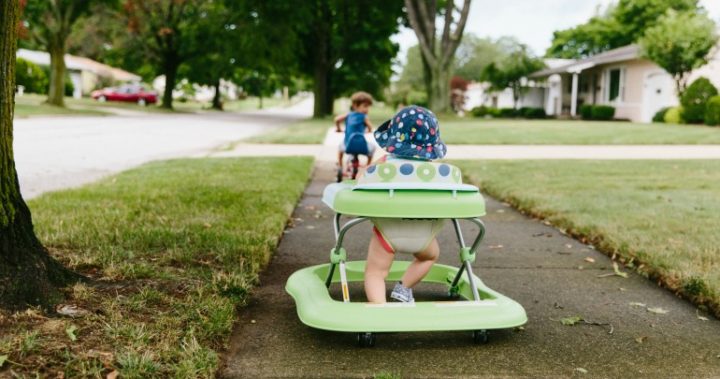
Anyone who raised children or grandchildren in the 1970s and ‘80s will know that the humble baby walker has helped toddlers and infants find their feet for years.
Also known as exersaucers, the apparatus has been loved by parents for generations and lets them place their child in the baby walker to supposedly walk around safely, without putting themselves in harm’s way. Having said that, there have actually been a number of significant injuries and even deaths caused by the walkers since the ‘70s.
While infant walkers remain a fixture in the homes of many parents and grandparents around the world, there are fresh calls for them to be banned in the United States. The American Academy of Pediatrics (AAP) claims the walkers don’t provide any benefit to children and that they actually increase the risk of injury. Published in the Journal of Pediatrics, a study found more than 230,000 American children younger than 15 months were treated in hospital emergency departments due to walker-related injuries between 1990 and 2014.
The number may seem high, but researchers noted it actually dropped from 20,650 in 1990 to 2,001 in 2014. The decline was the result of less infants falling down stairs while in the walkers, a result of a design change in 1997 that forced all infant walkers to be wider than a standard doorway. In 2010, further stringent requirements were placed on the design of the walkers, although authors of the study aren’t satisfied it’s enough to prevent injury.
Read more: How to grandchild-proof your home in a few easy moves
“The good news is that the number of infant walker-related injuries has continued to decrease substantially during the past 25 years,” senior author of study Gary Smith said in a statement. “However, it is important for families to understand that these products are still causing serious injuries to young children and should not be used.”
Alarmingly, 91 per cent of reordered injuries were to the head and neck, while 30 per cent were concussions, closed head injuries and skull fractures. Injuries were most likely to be caused by children falling down stairs, falling out of the walker or being injured because the walker allowed children to access dangers such as hot objects.
“Infant walkers give quick mobility (up to 4 feet per second) to young children before they are developmentally ready. Despite the decrease in injuries over the years, there are still too many serious injuries occurring related to this product,” Smith said. “Because of this, we support the American Academy of Pediatrics’ call for a ban on the manufacture, sale, and importation of infant walkers in the US.”
Read more: Grandmother seeks advice for out-of-control grandchildren
According to the Australian Competition and Consumer Commission (ACCC), the risk of injury is also possible in Australia – especially when children aren’t supervised. In addition to gaining access to potentially hazardous areas such as bench tops, kitchen utensil drawers and ovens, it warns that it can also delay a child’s ability to walk if they’re using a walker for more than 15 minutes at a time.
It recommends that baby walkers only be used when an adult is supervising a child, that they are only ever used on flat and even surfaces, that access to steps, kitchens and fireplaces is restricted and for parents not to place heavy items on a walker that could cause it to tip.





 Proudly Australian owned and operated