
Empty driveway? It could earn you $400 a month


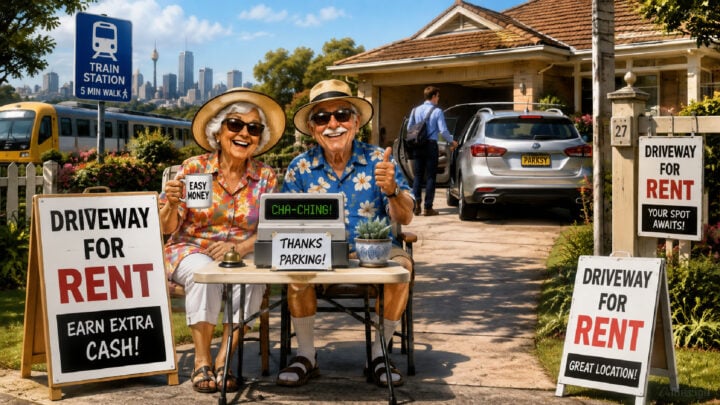
An unused driveway or garage could bring in thousands of dollars in extra income each year, particularly if you live near a station, hospital or other busy destination, but there are a few things homeowners should check first.
Most of us don’t think of the driveway as an income-producing part of the family home, but if yours sits empty for much of the day there could be someone nearby willing to pay to use it.
Parking marketplace Parksy says owners renting out private driveways, garages and car spaces typically ask between $200 and $400 a month, depending on where the property is and what type of parking is available.
At the upper end, that’s $4,800 a year from a piece of the property that may otherwise be doing very little.
Parksy founder and CEO Daniel Battaglia told Starts at 60 that location is one of the biggest factors determining what a space can command.
“The premium sits where street parking is scarce and demand is daily,” Battaglia said.
That can include inner-city suburbs and areas close to train stations, hospitals, universities and sporting grounds.
Beachside suburbs can attract demand during summer, while homes close to airports present another opportunity because travellers may be looking for somewhere to leave a car for several days or weeks. Security can also increase the value of a space, with a lock-up garage generally commanding more than an exposed driveway.
How does it work?
The idea is essentially the parking version of the sharing economy: match somebody with unused space with somebody who needs it.
On Parksy, the homeowner sets the price and lists the space. The driver then contacts the owner and the pair agree on the arrangement and payment.
Parksy doesn’t take a commission from the rental payment, Battaglia said, meaning the homeowner keeps what they charge.
“Usually [payment is] cash or bank transfer weekly or monthly,” he said.
The company says it has about 13,000 listings across private garages, driveways and commercial car parks, including about 5,000 private garages.
There is an important qualification, however. Because Parksy doesn’t process the payments between homeowners and drivers, it cannot determine how many listed spaces are currently being rented or independently verify what owners ultimately earn.
Battaglia said arrangements can vary from a weekend through to several months depending on whether the driver needs parking for work, travel or another reason.

Before putting up the ‘for rent’ sign
There are several checks homeowners should make before deciding their empty driveway is their newest income stream, starting with your local council.
Planning requirements differ between areas, so homeowners should check whether using residential property for ongoing paid parking requires permission in their municipality.
For people living in apartments, units or townhouses, owners corporation, strata or body corporate rules also need to be checked. By-laws or other restrictions may prevent a parking space from being rented separately or used by somebody who doesn’t live in the building.
Insurance deserves a phone call too.
Homeowners should tell their insurer exactly what they’re proposing and establish whether allowing a paying driver’s vehicle onto the property affects their home and contents or liability cover.
Then there’s tax. Income earned from renting property, including part of a home through the sharing economy, generally needs to be declared to the Australian Taxation Office. Depending on the circumstances, using part of a home to produce income can also have implications for deductions and the main residence capital gains tax exemption.
That makes it worth seeking tax advice for your individual circumstances rather than assuming a few hundred dollars a month has no consequences.
An idea that once got councils talking
Renting out the humble driveway might sound like a product of today’s sharing economy, but Battaglia has been pursuing the idea for more than a decade.
He founded the business originally known as Parking Made Easy in 2011 after struggling to find a park while visiting a friend in Sydney’s Paddington and noticing empty private driveways nearby.
By 2012, the concept was generating controversy when the business became involved in a public dispute with then City of Nedlands mayor Max Hipkins in Western Australia amid concerns about people renting parking spaces and the use of council-controlled verges.
Fourteen years later, Battaglia’s business has evolved into Parksy and the company has relaunched its driveway-sharing service with new technology designed to connect drivers and space owners.
For homeowners, though, the proposition remains simple: if there’s an empty patch of concrete beside your house, it may be worth finding out what somebody would pay to park on it.





 Proudly Australian owned and operated
Comments 1
Join the conversation. Comments are reviewed before they appear.
Nice one Scott, ill share on the socials too!
Join the conversation
Tell us who you are to post a comment. We'll remember you next time.