


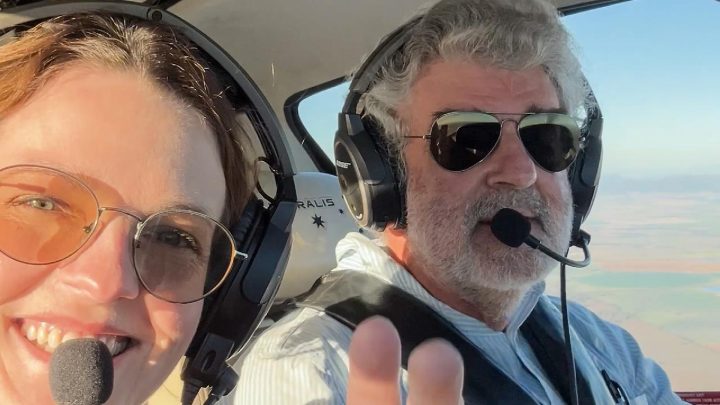
David Moore lands his small plane on a dusty rural air strip, drives a clunky old car through town and greets his patients at a clinic in a disused labour ward.
This is specialist care in rural Australia, with the ophthalmologist and pilot flying thousands of kilometres every year to ensure isolated patients can maintain their vision.
The clinics save those with declining sight in the northern NSW communities of Moree and Narrabri from taking long trips to Dr Moore’s rooms in Tamworth.
“Many patients have said if I stop going, they would have to stop getting care,” Dr Moore told said.
“For some of those patients, that would mean blindness.”
Dr Moore’s ophthalmologist daughter Phoebe is continuing his work both in the clinic and the cockpit, learning to fly ahead of his eventual retirement.
“We can’t stop these clinics. It’s imperative they continue,” she said.
Ophthalmologist David Moore and a patient talk about his outreach clinics in rural areas. (SUPPLIED/Bayer/Macular Disease Foundation)While Australians living in the cities can access a range of specialists close to home, rural patients usually have to travel or go without.
Workforce shortages and maldistribution have long been linked to higher rates of death and injury outside the cities, fewer cancer screenings and more preventable illnesses.
Health organisations and patients have written to a federal inquiry examining specialist access and affordability across mental health, cardiology, physiotherapy, oncology, pathology and more.
Treatment for macular disease is a stark example of the disparities faced by rural communities, according to submissions.
Though care has vastly improved with the development of eye injections that temporarily stem bleeding blood vessels, some patients still require monthly treatment.
That can be a difficult endeavour for rural people, who may not have access to public transport or the means to travel.
Those barriers can force some to abandon critical treatment, Macular Disease Foundation Australia chief executive Kathy Chapman said.
“It’s such a travesty that we have sight-saving treatments, but if people are not staying on them, the inevitability is most people will go blind,” Dr Chapman said.
The condition, which is loss of central vision, affects about 1.9 million Australians and costs at least $16 billion a year in aged care, home supports and lost productivity.
Most patients have to rely on private care, with only 20 per cent able to access metro-based public outpatient clinics.
The Moores shared their work in a short film to raise awareness of healthcare gaps in a partnership with the foundation, the NSW Country Women’s Association, the National Rural Health Alliance and pharmaceutical company Bayer.
They emphasised many specialists go the extra mile for rural healthcare.
“Rural Australia carries our nation,” David Moore said.
“The people we treat are the grassroots of Australia that provide the wealth, so they deserve as good care as they could get in a big city.”
The parliamentary inquiry’s patient, families and carers survey closes on Friday.





 Proudly Australian owned and operated
Comments 1
Join the conversation. Comments are reviewed before they appear.
What an amazing pair. Thank you for the fabulous work you do.
Join the conversation
Tell us who you are to post a comment. We'll remember you next time.