
A journey back 42,000 years: An extraordinary destination for your bucket list


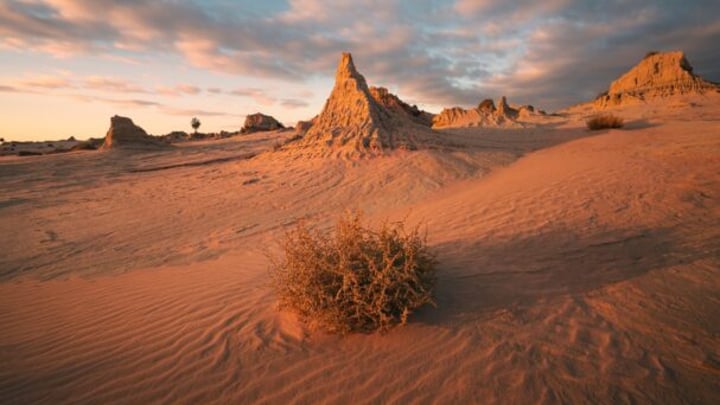
If you’ve been dreaming of an outback adventure, Lake Mungo deserves a place on your bucket list. With its otherworldly landscapes, fascinating ancient history and remarkable connection to Australia’s Traditional Owners, it offers an unforgettable journey back through time.
There’s nothing like travelling through the Australian outback – endless horizons, extraordinary colours and a peaceful silence at night have a way of reminding you how vast and ancient this country is. Few places capture that feeling quite like Lake Mungo in Mungo National Park, south-western New South Wales.
At first glance, its sweeping dry lake bed and unusual sand formations look like the surface of another planet. Yet beneath this seemingly barren landscape lies one of the most important chapters in Australia’s human history.
The discovery that changed Australian history
In 1974, geologist Jim Bowler was exploring the ancient lake bed on his motorbike when something unusual caught his eye: Protruding from the Earth was a white object that turned out to be part of a human skull.
The discovery would become internationally significant. The remains, now known as Mungo Man, were those of a person who had lived approximately 42,000 years ago. He had been carefully laid to rest on his back, his hands folded in his lap, with red ochre sprinkled over his body.
Remarkably, the ochre had been transported from hundreds of kilometres away, suggesting considerable effort and meaning had gone into the burial. It was extraordinary evidence of ancient ceremonial practices and the sophisticated cultural traditions of Australia’s First Peoples.
And Mungo Man wasn’t the first incredible discovery in the region. Five years earlier, in 1969, the cremated remains of Mungo Lady had been uncovered nearby. Her carefully prepared burial provided further evidence of complex spiritual and cultural practices tens of thousands of years ago.
Together, these discoveries helped transform understanding of how long Aboriginal people have lived on this continent.
A place of deep cultural significance
For the Barkandji/Paakantyi, Mutthi Mutthi and Ngiyampaa peoples, the traditional custodians of the Willandra Lakes region, Lake Mungo is far more than an archaeological site. It is Country, carrying profound cultural and ancestral significance.
After decades held in scientific institutions, the remains of Mungo Lady and Mungo Man were returned to their traditional custodians through separate repatriation processes. Speaking about Mungo Man’s return, Mutthi Mutthi elder Mary Pappin captured the importance of bringing him home.
“We are so grateful he is going to be coming home. He’s done his job. It is time for him to go home and rest now.”
For visitors, understanding this connection adds another dimension to the experience. You won’t see the ancient remains on display, but standing on the same landscape where these people lived thousands of years ago is deeply moving.
When the desert was a freshwater paradise
It’s almost impossible to imagine when looking across Lake Mungo today, but this vast, dry expanse was once filled with water. Around 40,000 years ago, freshwater fish, mussels, birds and other wildlife flourished here. Aboriginal communities lived along the shoreline, making use of the lake’s abundant natural resources.
Over thousands of years, changing climatic conditions transformed the landscape. The lake eventually dried up more than 10,000 years ago, leaving behind the extraordinary formations visitors see today. Its dramatic beauty is particularly striking in the softer light of early morning and late afternoon, when the ancient dunes glow in shades of cream, gold and orange.
For travellers who enjoy photography, birdwatching or simply soaking up the scenery, it’s an unforgettable sight.
Discover the famous Walls of China
One of Lake Mungo’s most spectacular attractions is the Walls of China – a series of towering sand and clay formations sculpted by wind and water over thousands of years. Despite the name, there’s nothing man-made about these extraordinary structures. The formations are part of a lunette, a crescent-shaped dune system that stretches along the eastern edge of the ancient lake.
The best way to appreciate their beauty and significance is on a guided tour with a local Aboriginal guide. You’ll discover how the landscape formed, learn about its ancient history and gain a deeper appreciation of its cultural importance. Tours can be arranged through the Mungo Visitor Centre, with schedules varying throughout the year.
For those who prefer exploring at their own pace, the Walls of China viewing platform offers sweeping views without requiring a lengthy walk.
Take the scenic route
If you enjoy a good road trip, the Mungo self-guided drive tour is a wonderful way to discover the park. The route takes visitors across the ancient lake bed and through changing outback scenery, with opportunities to stop and explore along the way.
Highlights include the historic Vigars Well picnic area – once a watering point for horse-drawn wagons, and the spectacular surrounding sand dunes. Stop for lunch and appreciate the remarkable tranquillity, and keep an eye out for kangaroos and birdlife, including wedge-tailed eagles, whistling kites and other birds of prey.
For those who enjoy stretching their legs, shorter walking tracks offer opportunities to experience the landscape without committing to a strenuous hike.
The visitor centre is also well worth exploring, with displays covering the area’s Aboriginal heritage, ancient wildlife and fascinating archaeological discoveries.
If you enjoyed this feature on Mungo National Park, you might like this story on foraging for mushrooms in the wilds of Canada.





 Proudly Australian owned and operated
Comments 0
Join the conversation. Comments are reviewed before they appear.
Be the first to comment.
Join the conversation
Tell us who you are to post a comment. We'll remember you next time.