
Lost in the Woods With Shaggy Jack: A Day Foraging Wild Mushrooms on Canada’s Sunshine Coast


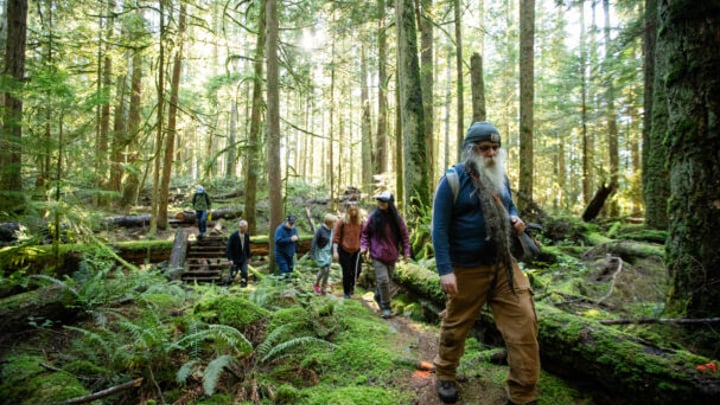
The man waiting for us at the campsite looks like a garden gnome who walked off his plinth one night, wandered into the forest, and spent the next few decades hanging out with Bob Marley.
There is a beard, first of all, a great flowing silver cascade of the kind any department store Santa would sell his reindeer for. Then there is the beanie, which on closer inspection is not so much a hat as a containment vessel, because tucked beneath it is a rope of dreadlocks that, once released, streams down past his waist and very nearly reaches his knees. This is Jody Franklin, though nobody on British Columbia’s Sunshine Coast calls him that. Here he is simply Shaggy Jack, and he is, I will discover over the next seven hours, the most knowledgeable man I have ever met on the topic of mushrooms.
He says good morning. He says it softly, to the ground. He shakes hands. He says almost nothing else. And then somebody asks him a question about mushrooms, and it is as though someone has plugged him into the mains.
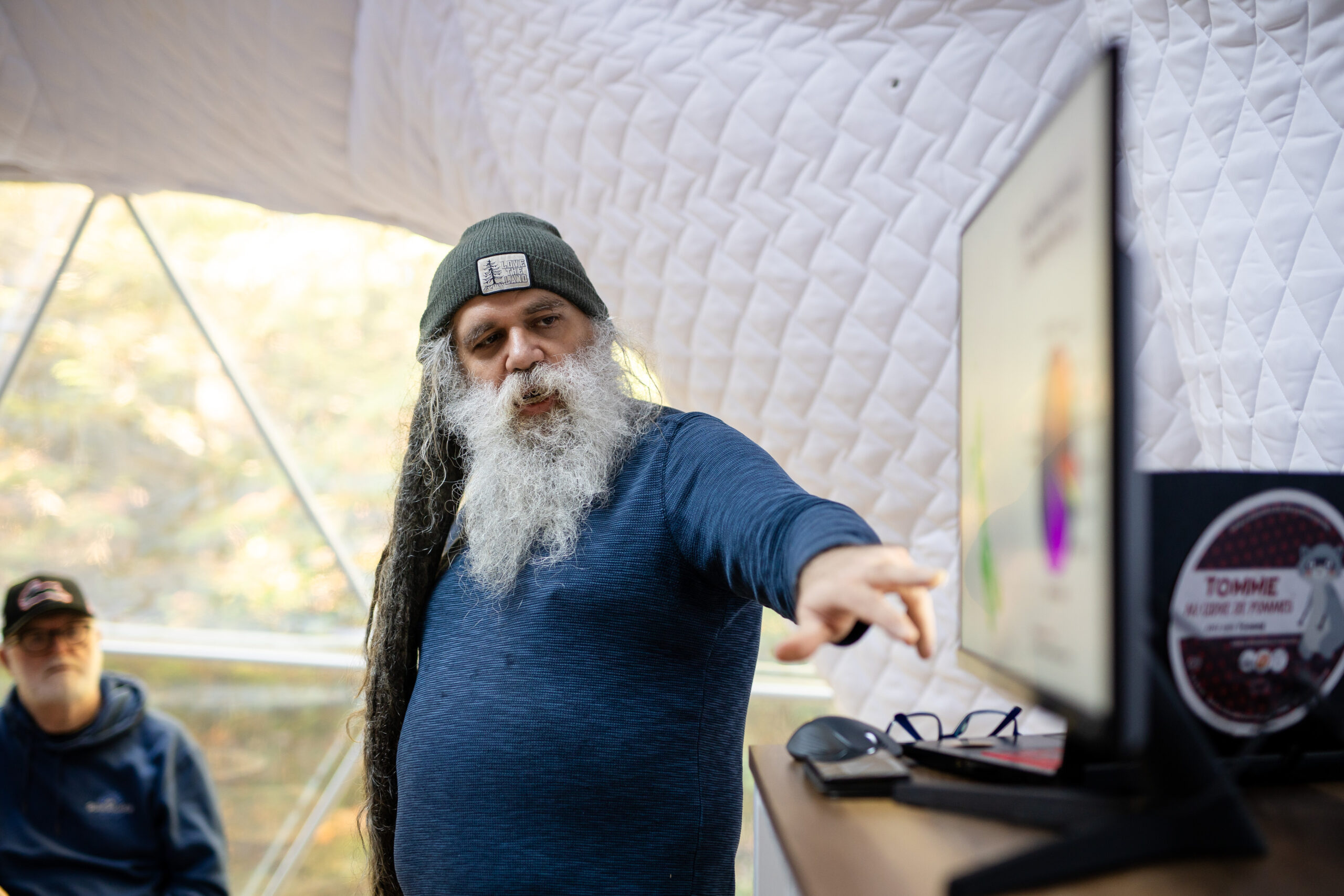
Class in a dome
There are eight of us in the class, ranging from a couple in their early thirties to me, the senior student by a comfortable margin at the back end of my sixties, and we are seated in one of the geodesic domes at Stay Wilder, an off-grid eco-glamping resort tucked into 160 acres of coastal rainforest outside Sechelt.
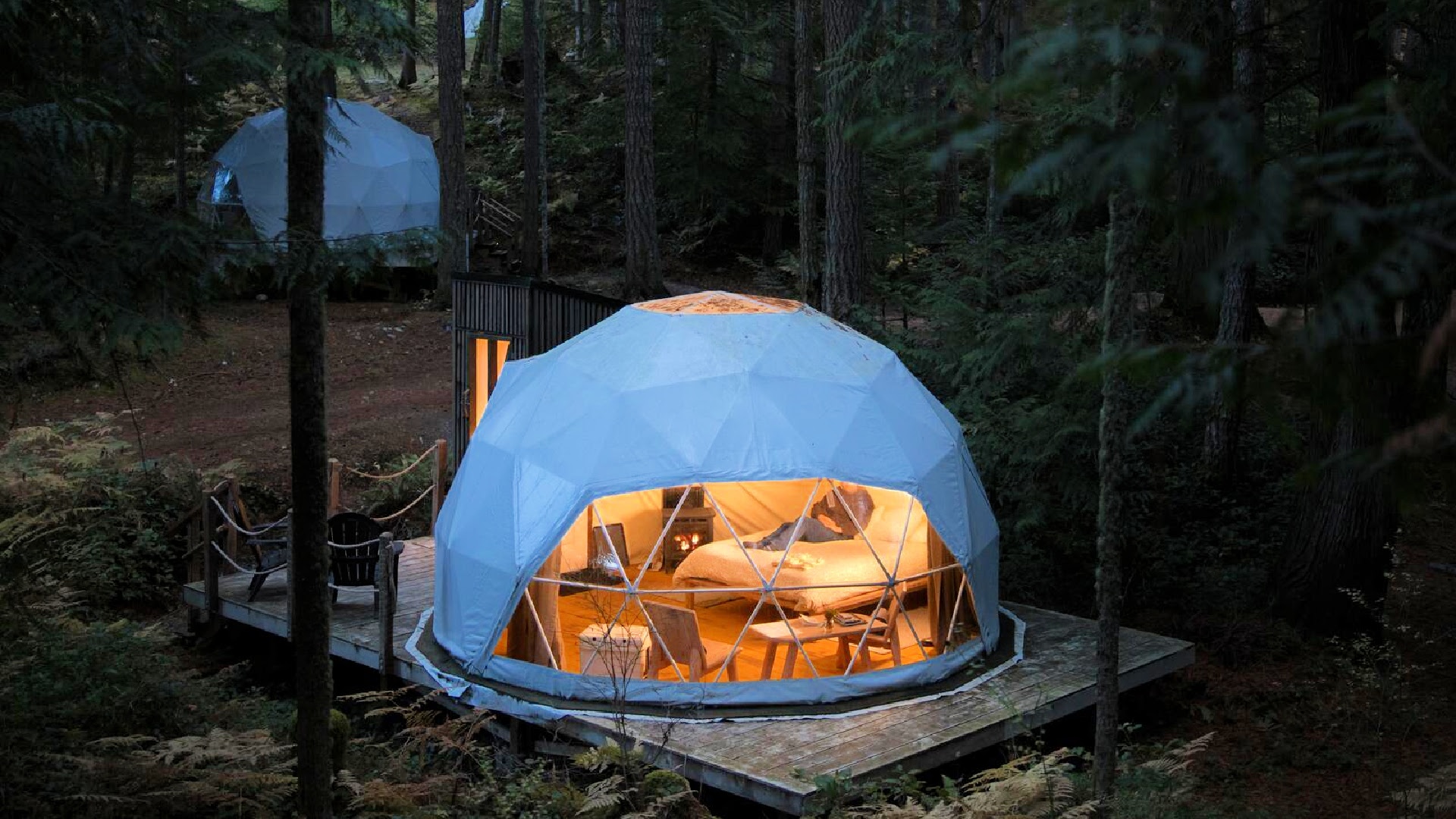
The domes are the sort of thing a hobbit would build if a hobbit had a design degree and a solar panel. Wide windows look straight out into the trees, there’s a skylight overhead for stargazing, an organic queen bed, furniture made from reclaimed timber, a little fireplace, a locally made linen robe on the hook. Everything runs on sunshine. There’s no wifi, which the resort frames as a gift and which I initially frame as an act of cruelty, until about an hour in, when I realise I haven’t looked at my phone once and feel, for the first time in years, faintly like a person.
For the next four hours, Jack teaches. Not lectures. Teaches. A mushroom, he explains, is not the organism at all. It is merely the fruit. The real creature is the mycelium, a vast web of threads running unseen through soil, rotting logs and the roots of living trees, doing all the eating and quietly getting on with things for years, decades, sometimes centuries. He tells us about a single honey mushroom organism in Oregon thought to have spread across roughly 2,400 acres over thousands of years, which is the point at which I stop thinking of mushrooms as a side dish and start thinking of them as a landlord.
Picking a mushroom, he says, is less like uprooting a plant and more like picking an apple off a tree. The tree remains. Then he tells us something that genuinely surprises me: fungi are more closely related to animals than plants. They breathe oxygen and exhale carbon dioxide, like us. I look down at my hands and consider this for longer than is strictly healthy.
He is fierce, in his gentle way, on two points. First, foraging is far kinder to the forest than most people assume. He cites a long-running European study of more than 800 harvesting sites over 40 years, which found mushroom productivity and range tended to go up, not down, partly because foragers spread spores as they walk. Of all the endangered fungi on the world’s red lists, he says, he has yet to find one threatened by human picking; habitat destruction is the culprit every time. The only real local competition, apparently, is the northern flying squirrel, which eats about half its diet in mushrooms and always gets to the truffles first.
Second, and more urgently, do not trust the apps. Photo-matching technology, he says, produces far too many false positives, because people photograph the cap and the app guesses at the rest. You need to see the whole mushroom. Buy a proper regional guidebook with a recent copyright date, he says, holding up a copy of Mushrooms of British Columbia, and if you’re starting out, get an expert to confirm what you’ve found. Using a Californian guide in Canada, or a Swiss one anywhere, is how people end up confidently identifying mushrooms that grow two thousand kilometres away.
We learn which mushrooms are cut at the base with a knife and which can be gently twisted from the earth. We learn that the best season here runs from September through to December, and that a run of nights between 18 and 2 degrees, followed by rain, is the signal that the forest is about to deliver. We learn the trees, because the mushrooms we want keep very particular company.
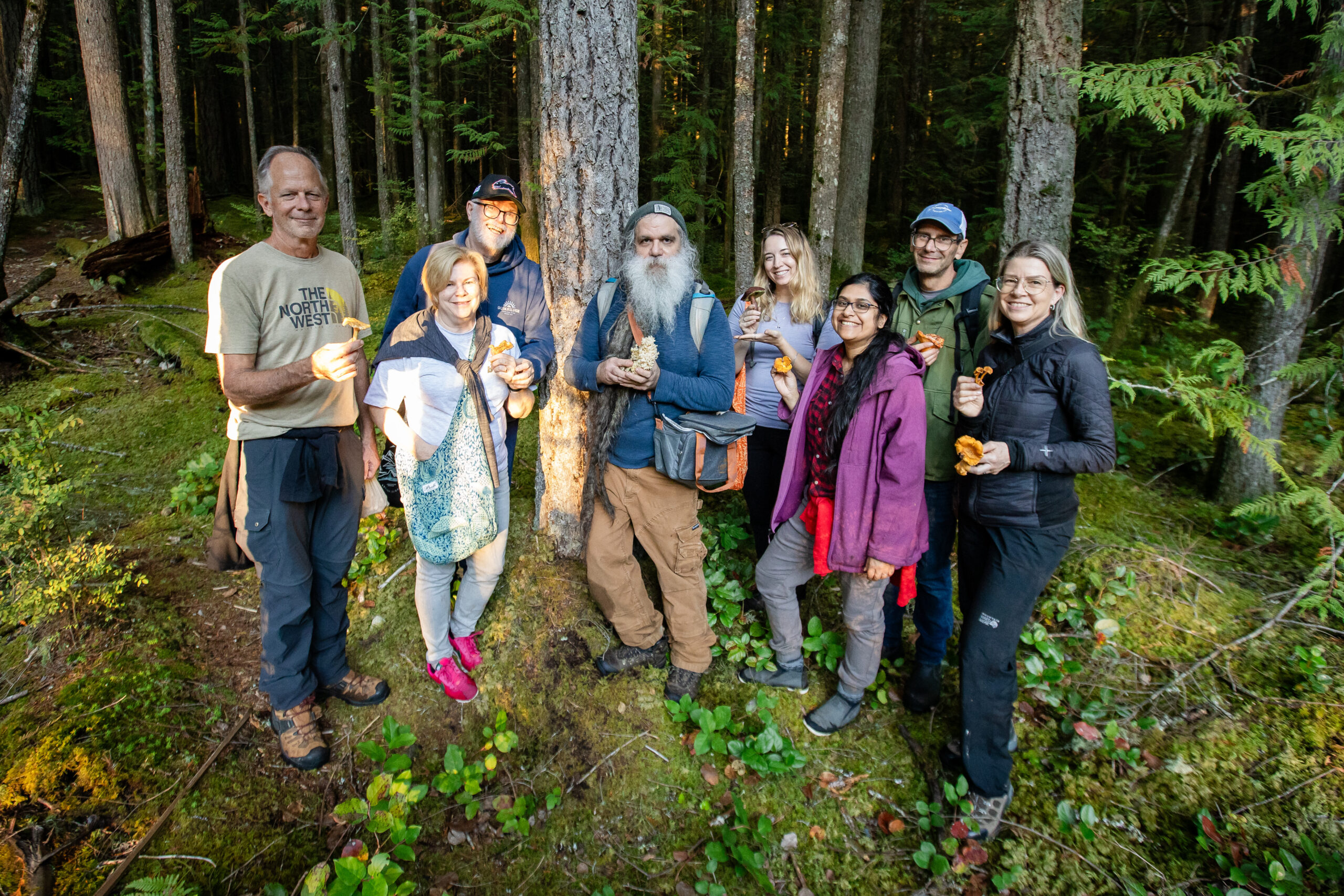
Into the forest
After lunch we drive in convoy to Roberts Creek, a small, faintly bohemian community on the coast between Gibsons and Sechelt, and pull up in the forest near the Sunshine Coast Golf and Country Club. The golfers are in their bright polos. We are in our worst boots. Nobody acknowledges the other.
For the next three hours, we walk. Up hills and down them. Over fallen logs the width of a dining table, some of which I straddle with more dignity than others. Across dry creek beds, waiting for the autumn rains. It is 18 degrees, the sun is out, and the forest is the kind of coastal temperate rainforest that makes you lower your voice without being asked: towering Douglas fir, western red cedar and western hemlock, the ground a deep cushion of moss and fern, old stumps from logging a century ago now furred green and sprouting new trees from their tops.
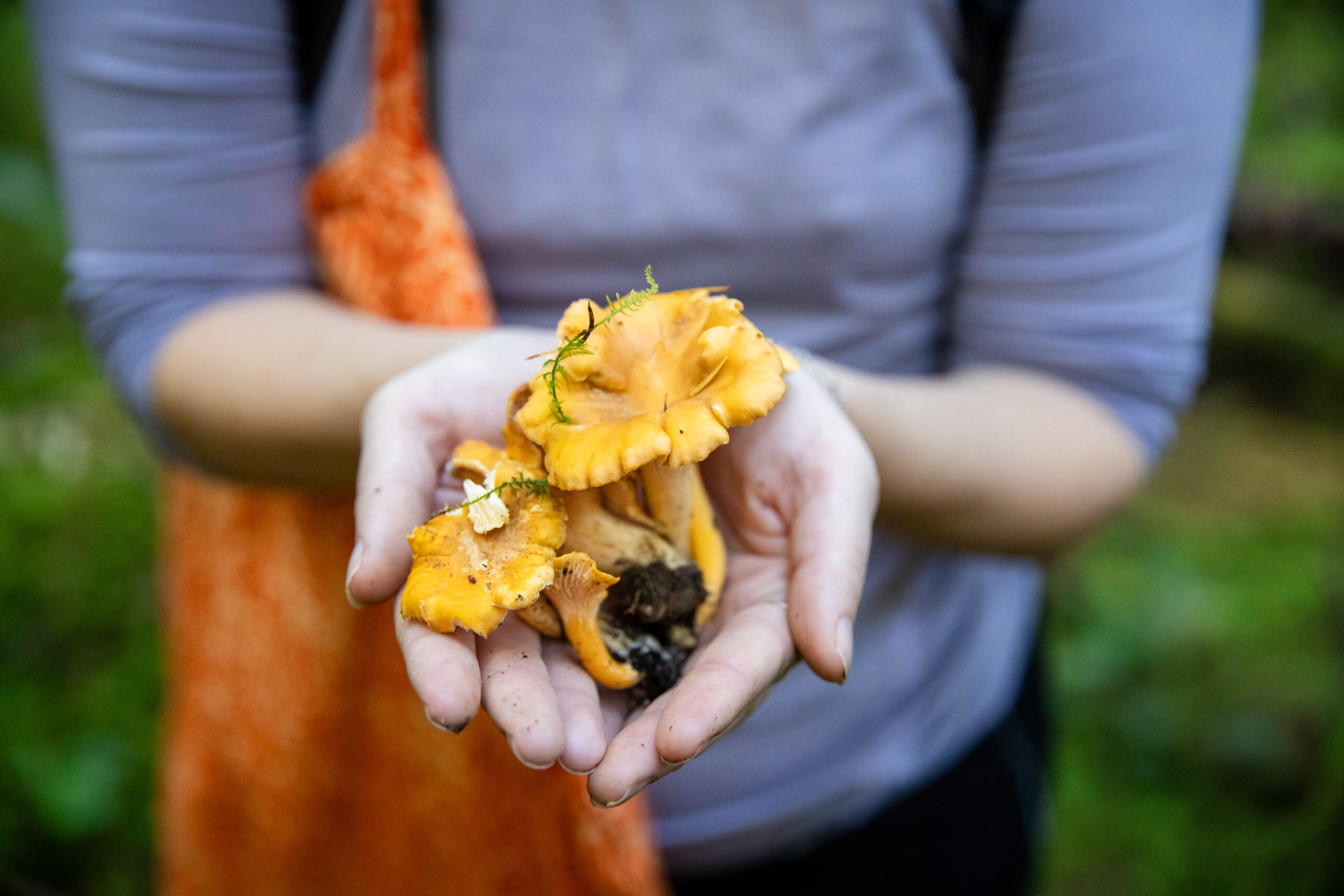
And Jack, who said perhaps eleven words before nine o’clock this morning, now stops every few minutes to kneel in the moss and murmur, with the reverence of a man showing you his grandchildren, about what he’s found. We fill our baskets. We learn to look properly, which is to say slowly. I am fairly certain I walk past more mushrooms than I find, which Jack assures me is how everybody starts.
The bigger point
There’s something going on here beyond a pleasant walk in the woods. More and more of us want to know where our food actually comes from, who grew it, who caught it, who picked it. Farmers’ markets, paddock-to-plate dining, the quiet pleasure of a tomato you grew yourself. Foraging is the purest end of that impulse. You don’t just know where your dinner came from. You found it, on your knees, in the moss, with a softly spoken man in a beanie telling you not to eat the wrong one.
It suits Jack perfectly. He is of Otipemisiwak Métis heritage, grew up foraging, fishing and hunting, and picked his first morels with his family in Saskatchewan in 1978, aged five. He became a full-time forager after moving to the Sunshine Coast in 2012, started teaching in 2018, and now runs Shaggy Jack’s Food Market in the Gibsons Public Market with his wife, Andrea, stocking local, wild and artisan food. Nobody I’ve met lives closer to the source of what they eat.
Where on earth is the Sunshine Coast?
Here’s the curiosity: the Sunshine Coast is on the Canadian mainland, yet you can’t drive to it from Vancouver. Mountains and inlets see to that. It stretches for roughly 180 kilometres north-west along the coast, and the usual way in is a 40-minute ferry from Horseshoe Bay in West Vancouver to Langdale, near Gibsons, followed by a slow, scenic drive up Highway 101 through Gibsons, Roberts Creek and Sechelt. It feels like an island. It isn’t. That’s the charm.
It’s a coast of small towns, artists, waterfront cafes, ocean views to Vancouver Island, and forest that comes right down to the road. Locals say it gets more sun than Vancouver, hence the name. On the day I was there, I wasn’t inclined to argue.
GETTING THERE
Flights: Air Canada and Qantas fly from Australia to Vancouver. Check current schedules and fares from your nearest capital city.
Ferry: BC Ferries runs regular sailings from Horseshoe Bay (West Vancouver) to Langdale on the Sunshine Coast, about 40 minutes. Bring a car, or arrange a hire car or taxi on the other side, as you’ll need transport to reach Stay Wilder and the forest walk. Book at bcferries.com.
Seaplane: Floatplane services also run from Vancouver Harbour to Sechelt, if you’d rather arrive with a view.
Driving time: Stay Wilder is about 34km from the Langdale ferry terminal, but allow extra time; the road is winding and slow.
THE FORAGING
Shaggy Jack’s Wild Mushroom Foraging for Beginners: CAD$149 per adult (students CAD$89), which includes a 3.5-4 hour classroom session and a 2.5-3 hour guided forest walk. Students take home edible mushrooms they’ve harvested. Classes run on selected dates through October and November at venues including Stay Wilder, Gibsons Public Market and Up The Creek Backpacker’s Lodge in Roberts Creek. Group and returning-student discounts available. Book at shaggyjack.com.
THE STAY
Stay Wilder Eco-Glamping Resort, Sechelt: Six adults-only, dog-friendly, solar-powered geodesic domes in 160 acres of rainforest, each with an organic queen bed, private hot shower and toilet, fireplace and skylight, plus a shared community kitchen with pizza oven, fire pit and cedar barrel sauna. Rates generally start from around CAD$200 a night, with a two-night minimum (three on long weekends). Through October, book three nights and pay for two. Stay Wilder and Shaggy Jack also run a two-night all-inclusive retreat, FORAGED, featuring classes, two forest walks and chef-cooked meals using the day’s harvest, priced from CAD$1,599 per person twin share in 2026. Book at staywilder.eco.
Prices are in Canadian dollars and were correct at the time of writing. Check directly with operators for current rates and availability. If you need help booking anything, contact the lovely team at Travel at 60.





 Proudly Australian owned and operated
Comments 0
Join the conversation. Comments are reviewed before they appear.
Be the first to comment.
Join the conversation
Tell us who you are to post a comment. We'll remember you next time.