
The card surcharge is dead, so who pays the bill now?


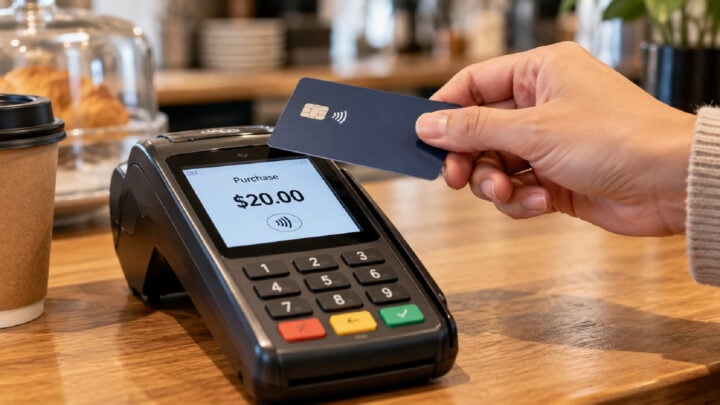
From tomorrow, if something costs $20 and you tap your card, you should pay $20 and not $20.20 or $20.30.
From October 1, businesses will no longer be able to add a surcharge to payments made using eftpos, Mastercard or Visa debit, prepaid and credit cards. American Express and UnionPay are also removing surcharges from the same date, while PayPal will follow from October 5.
Australians currently pay an estimated $1.6 billion a year in card surcharges, according to the Federal Government.
But while those fees are disappearing from the checkout, economists are divided over whether consumers will ultimately save the full amount.
Some expect businesses to absorb at least part of the cost. Others believe it will eventually find its way into higher prices, while rewards credit-card customers could face higher annual fees, fewer points or reduced perks.
A Finder survey of economists and finance experts found 62 per cent of the 26 panellists who expressed a view regarded the change as a net positive for consumers. Another 31 per cent considered it broadly neutral, while just one believed consumers would be worse off.
Dr Shane Oliver of AMP was among those expecting little overall change.
“There is no such thing as a free lunch. Removing fees will just lead to higher prices/lower card benefits,” he said.
Veteran finance commentator Adjunct Professor Noel Whittaker also expects some of the cost to reappear elsewhere.
“I can’t see it will make a big difference. The merchants will increase their prices, and the credit card companies will increase their fees and reduce their points.”
Finder has been tracking changes to rewards credit cards ahead of October 1, with some providers increasing annual fees, reducing points earn rates or cutting benefits.
Taylor Blackburn, personal finance specialist at Finder, said removing surcharges did not remove the underlying cost of accepting card payments.
“While it’s a win for those who’ve been stung by surprise fees, the ban doesn’t make the cost of card payments disappear. It just moves it somewhere less visible.
“Some businesses will build it into their prices, and banks are already recouping lost revenue from rewards cardholders through fewer points, higher annual fees, or fewer perks.”
Others see a clear consumer benefit
Other economists believe greater price transparency makes the change worthwhile.
Graham Cooke of Aussie Insights described it as a “no-brainer”.
“The consumer should not have to pay more depending on the method of payment used,” he said.
University of Sydney economist Stella Huangfu said consumers should have a clearer idea of what they will actually pay before reaching the checkout.
“The ban should improve price transparency and reduce unexpected costs at checkout,” she said.
“Combined with lower interchange fees, it should also put downward pressure on payment costs, although some merchants may ultimately incorporate these costs into advertised prices.”
Cameron Murray of Fresh Economic Thinking compared the change with the treatment of GST, arguing the cost of payment systems should be included in advertised prices.
Nicholas Gruen of Lateral Economics also backed the change on transparency grounds, while acknowledging some payment costs were likely to be incorporated into retail prices.
That could mean customers using cheaper payment methods effectively sharing some of the cost generated by more expensive cards.
Mark Crosby of Monash University expects any overall impact to be modest.
“Some prices will rise slightly while others will fall, so expect a very marginal effect.”
What changes from October 1
The new rules cover surcharges imposed on eftpos, Mastercard and Visa transactions, including debit, prepaid and credit cards. American Express and UnionPay are also removing card surcharges from October 1.
But other fees haven’t suddenly disappeared.
The Reserve Bank says the changes do not apply to weekend or public holiday surcharges, booking fees or service fees. The new rules specifically concern fees charged because a customer chooses to pay by card.
The reforms also reduce interchange fees on domestic card transactions, designed to lower the cost to businesses of accepting card payments.
Check your credit card
For Australians with rewards or frequent-flyer credit cards, the changes make it worth checking the annual fee, points earn rate and benefits attached to the card.
Finder says some rewards cards have already been repriced or had benefits reduced ahead of October 1.
Whether a rewards card remains worthwhile will depend on how much you spend, the annual fee, the points you earn and how those points are redeemed.
Blackburn said the value can vary enormously.
“Spending 100,000 points on a $400 piece of tech is getting less than a half a cent per point earned,” he said.
“Meanwhile if you spend 48,000 points on a $1,000 flight you are getting more than 2 cents per point.”
For consumers, the immediate change should at least be easy to spot. If a card terminal shows $20 from tomorrow, the act of tapping an eligible card should no longer turn it into $20.30.
ALSO CHECK OUT CHECK WHAT YOU’RE LOSING IN RETURN





 Proudly Australian owned and operated
Comments 4
Join the conversation. Comments are reviewed before they appear.
As a consumer, the biggest issue I have with the change is that I now have to pay some of my bills via direct debits as the supplier no longer accepts credit card.
The problem being, I don’t always have that cash available in my account. Particularly for pensioners who live fortnight to fortnight, this is now a major issue. It can be easy to say we’ll just have more money sitting in your account, provided of course you have extra money from somewhere to put into your account!!!!!
The economists are wrong. How can increased prices and reduced benefits for consumers be seen as a benefit. Will probably lead to increased inflation and more interest rate increases.
these so called experts are living in lala land small businesses are struggling now so prices will go up not down. Cash is king!!
We, the consumers will pay more of course.This is always the case.
Join the conversation
Tell us who you are to post a comment. We'll remember you next time.