
Ask Bora: The shop that doesn’t exist


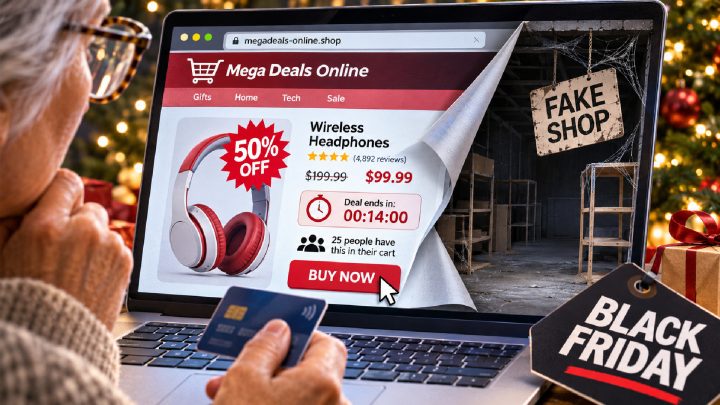
Black Friday kicks off the Christmas shopping rush, and the fake shops are open for business, too. Cyber security expert Bora Seker explains how to spot them before you pay.
You find the perfect gift for your granddaughter. Half price. A clock on the screen says the deal ends in 14 minutes, and a little message says 25 people have it in their cart. You reach for your card.
That’s not a bargain. That’s a film set.
From the front, it looks like a real shop – the photos, the reviews, the friendly ‘About us’ page. Walk through the door and there’s nothing behind it.
Black Friday falls on November 27 this year, with Cyber Monday following on November 30. Australians spend billions of dollars during these sales, and scammers know it.
The numbers are sobering. In the first six months of this year, Australians reported losing $554 million to scams. That’s about $3 million every single day.
At CyberCon in October, IDCARE shared figures showing more than $82 million was lost in July alone, with New South Wales and Victoria hit hardest at around $27 million each.
Shopping scams are among the most common scams Australians encounter, and thousands of fraudulent websites have been taken down.
You might think you’d spot a fake. Ten years ago, you probably would have. Today, scammers use artificial intelligence (AI) to create product photos, write convincing reviews and even impersonate established businesses. Scamwatch has seen fake shops displaying Australian addresses, phone numbers and business registration numbers.
So, what can you do to protect yourself?
1. A polished shop proves nothing
A nice-looking website is no longer a sign of a legitimate business. Type the address of shops you already know into your browser yourself, rather than clicking on an advertisement.
For a shop you’ve never heard of, search its name alongside the words ‘reviews’ or ‘scam’ and see what other people are saying. Look for independent reviews rather than relying on those published on the shop’s own website.
A brand-new shop offering enormous discounts is a good reason to hold off.
2. Don’t let the countdown clock rush you
Timers and messages such as ‘only two left’ and ’25 people have this in their cart’ are designed to rush you into making a purchase. Legitimate retailers use these tactics, too, but scammers rely on them to stop you thinking carefully.
Use the 24-hour rule – for anything over $100, sleep on it or show it to someone you trust first.
No bargain is worth losing your money over.
3. How you pay matters
Pay by credit card or through a payment service that offers buyer protection. If something goes wrong, you may be able to recover your money.
If an unfamiliar online shop only accepts bank transfers, gift cards or cryptocurrency, walk away.
And if a new shop asks you to create an account, give it a fresh, unique password – never the one you use for your bank or email.
Three more scams to watch for this Christmas
As Christmas gets closer, there are a few other tricks worth keeping an eye out for.
Parcel delivery scams: Text messages claiming a parcel couldn’t be delivered, often accompanied by a link and a deadline to pay a small fee. Check your tracking details through the official Australia Post app or the relevant courier’s website instead.
Fake charity appeals: Watch for organisations with names that sound almost right. Donate through the charity’s own website, which you’ve found independently, and hang up on anyone who pressures you into giving money.
Gift card scams: Check the packaging and the back of the card for signs of scratching or tampering before you buy, and keep your receipt. Be particularly suspicious of anyone demanding that you settle a bill or debt using gift cards.
A real shop doesn’t mind you waiting a day. A fake one is counting on you not to.
Where to get help
-
Scamwatch: scamwatch.gov.au – report a fake shop or scam and check the latest warnings.
-
IDCARE: 1800 595 160 – free support if you believe your personal information has been compromised.
-
Your bank: If you’ve paid a fake shop, call the number on the back of your card straight away, never a number supplied in a suspicious message.
Ask Bora: Your questions answered
Q: I ordered a jacket from a website I found on Facebook. It’s been six weeks, nothing has arrived and the emails have stopped. Is my money gone?
A: Not necessarily, but move quickly. If you paid by credit or debit card, ring your bank on the number on your card and ask about a ‘chargeback’, which is a way of disputing a payment when, for example, the goods you ordered never arrived.
Banks have time limits, so don’t wait another week hoping it turns up. Keep copies of your order confirmation, receipts and any correspondence with the seller.
Report the website to Scamwatch. And be careful when complaining about it on Facebook – scammers watch for those posts and may reply pretending to be the shop’s customer service team.
Q: Is it safe to buy from the ads I see on Facebook and Instagram?
A: Some are legitimate, but plenty of fake shops find their customers through social media advertising.
Treat an ad as a shop window, not a recommendation. If you like what you see, close the ad and look up the business yourself. Check for independent reviews outside its own website, and if you can’t find any, think twice before buying.
Q: I get a text every few days saying my parcel is waiting and I need to pay a small fee. How do I know which ones are real?
A: Treat them all with suspicion. Never click on a link in an unexpected text asking you to pay a delivery fee.
If you’re waiting on a parcel, open the official Australia Post app or type auspost.com.au into your browser and check the tracking details yourself. If you’re expecting a delivery from another courier, follow the same process using its official website.
Even if the fee is only a dollar or two, what the scammers may really be after is your credit card information.
Got a question for Bora?
Bora Seker hosts the Dumb Ways to Get Hacked podcast and runs Cyber Safe Homes, an online community on Skool where families learn to spot scams together. Find him at @dumbwaystogethacked on YouTube, Instagram and LinkedIn
Send your question to [email protected] and Bora may answer it in an upcoming Ask Bora column. Find Bora at @dumbwaystogethacked on YouTube, Instagram and LinkedIn.





 Proudly Australian owned and operated
Comments 0
Join the conversation. Comments are reviewed before they appear.
Be the first to comment.
Join the conversation
Tell us who you are to post a comment. We'll remember you next time.