
Experts finally unlock the key to why our cats like to purr


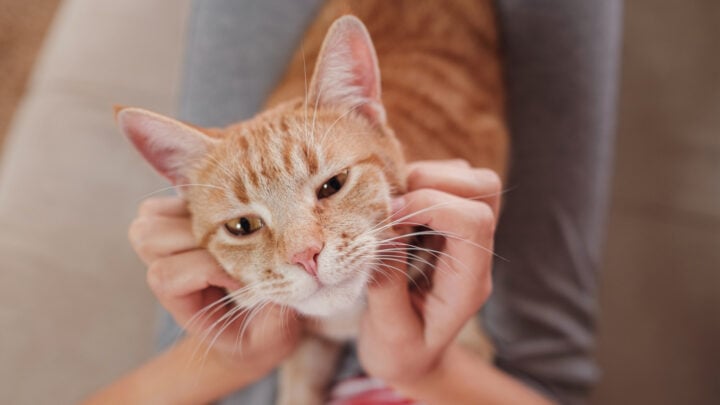
It’s a mystery that’s thousands of years old but one that scientists may soon solve.
For as long as humans and cats have lived together, we have been fascinated by many of their behaviours – none more so than purring.
While big cats produce similar vocal vibrations, no one is sure if these count as purrs or if the sound truly is unique to the smaller members of the cat family.
Now scientists in Japan think they have the answer.
Researchers from Kyoto University have identified the potential genes behind cat purrs, and it could help us understand how cats communicate and why they make this noise.
Led by biologist Dr Yume Okamoto, the team from Kyoto University analysed the DNA and owner-reported behavior of 280 domestic cats from 11 different species, and identified a gene that linked many forms of cat vocalisations, including purring.
They found that cats with short-type androgen receptor genes were reported by their owners to purr more than those with the long-type gene, and saw that this long-type version was only present in domestic cats. In fact, even their closest relatives, the fishing cat and leopard cat did not have the longer forms of the gene, suggesting it arose during domestication.
Writing in science journal PLoS One, Dr Okamoto and the team explain that previous studies showed that pure-bred cats are more likely to have the long-type gene than mixed-breed cats, which often began life as strays.
The team believes this happened as cats consistently raised by humans aren’t as dependent on vocal communication for their survival, thereby allowing cats with the long-type genetic variation to survive in the pure-bred population.
“This result aligns with the association between purring and vocal communication as strategies for seeking attention or support, benefiting survival through interactions with both cats and humans,” they wrote.
In addition, the research team hopes their findings can help predict house cat behavioural tendencies and lead to enhanced care, thereby improving animal welfare.
“Through our research, we hope to deepen our understanding of cats and contribute to building happier relationships between cats and humans,” they wrote.
While these Japanese researchers may uncover more cat mysteries, another expert has thankfully decoded another cat habit that can leave us mystified.
Exactly why do our feline friends insist on joining us in the bathroom.
Clinical cat behaviorist Amanda Campion has now explained the reason why your tabby will follow you to your own sacred throne, and the answer is “endearing”.
In a video she posted to Tiktok, Campion shared the many reasons why your cat wants to join you in the bathroom.
“Following you is a sign of attachment,” she said.
However, cats are also “curious creatures” and she explained that cats see doors “as a barrier to something they may be missing out on”.
“If you’re closing the door when you go to the bathroom this could be one reason why.”
Cats also see toilet time as “one-on-one” time where “you’re just a sitting duck” and they have you all to themselves.
@kittysittycatbehaviour “Privacy? Not when you have a cat. Here’s why they follow you into the bathroom!” “Drop a toilet emoji if you’ve got a bathroom bodyguard too!” #catbehavior #bathroombodyguard #whydoesmycat #catparents #catsoftiktok #funnycats #understandingcats #clingycat #catlove #petparentlife #kittysitty ♬ original sound – kittysittycatbehaviour
So next time your kitty companion follows you too closely, just know it often means they love you … sometimes.





 Proudly Australian owned and operated
Comments 0
Join the conversation. Comments are reviewed before they appear.
Be the first to comment.
Join the conversation
Tell us who you are to post a comment. We'll remember you next time.