
Jeremy Rolleston’s life of peaks and high-speed falls


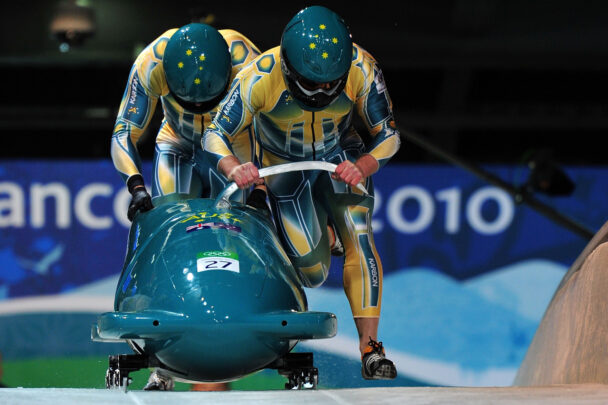
Image: Supplied
Life is, by its very nature, a series of sliding doors moments. You’re heading in one direction when something unexpected sends you in another.
Picture this. A rugby field, 50 metres wide, ringed by tens of thousands of spectators watching elite athletes battle for territory.
Now picture this. Two athletes at the Winter Olympic Games – clad in lycra, Kevlar and bobspiked shoes – charging forward with a 60-centimetre-wide bobsleigh before hurtling down an icy chute at up to 150kph through dark, twisting tunnels.
You wouldn’t expect the same person to have lived both experiences.
Meet Jeremy Rolleston.
To some, it’s a name that might prompt a flicker of recognition. Look closer and it reveals a uniquely Australian sporting story – one defined not just by success, but by resilience, reinvention and risk.
Rolleston describes himself as a “typical Aussie kid”. Sport was always central – soccer and athletics among them – but rugby union stood out. Through secondary school and university, he rose through the ranks, playing in the NSW Shute Shield and catching the attention of Wallabies selectors. Selection in the Australian Sevens side followed, where he faced Fiji and other regional powerhouses.
Then came the first sliding door.
“Coach Mark Ella had told me that I was doing well, then I got tackled while scoring a try and snapped my cruciate,” Rolleston told Starts at 60.
“And that was the sliding doors moment again, because a few days later, Mark Ella rang up not knowing how badly I’d injured my knee, and he picked me for the Hong Kong Sevens for the Wallabies. But I couldn’t walk, and I had to tell him, so I never got my Wallabies jersey.”
A cruciate injury halted his momentum just as international honours beckoned. After extensive rehabilitation, he returned to rugby at club level in Italy. But another door was about to open.
He met Kieran Hansen, a three-time Winter Olympian in short-track speed skating and former teammate of Steven Bradbury. Hansen saw something in Rolleston’s build and athleticism.
Why not try bobsleigh?
“Do I look Jamaican to you? Bobsleigh, what are you talking about?”
It sounded absurd. Australia and bobsleigh are not natural companions. But Rolleston had always combined sport with study, graduating from the University of New South Wales with a Bachelor of Science in Business Information Technology. He had also begun building a career in finance and investment, driven by a pragmatic understanding that sport can be fleeting.
That analytical mindset kicked in.
“I was fast and I was strong for my weight, and then he (Hansen) could see that if I just added more weight on and became more powerful, that I could translate that into pushing a sled.”
There was one obvious problem. Australia has no bobsleigh tracks. Not one.

Image: Supplied
A competition-grade track costs upwards of $100 million to build, with enormous maintenance costs. For Australians, serious bobsleigh means living overseas for months at a time – often without funding.
“You obviously have to train overseas, but then how do you maintain a job, while trying to spend four months a year overseas? And then at the same time, when you’re not funded, how do you afford it all? Even back then in the late-90s, when a quality bobsleigh would cost upwards of $100,000, plus food, transport and accommodation.
“I had to have my job, and then the juggle became, how do I get time off,” Rolleston said.
At the time, he was Head of Private Wealth Advisory at ANZ. The bank granted him nine months’ unpaid leave to pursue Olympic qualification. Later, a role with Goldman Sachs forced a decision between career and sport.
Sport won.
Rolleston began as a brakeman. Casual viewers might not realise sleds even have brakes; they are only used after crossing the finish line. Once a run begins, there is no slowing down.
He remembers his first descent vividly.
“The first time I went down in the sled, I just remember thinking: ‘This is insane. Get me out’.”
Bobsleigh is visceral in ways television cannot convey. It is loud. It is violent. It is brutally physical.
“They’re metal structures hurtling 100 to 150 kilometres an hour down a hill. You’ll hear them on the ice [and] that’s one thing that always sort of captures your attention. And in terms of driving it, it’s quite rudimentary.
“Imagine a billy cart, where you have two ropes. You pull the left one and the front two – what we would call bobsleigh runners – move, and the axle wheels move. It’s the same in bobsleigh. The back ones don’t move [but] the two front ones move in unison. You’re just pulling left or right, literally via two ropes attached to two D rings. That’s literally how they drive. Then put in G-forces, speed and corners and it’s insane, but it’s also awesome at the same time.
“It’s dangerous. They don’t stop when you crash. They go all the way down. You’re on your head sliding through these corners at 100 kilometres an hour. It can be dangerous because either you’re getting ice burn or hitting things, and inside the sled it’s not nicely padded, it’s just metal.”
Beyond the physical challenge was the competitive gulf. Traditional powers such as Germany, Russia and the United States operated with institutional support, advanced engineering programs and corporate backing.
“[I went] from a big sport where Australia is good at that sport, to an absolute minnow, and people are laughing or thinking ‘what the hell is Australia doing here’.
“And you’re under-resourced and you see these Germans and Russians turning up in these big, sponsored trucks and institutes of sport that are building sleds for them, and the US working with NASCAR on their sleds, and at the same time you’re trying to rent a sled and figure out who’s going to coach you. That’s the frustration.
“The journey of all the bobsleigh athletes is very similar because it’s a sport you can’t do in Australia. You can do moguls in Australia, you can do figure skating in Australia, you can do snowboard. Maybe not like you can overseas, so everyone spends a lot of time overseas, but we literally cannot do bobsleigh in Australia.”
Despite the disadvantages, Rolleston qualified for two Winter Olympics: Turin in 2006 and Vancouver in 2010.
He still recalls his first Opening Ceremony in Italy – Ferraris, Andrea Bocelli, all the Italian pomp and pageantry on show.
“When people are watching the Olympics, there’s two moments that are quite distinct for the athletes. One is walking into the opening ceremony, especially their first, because that’s very much the culmination of enjoyment of the journey to get there. And then quickly your head turns to what I was actually training for was the actual competition, and that’s the second moment.”
But elite sport rarely ends in triumph alone. Eventually, the internal fuel runs low.
“I knew I’d run my race in bobsleigh, and I can remember the moment. I’ve mentioned how hard it is to do it unsupported, and I remember being on my own with a teammate, up in Lillehammer in Norway, on my back, on cold concrete, trying to do some sled work and just thinking ‘No, I don’t want to do this, I don’t have the motivation to do this anymore.
“After a couple of years doing what I did, I really was like, no, I don’t have any competitive juices left.”
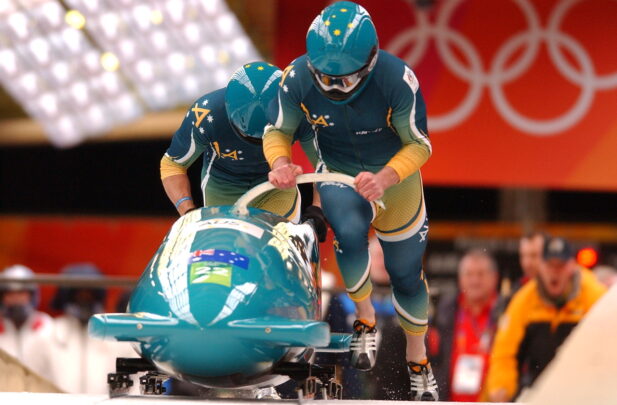
Image: Supplied
Rugby. Check. Bobsleigh. Check.
The business world, long running parallel, now took precedence. Rolleston leaned into his education and experience in finance and investment, building a successful corporate career.
But the competitive instinct never entirely fades.
Living in Queenscliff on Sydney’s northern beaches, he reconnected with Newport Surf Life Saving Club and turned to beach sprinting – a world away from icy European tracks. Rolleston’s physical prowess led to him winning two World Masters titles in 2014.
“Obviously a lot of people do nippers, even though I didn’t, and I’ve done sprinting, so beach sprint wasn’t a big jump. And when you’re training for bobsleigh, you’re still doing sprint training, so you’ll come across people that are training for beach sprints and beach flags. So it wasn’t hard to take exactly the training you’re doing and just sort of apply it more specifically to the beach.
“It was literally just something to keep myself fit. I [was] 40, I enjoy running on the sand, I don’t need equipment, I just literally have my body, and that’s nice as a change after trucking sleds around the world and a sport where equipment makes a difference, so let’s try this. And again, I really enjoyed it.”
Across three vastly different sports – rugby union, bobsleigh and beach sprinting – Rolleston represented Australia at the highest levels. None are mainstream Australian juggernauts like cricket, NRL or AFL, yet the commitment required to reach elite status remains immense.
His life reads like a study in contrasts: sun and ice, corporate boardrooms and Olympic villages, grassroots clubs and global arenas. But the thread is constant – a willingness to chase the challenge, even when the odds are long.
More simply, you might understand him through his favourite films: Braveheart. Gladiator. The Blind Side. The war experience might not be there, but the resilience is in spades.
In the end, Jeremy Rolleston’s story isn’t really about rugby fields or frozen tracks. It’s about stepping through whatever door opens next. From the roar of packed grandstands to the violent hush of a bobsleigh tunnel at 150kph, from corporate offices to barefoot beach starts, he has chased the same thing each time: the test. The edge. The chance to find out what he is made of.
Peaks, high-speed falls and all, his story proves that success is not only measured by the jersey you wear or the medal you win – but by the courage to push off again when the track ahead is narrow, cold and completely unknown.
Relive all the excitement and highlights from the 2026 Winter Olympic Games on Nine, 9Now and Stan.





 Proudly Australian owned and operated
Comments 0
Join the conversation. Comments are reviewed before they appear.
Be the first to comment.
Join the conversation
Tell us who you are to post a comment. We'll remember you next time.