
Bradbury’s 14 years of training remembered for 14 seconds


The BIG Sunday Interview, with Matt Lennon
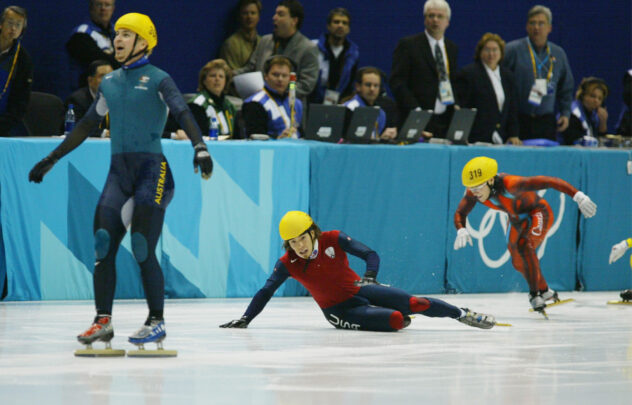
“They’ve all gone down. Bradbury is going to come through and win gold.”
Those words, spoken by Channel Seven commentator Basil Zempilas, accompanied one of the most extraordinary moments in Australian sporting history, as Steven Bradbury claimed Australia’s first-ever Winter Olympic Games gold medal in the 1,000-metre speed skating.
Not long after that, the jokes began. Hostility followed too.
“Wipe that grin off your face, buddy” one angry spectator jeered at Bradbury as he made his way to the medal ceremony. Had he committed a crime?
“He looked like the tortoise behind four hares,” USA Today later wrote about the race, even though we all know how that fable ends.
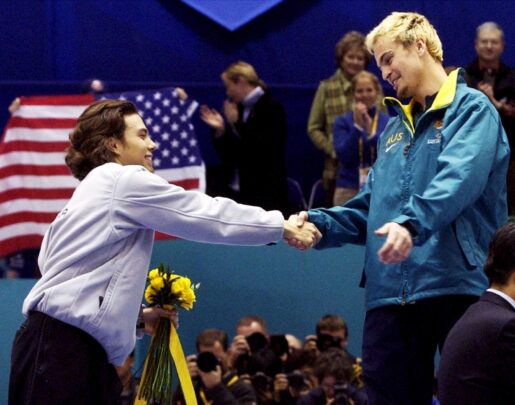
Graciously, Bradbury’s fellow competitors Apollo Ohno and Mathieu Turcotte – the only two who could speak English – congratulated Bradbury on his win. True sportsmanship.
Nobody joked when Ian Thorpe or Grant Hackett won all those gold medals in the pool in Sydney. There was only admiration when Cathy Freeman won gold in her finest 400-metre moment. So why was Bradbury lampooned and satirised so brutally for crossing the finish line first, irrespective of the circumstance?
It’s a question the man himself has occasionally reflected on post-race, particularly in the days afterwards. Bradbury’s win became the butt of countless jokes, even from Australia, but for many Americans in the media, it was framed as an injustice, made worse considering their own skater – Apollo Ohno – was a multiple world champion and gold medallist in the 1,500-metre distance. Winning the shorter 1,000-metre event was considered a given.
“I didn’t feel like I had to defend it, but I kind of did, and I understand where they’re going with it because they’re trying to make a headline,” Bradbury recalled to Starts at 60.
“The headline for them was, ‘You didn’t deserve to win. Our American skater, Apollo Ohno, should have won. Do you feel like you deserve to take that gold medal home with you?’”
“There was one journo who pushed me a bit too hard on that – [the now disgraced] Matt Lauer on the Today Show, the biggest morning show in the US. He asked me that question about 10 different ways, and the last time I said ‘Well mate, who’s wearing the medal? Are you wearing it? You’re not. And I basically wanted to say shut the f**k up, but I didn’t.”
Had it happened in today’s social media-driven and hyper-sensitive world, Bradbury would have been well supported and celebrated for his achievement. But at the time, the pressure stayed on long after the skates came off.
In the event of a mass crash like what occurred on that night, judges have the authority to order a re-run of the event. This often happens when the crash occurs mid-race, before the distance has been completed. The offending skater, if identified, is usually disqualified and the race restarts.
On this occasion, the crash unfolded on the final corner, and all competitors crossed the finish line – leaving no opportunity for a re-run. Japan’s Li Jiajun was deemed the instigator, falling first as he entered the final turn. South Korea’s Ahn Hyun-soo then lost his footing and brought down the remaining skaters, opening the door for Bradbury to skate through untouched.
Falls and spills are commonplace in speed skating at any level, especially the Olympic Games. It’s just part and parcel of the sport.
Bradbury’s presence in the final — much like his win — was the result of a remarkable, almost freakish chain of events. But there are three key facts from that night that are often forgotten.
At Olympic level, the speed-skating event takes place in its entirety over roughly a two-hour window. Bradbury won his heat and finished third in the quarter-final, thinking then that his night was over, as only the top two could progress. But Canadian rival and four-time world champion Marc Gagnon was disqualified for obstruction, allowing Bradbury to progress. But here’s where it gets weird.
Prior to the semi-final, Bradbury and coach Ann Zhang devised an unconventional yet entirely legitimate strategy: sit back from the leading pack and hope for a crash ahead. To some, deliberately not contesting the lead may seem at odds with the Olympic ideal. But the plan worked. A late spill wiped out the frontrunners, and Bradbury skated through to win. Once again, a Japanese skater was disqualified – a virtual dress rehearsal for what was to come.
By the time the final arrived, Bradbury had already raced three times in under two hours and was physically spent – evident in the way he trailed the field in the closing stages.
“There was a high chance that the other skaters would go through each other to win,” Bradbury said.
“And that left an opportunity for an alternative strategy which definitely took some experience and judgment but also took me knowing my own limitations and being realistic that, on that night, I wasn’t as strong as the other skaters and I knew it.
“It wasn’t voluntary that I dropped off, but it played into my tactics anyway because I had a discussion with my coach before the final and we decided that the other four skaters here are all out there to win, [so] there’s a good chance that there’s going to be some sort of crash and that will probably allow me to pick up a bronze medal. I never imagined it would be better than bronze,” Bradbury told Starts at 60.
What’s often overlooked is that for a race lasting just 90 seconds, Bradbury had trained and competed relentlessly for more than a decade to be there. His dues had been paid. The glory was earned. Yet he was painted as an imposter.
Bradbury was a second-generation speed skater. His father, John, was a national champion in the 1960s — before the sport even had world championships, let alone Olympic status. When Steven qualified for his first Olympics in Albertville in 1992, John became the team manager.
“He pushed me pretty hard when I was a kid. When I was 13 or 14 years old, he forced me to go running and cycling with him before I went to school and on the weekends, and I hated him for it, but because he did that, it allowed me to make the national team when I was 15 because I was fit enough.”
Selection for the 1994 Lillehammer Games delivered his first taste of success, with a bronze medal in the relay – Australia’s first-ever Winter Olympic medals. Later that year, however, his life changed forever.
During training, a collision saw another skater’s blade slice through all four quadriceps muscles in Bradbury’s right thigh. His heart rate surged towards 200 beats per minute. He lost four litres of blood, nearly died on the ice and required 131 stitches. Still, he wasn’t finished. He had “unfinished business”.
After recovering and returning by representing Australia at the 1998 Winter Olympics in Nagano, another setback occurred in 2000. A training mishap saw Bradbury trip over another competitor while trying to avoid him, hitting the barriers headfirst and fracturing two vertebrae in his neck. More than 45 days in a halo brace, four pins in his skull and a hardware store’s worth of plates and screws in his back and chest, Bradbury set his sights on Salt Lake City in 2002 even if he only had 16 months to train and prepare. The rest, as they say, is history.
Image: Don Arnold / WireImage
Since then, Bradbury dabbled in motorsport for six years until a bad head knock in a crash made him reconsider life’s priorities, at the time married and with twins on the way.
He has also been recognised for bravery. While teaching his children to surf, Bradbury noticed four girls caught in a rip, swept out and battling two-metre waves. After sending his son to alert lifeguards, he paddled out, rescuing two himself and helping the other two into a rescue dinghy.
“It was a feel-good story because no one died. Those girls were swimming where they shouldn’t have been, in conditions where they shouldn’t have been in the water at all, and they were lucky that I was there.
Anybody who meets Steven Bradbury will agree he’s a knockabout Aussie bloke, one you could easily have a beer with at the pub, even if he would prefer his own brand – Last Man Standing.
But this is also a man who reshaped how Australia is viewed in the winter sports arena. We may be a sunburnt country, but we’re battlers — prepared to fight fair and square for victory, no matter the odds.
Since that fateful night in 2002, the term ‘doing a Bradbury’ is now in the Australian colloquial vernacular. It’s made its way into the Australian National Dictionary – a distinction Bradbury considers a badge of honour.
“It’s pretty cool that I’ve got a saying that is used in everyday life in Australia and under lots of different circumstances, where usually people get the context right. Even if they don’t know where the original saying of ‘Doing a Bradbury’ came from, which some of the younger generation, they don’t know because it was 24 years ago now. For me, it’s a legacy that will remain after I’m dead.
“I get it. I’m the luckiest individual Olympic gold medallist in sporting history, but that doesn’t change the fact that I trained my guts out for 14 years to pull myself there.”
“I trained five hours a day, six days a week for 14 years to become an overnight success.”
Catch full coverage of the 2026 Winter Olympic Games from Milan on Nine, 9Now and Stan.





 Proudly Australian owned and operated
Comments 0
Join the conversation. Comments are reviewed before they appear.
Be the first to comment.
Join the conversation
Tell us who you are to post a comment. We'll remember you next time.