
Warning: older Australians are becoming the budget’s easiest target – and Mark Butler just fired the first shot


by Brian Crisp, Starts at 60 editor
I have spent a career writing about places worth visiting. But this week I want to talk about a place that deserves scrutiny: the intersection of Canberra politics and your retirement.
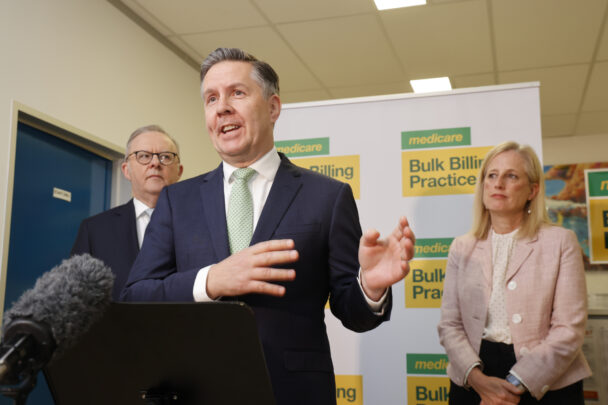
Something significant happened on Wednesday. Health Minister Mark Butler stood at the National Press Club and announced that the additional private health insurance subsidy for Australians over 65 – introduced by John Howard and income-tested, meaning it went to those who needed it – would be scrapped. The saving to the government: $3 billion over the forward estimates.
Butler cast the decision in generational equity terms. “This budget will return the rebate for older Australians back to the level paid for everyone else and divert the money back into aged care,” he said. The extra subsidy, he argued, meant two households on the same income received different levels of government support based only on their age. Not fair between generations, he said.
It is a tidy argument. But let me offer a different way of looking at it.
What the subsidy actually did
The higher private health insurance rebate for over-65s existed for a reason. Older Australians use the health system more – significantly more. They have more procedures, more specialist visits, more chronic conditions to manage. The extra subsidy recognised that reality and acknowledged that private health insurance costs more to use as you age, because the actuarial risk is higher and premiums reflect that.
Scrapping the additional subsidy does not make the health system younger people are paying into fairer. It makes the cost of maintaining health coverage in retirement higher for older Australians – at exactly the stage of life when their income is fixed, their health needs are growing, and their ability to absorb extra costs is most limited.
The government argues the money is being redirected into aged care – including, specifically, funding the full cost of showering for people on home care packages. That is a genuine improvement for a genuinely vulnerable group. The swings and roundabouts argument has some merit.
But the framing of the decision deserves scrutiny. Because “generational equity” is becoming a very useful phrase in Canberra right now – and older Australians need to understand what it means for them.
The bigger picture
There is growing concern that Australia’s tax and transfer system disproportionately benefits older, wealthier retirees while placing a rising burden on younger workers – a tension now central to Treasurer Jim Chalmers’ pre-budget messaging.
Economists note that the share of over-65s paying income tax has fallen from 27 per cent to 17 per cent. Retirees can hold up to $2 million in tax-free super, plus special senior tax offsets. In some quarters of Canberra, this is being framed as older Australians not paying their share – a characterisation that is both politically convenient and deeply unfair to the majority of retirees who are managing carefully on modest incomes and doing exactly what the system asked them to do.
Meanwhile, Jim Chalmers has already moved on superannuation. From July 1 this year, Australians with super balances above $3 million will face an additional 15 per cent tax on earnings – a combined headline rate of 30 per cent on the earnings portion above that threshold. The government says this affects less than half a per cent of Australians. For most of us reading this, it won’t land directly. But it signals a direction of travel.
The $3 million and $10 million thresholds will be indexed – a concession won after significant community pushback on the original proposal, which would have eventually swept in average workers over time. The indexation matters. It was hard won and worth defending.
But here is my concern. Each of these changes is presented as targeted, fair and modest. And perhaps each one, viewed in isolation, is. The problem is the pattern. Older Australians are being framed as the group with the assets – the home, the super, the health insurance subsidy – and therefore the group from whom savings can most readily be extracted in the name of intergenerational fairness.
The argument being built against us
A retired bank economist was quoted recently expressing disbelief that young Australians aren’t “marching in the streets,” arguing that wealthy retirees pay effectively zero tax. “Rich people like me who stopped working at 53 and have been wandering the world travelling and volunteering – their tax rates in retirement are effectively zero,” he said.
That may be true for some. It is emphatically not true for the majority of Australians over 60, many of whom are managing on the Age Pension plus modest super, paying rent in an overheated market, and watching their grocery bills climb every week.
The “wealthy retiree” frame is a political construction that serves a budget purpose. It lumps together the genuinely asset-rich – those with multimillion-dollar investment portfolios and fully paid-off properties – with the millions of older Australians who own one modest home, hold average superannuation balances, and have no other financial reserves.
When Butler talks about “generational equity,” he is not talking about the retiree eating toast because her home care package ran out of funds for meal preparation. He is talking about the household with $2 million in super and a waterfront property – a group that exists, and may indeed be able to absorb some additional contribution to the tax base.
The risk is that the policy bluntness catches the wrong people.
What to watch for in the May budget
The May budget arrives in a political environment where the government has a strong mandate, a weakened opposition and growing intellectual support for the idea that older Australians as a cohort hold disproportionate wealth. The Treasury’s Intergenerational Report projected that personal income tax revenue would rise from around 53 per cent of total taxes currently to more than 58 per cent in 2062-63 without reform – driven by a shrinking workforce supporting an ageing population.
The pressure to find new revenue from somewhere is genuine and the case for structural reform has genuine merit. But older Australians should be watching the language carefully. When “generational equity” is invoked, ask who specifically is being asked to pay and whether the cost is landing on those with the capacity to bear it, or simply on those who are easiest to target.
The private health insurance subsidy was the first move this week. It will not be the last.
Mark Butler framed it as fairness between generations. I would frame it differently: it is the beginning of a conversation about what older Australians owe the country they built – and that is a conversation we should all be part of, loudly and clearly, before the budget is handed down.
This article represents the personal views of the author and does not constitute financial or legal advice.





 Proudly Australian owned and operated
Comments 0
Join the conversation. Comments are reviewed before they appear.
Be the first to comment.
Join the conversation
Tell us who you are to post a comment. We'll remember you next time.