


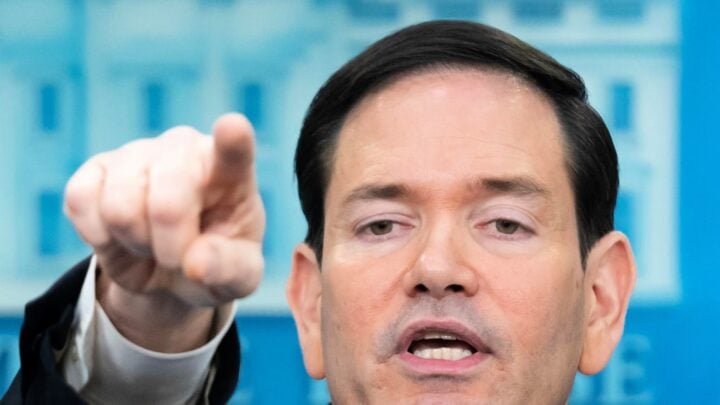
The US military operation against Iran has ended, Secretary of State Marco Rubio says, as Washington shifts its focus to reopening the Strait of Hormuz for shipping and global oil trade.
“The operation is over. Epic Fury, as the president notified Congress, we’re done with that stage of it,” Rubio told reporters at a White House press conference on Tuesday.
The United States had achieved the objectives of the operation and was now moving on to “Project Freedom”, aimed at reopening the Strait of Hormuz, a key route for global oil trade, to shipping traffic, he said.
“There’s no shooting unless we’re shot at first,” Rubio said.
US President Donald Trump declared the hostilities against Iran over in a letter to Congress on Friday.
There had been no fighting between the two countries since a ceasefire began on April 7, he wrote.
“The hostilities that began on February 28, 2026, have terminated,” it said.
By framing the conflict with Iran in this way, the Trump administration sees itself as able to remain active in the Middle East without congressional approval.
Trump’s central objectives in launching military strikes against Iran was to ensure Tehran does not develop a nuclear weapon, something Tehran has denied seeking. However, Iran has yet to hand over more than 900 pounds of highly enriched uranium.
Meanwhile US ally the United Arab Emirates said it had suffered a new wave of Iranian missile and drone strikes, although Iran’s joint military command denied carrying out attacks.
The UAE’s foreign ministry said the attacks were a serious escalation and posed a direct threat to the country’s security, adding that the Gulf Arab state reserved its “full and legitimate right” to respond.
Iran’s foreign ministry rejected Abu Dhabi’s statements, saying its armed forces’ actions have been solely aimed at repelling US aggression.
The US military said on Monday that two US merchant ships had made it through the strait, without saying when, while shipping company Maersk said the Alliance Fairfax, a US-flagged ship, exited the Gulf under US military escort.
Iran denied any crossings had taken place.
The Strait of Hormuz has also been virtually shut since the war began on February 28, triggering disruptions that have pushed up commodity prices around the world.
Iran effectively sealed off the strait, which handles one-fifth of the world’s oil and gas supply, by threatening to deploy mines, drones, missiles and fast-attack craft.
The US countered by blockading Iranian ports and mounting escorted transits for commercial vessels.
While Rubio was speaking, Britain’s Maritime Trade Operations agency reported that a cargo vessel had been struck by a projectile in the strait.
US Defense Secretary Pete Hegseth said the US had secured a path through the waterway and hundreds of commercial ships were lining up to pass through. The four-week-old truce with Iran was not over, he said.
“Right now the ceasefire certainly holds, but we’re going to be watching very, very closely,” he said.
General Dan Caine, chairman of the US Joint Chiefs of Staff, said Iranian attacks against US forces fell “below the threshold of restarting major combat operations at this point”.
Asked what Iran would need to do to violate the ceasefire, Trump said: “They know what not to do.”
Rubio said the US was continuing to explore a possible diplomatic path in the Iran war.
US special envoy Steve Witkoff and Trump’s son-in-law Jared Kushner were working “very hard” on the effort, Rubio said.
If there was a real diplomatic path it could lead Iran to “to reconstruction, to prosperity and to stability, and to not posing a threat to the world”, he said.
US-Iran talks have recently been largely deadlocked, mainly over Tehran’s nuclear program and its stockpiles of highly enriched uranium.
Iranian Foreign Minister Abbas Araqchi said peace talks were still progressing with Pakistan’s mediation.
He was travelling to Beijing on Tuesday for talks with his Chinese counterpart, his ministry said. Trump is also due to visit China this month.
with Reuters





 Proudly Australian owned and operated
Comments 0
Join the conversation. Comments are reviewed before they appear.
Be the first to comment.
Join the conversation
Tell us who you are to post a comment. We'll remember you next time.