


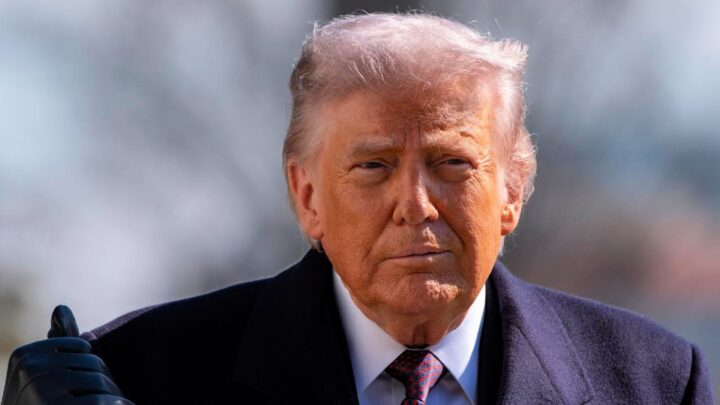
US President Donald Trump says he has agreed to a two-week ceasefire with Iran, less than two hours before his deadline for Tehran to reopen the Strait of Hormuz or face widespread attacks on its civilian infrastructure.
Iran’s Supreme National Security Council said it has accepted a two-week ceasefire in the war and it would negotiate with the United States in Islamabad, Pakistan, beginning on Friday.
“It is emphasised that this does not signify the termination of the war,” the council’s statement said.
Iran’s foreign minister said ships would be allowed to pass through the Strait of Hormuz, the narrow mouth of the Persian Gulf, over the next two weeks under co-ordination from Iran’s military.
“For a period of two weeks, safe passage through the Strait of Hormuz will be possible via coordination with Iran’s Armed Forces and with due consideration of technical limitations,” Foreign Minister Abbas Araghchi wrote in a statement.
Iranian state TV flashed an announcement saying Trump had accepted Iran’s terms for ending the war, describing it as a “humiliating retreat” by the US president.
Trump’s announcement on social media represented an abrupt turnaround from earlier, when Trump issued an extraordinary warning that “a whole civilisation will die tonight” if his demands were not met.
Trump said the last-minute deal, negotiated with Pakistan serving as a mediator, was subject to Iran’s agreement to pause its blockade of oil and gas supplies through the strait, which typically handles about one-fifth of global oil shipments.
“This will be a double sided CEASEFIRE!” Trump wrote on his Truth Social platform less than two hours before his deadline of 8pm EDT Tuesday (10am AEST Wednesday).
“The reason for doing so is that we have already met and exceeded all Military objectives, and are very far along with a definitive Agreement concerning Longterm PEACE with Iran, and PEACE in the Middle East.”
Two White House officials confirmed Israel has also agreed to the two-week ceasefire and to suspend its bombing campaign on Iran. A few minutes after Trump’s announcement, the Israeli military said it identified missiles launched from Iran towards Israel.
Trump, who has issued a series of threats in recent weeks only to back away, claimed progress between the two sides.
He said Iran had presented a 10-point proposal that was a “workable basis” for negotiations and he expected an agreement to be “finalised and consummated” during the two-week ceasefire.
The abrupt turnaround capped a whirlwind day that was dominated by Trump’s threat to destroy every bridge and power plant in Iran unless Tehran reopened the strait, which unnerved world leaders, rattled global financial and energy markets and drew widespread condemnation, including criticism from the head of the United Nations and Pope Leo.
As the clock ticked down to Trump’s deadline, US and Israeli strikes on Iran intensified, hitting railway and road bridges, an airport and a petrochemical plant. US forces attacked targets on Kharg Island, home to Iran’s main oil export terminal.
In response, Iran declared it would no longer hold back from hitting its Gulf neighbours’ infrastructure and said it had carried out fresh strikes on a ship in the Gulf and a huge Saudi petrochemical complex.
Booms were heard in Doha late on Tuesday night, according to a Reuters witness in the Qatari capital.
The war, now in its sixth week, has claimed more than 5000 lives in nearly a dozen countries, including more than 1600 civilians in Iran, according to tallies from government sources and human rights groups.
The closure of the strait, through which almost a fifth of the world’s oil supply typically travels, has sharply increased oil prices, escalating the chances of a global economic downturn or even recession.
With the US midterm election campaign ramping up, Trump’s approval ratings have hit their lowest level ever, leaving his Republican Party at risk of losing its grip on Congress.
Polls show sizeable majorities of Americans opposed to the war and frustrated by the rising cost of petrol.
With AP





 Proudly Australian owned and operated
Comments 0
Join the conversation. Comments are reviewed before they appear.
Be the first to comment.
Join the conversation
Tell us who you are to post a comment. We'll remember you next time.