


The following blog by Shelley Winkel was originally published on the Queensland Blog.
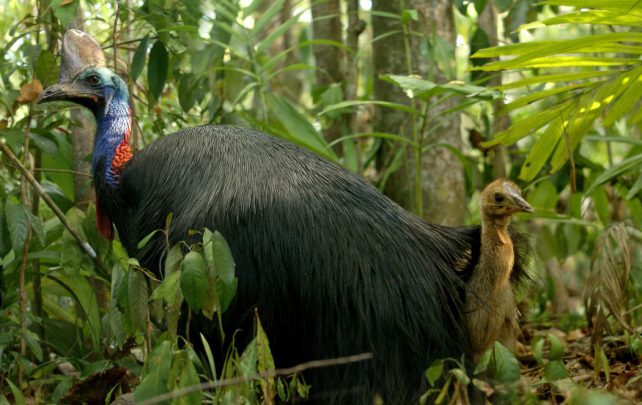
You would think finding a 60kg bird, some as big as two metres in height, would be easy, wouldn’t you? Especially when they’ve got a brilliant-blue neck and rapper-sized red throat bling, known as a wattle. But it’s not.
Throw in a thick jungle camouflage, a considered rarity – there’s only 4000 remaining in the entire world – and a deep aversion to meeting humans, and the cassowary, the third largest bird in the world and an Australian native animal, can be notoriously hard to spot. That is unless you know where to go.

Photo of Ms Cass and Joov by Liz Gallie
And that, nature freaks, is Mission Beach, two hours south of Cairns on the eponymous Cassowary Coast overlooking Dunk Island on the Great Barrier Reef.
This stunning seaside resort town is home to an estimated 100 resident wild cassowaries like Ms Cass and Joov (above) and an active group of humans doing their darndest to ensure the species continues.
One of them is the elegant Liz Gallie, a jeweller by day and a long-term advocate for travellers to this region to slow down, sit quietly and appreciate nature.
After 10 minutes chatting with Liz, I’ve got a good grip on the seven best places to spot a cass’ plus a stern warning that success rests on two things: slow and quiet. So grab your coffee and your repellent and join in.
image: http://cdn-blog.queensland.com/wp-content/uploads/2017/09/licuala-state-forest_the-dreaming-trail_blog.queensland.com_.jpg

Licuala Forest | Photo by Jesus Angel Cuevas Moreno
Cool name, cool walking path! Liz Gallie says trekking through the rainforest is the number one way to spot a cassowary, if you go quietly.
The 3km stunning Dreaming Trail is worth doing just to understand the immense biodiversity of the Mission Beach region. The path crosses a handful of shallow creeks (footbridges are plenty) and winds through low-lying rainforests and under licuala palm forests.
I didn’t spot any cassowaries here (too focused on flicking leaches from my legs; the shrieking was anything but “quiet”, Liz), but we did spot oversized footprints in the muddy path and plenty of squishy cassowary poo. Quandongs – the cassowary’s favourite food – must be good for regularity.
image: http://cdn-blog.queensland.com/wp-content/uploads/2017/09/tully-mission-beach-road_shelleywinkel.jpg
 Both the Tully-Mission Beach and the El Arish Mission Beach access roads cut through large foraging ranges.
Often birds are spotted in the morning and late afternoons as they cross the busy roads and to look for new food sources.
Be warned: these flightless creatures can run up to 50km an hour, but they are no match for an 80km/hour car. So, please SLOW down and drive with the expectation that you WILL see one around the corner or over the next crest.
Also, don’t stop. That’s problematic for you and for the cars behind you.
It may be a handyman haven, but this lime green building sits right next to a cassowary corridor and is a great place to spot a bird. Keep your eyes peeled.
image: http://cdn-blog.queensland.com/wp-content/uploads/2017/09/cassowary-www.walkmyworld.com_.au_.jpg

Etty Bay | Photo by Walk My World
This must be the only dump in the world that has a cassowary, instead of the ibis, as its resident winged forager.
The Mission Beach tip is known haunt for a family of cassowaries as it happens to cross paths with a cassowary corridor.
image: http://cdn-blog.queensland.com/wp-content/uploads/2017/09/credit-lizgallie.jpg

Photo by Liz Gallie
This immaculately landscaped Beachcomber Coconut Holiday Park near Wongaling Beach at the south of Mission Beach borders a cassowary conservation park and the giant birds have been seen bobbing their heads up and down as they eat seedlings from the forest.
Some campers have even filmed cassowaries wandering through the caravan grounds in the early morning (cassowaries with your Cornflakes?) and along the beachfront.
image: http://cdn-blog.queensland.com/wp-content/uploads/2017/09/garners-beach_photo-by-jesus-angel-cuevas-moreno-e1505888453828.jpg

Photo by Jesus Angel Cuevas Moreno
The area near Bingil Bay Reserve is a known habitat for four adult cassowaries, including Cyrilina, and a bottleneck crossing to the World Heritage area in the south.
It’s also home to a secret swimming beach with massive beach figs that literally weep over the sand and provide a few degrees of cool shade on a hot day. It’s a great place to be, even if you can’t find a cassowary.
image: http://cdn-blog.queensland.com/wp-content/uploads/2017/09/cassowary-on-etty-bay_credit-www.walkmyworld.com_.au_.jpg

Photo by Walk My World
Etty Bay on the way back to Cairns, some 50km north of Mission Beach is a treacle-slow, village that fronts onto one of Australia’s best-kept secret beaches.
The town’s dog-free status is thought to be the reason that cassowary spotting – at the right time – is almost a guarantee.
image: http://cdn-blog.queensland.com/wp-content/uploads/2017/09/cassowary-wardens_credit-lizgallie.jpg

Photo by Liz Gallie
No matter where you look, here are Liz Gallie’s top tips for safe cassowary spotting.
Help. Do you know any other secret spots to see a cassowary?





 Proudly Australian owned and operated