


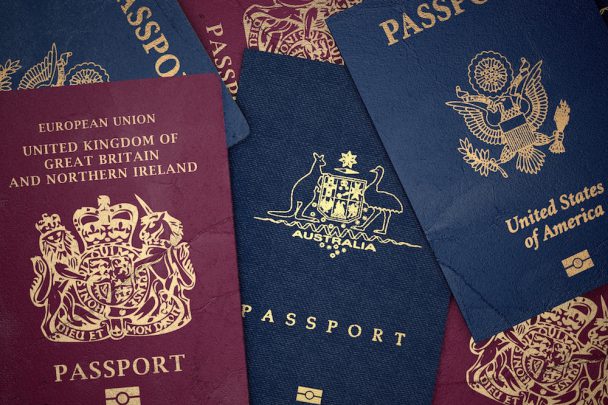
Have you ever been at the airport and wondered why the person next to you in the queue at customs has a different coloured passport? Passport shades aren’t chosen at random – there’s meaning behind why their nation chose to use that colour.
There are only four main colours of passports in the world: red, blue, green and black, however, they appear in various shades. These colours are chosen for their cultural, political and religious significance. Here’s what each colour means.
Countries with red passports spread geographically from the Philippines all the way up to China and Russia and over to Europe and the UK. The countries of the European Community, an alliance of some European nations before there was a European Union, debated for some time before settling on a colour for their passport, one that was symbolic of them and would make Europe instantly recognisable. They eventually chose red, and Turkey followed suit in 2010 to align itself with the European Union in the hopes of joining. Switzerland is part of the European Union, and chose a passport design that heavily reflects their national flag. As for Russia and China, their communist histories explain the symbolism of a red passport.
Read more: The surprising reason why you should get a second passport
Countries with green passports are concentrated in the Middle East as well as Africa and Indonesia – all places with significant Islamic populations. The colour green is significant to Islam and several nations in the Middle East have green, or partly green national flags.
Several of the major countries with blue passports are key players on the world stage and members of the Commonwealth. Australia, the United States, India, Canada and the Caribbean all have blue passports, which are also said to symbolise ‘the new world’.
The United States has had many different passport colours in the past, but the most recent colour was chosen to represent the blue on the American flag. The change of the colour from the previous red was for the US Bicentennial in 1976 – in the thick of the cold war – also possibly chosen to distance itself from communism.
There are very few countries with a black passport, but the benefits of having one is that they stand out. New Zealand is one of the few passports that are black, being their national colour. The Vatican’s passport is also black with a simple gold emblem, a striking symbol of its importance.





 Proudly Australian owned and operated