


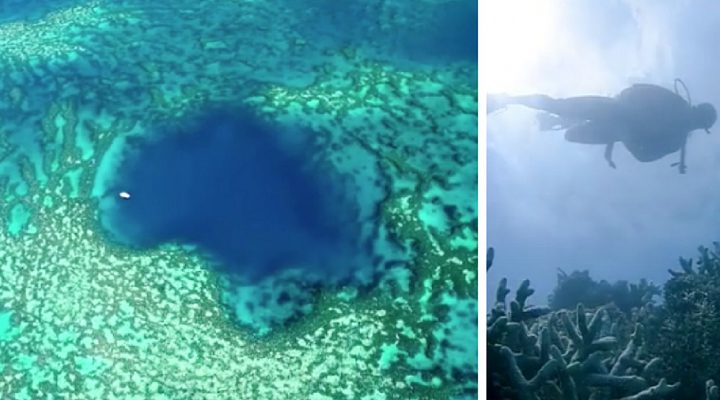
A marine biologist has revealed the incredible moment he discovered two huge blue holes off the coast of Australia, bringing new hope for the Great Barrier Reef following the devastation of Cyclone Debbie in 2017.
Johnny Gaskell made headlines last year when he and his team dived a huge 15-20m-deep blue hole he found on Google Maps, filming corals and fish that had until then remained largely undocumented.
The hole, which forms in weaker parts of the ocean floor as a sort of sinkhole, had sat hidden in one of the reef’s biggest lagoons, and Johnny only found it when he began scouring online maps and satellite images after the cyclone – to asses the damage and look for new corals.
They had to wait for months before they could dive down, due to bad weather and tides, but once they did – in September last year – they found beautiful corals which survived the 11-metre waves and gale-force winds of the cyclone.
“It was amazing, there were formations I couldn’t have imagined down there, and some of the most delicate structures I’ve seen. I was so happy to find an area that had remained untouched,” he told Travel at 60.
As well as huge birdsnest coral, they also saw super elongated staghorn coral – and Johnny captured parts of it on video. While the team plan to keep the location secret, they shared some of the hidden wonders online – proving there are still areas of the reef thriving despite extensive bleaching in the north, and damage from the cyclone.
Sharing an image of the amazing discovery on Instagram, he wrote at the time: “What we found inside was hard to believe considering five months ago a Cat 4 cyclone went straight over the top of it… The position of this deep hole within the lagoon walls has obviously protected these corals for decades.”
He’s since found a second undiscovered hole, which his team hopes to be able to dive when the weather improves, as well as two more which were previously found by geologists, but have little information recorded on them.
By analysing shadows and areas of clear blue water on Google Maps, Johnny was able to identify locations for each – but they’re very hard to find, and require near-perfect tides and weather to dive them.
“The importance of the next generation learning more about marine animals is paramount,” he added. “The ocean is the biggest environment that is losing its health the fastest.
By finding hidden wonders like these, and keeping their locations hidden, Johnny hopes he can preserve more life while some of the damaged areas of the reef continue to recover.
Explaining how a blue hole actually forms, he said: “In the Great Barrier Reef – and this is only what the geologists think, it’s not definitive – it’s believed that with the rise and fall of the sea level along the east coast of Australia, weaknesses cause big areas to fall in, creating a sink hole.
“As the sea levels rise to where they are now, they fill with sea water and coral is able to grow round the edge, where there’s more sunlight.
“There’s hardly any studies done on our blue holes, I don’t know why, that’s why I want to get out there. There’s a couple of really big ones that have never been dived we’ve found now.”
Johnny explained corals rely on sunlight to survive, as do plankton, so the most impressive formations tended to be along the sides of blue holes that have regular sunlight streaming down.
In addition, the depth of the hole causes a sort of channel where salt water is continuously moving down in sunlight, feeding the coral and causing it to grow faster.
The world’s largest known blue hole, named The Great Blue Hole, is found off the coast of Belize. The giant submarine sinkhole is 124 metres deep.
Read more: 5 amazing island beaches in Queensland
“The Whitsundays definitely captivated me – there are so many islands around here and they are all unique and wonderful,” he said. “Honestly, living here you never get sick of exploring new places but, on the off chance you did, you just go back to the places you love.”
While coral bleaching has become a huge problem in the north of the reef, Johnny remains positive for its health as a whole. Bleaching occurs in hotter weather when the temperature of the ocean increases, and while it only takes two to three years to occur, it can be a decade before the coral fully recovers – if it ever does.
The crystal blue waters of The Whitsundays are famous across the world. It’s a haven for divers and if you like your beaches, Whitehaven has the monopoly on the ‘World’s Best Beach’ crown.





 Proudly Australian owned and operated