
5 ancient ruins that hold modern mysteries


Our world is full of intrigue, mystery and things that have to be seen to be believed. These five ancient sites from around the world are some of the most fascinating mysteries of human history. Why were they made? Who put them there? And what purpose did they serve? Read for yourself about the ancient sites that have left people baffled.
1. Nazca lines, Peru
If planes weren’t invented, it’s quite possible the Nazca lines would still be a secret. Yet our discovery of them has led to very little in the way of figuring out the mystery behind them.
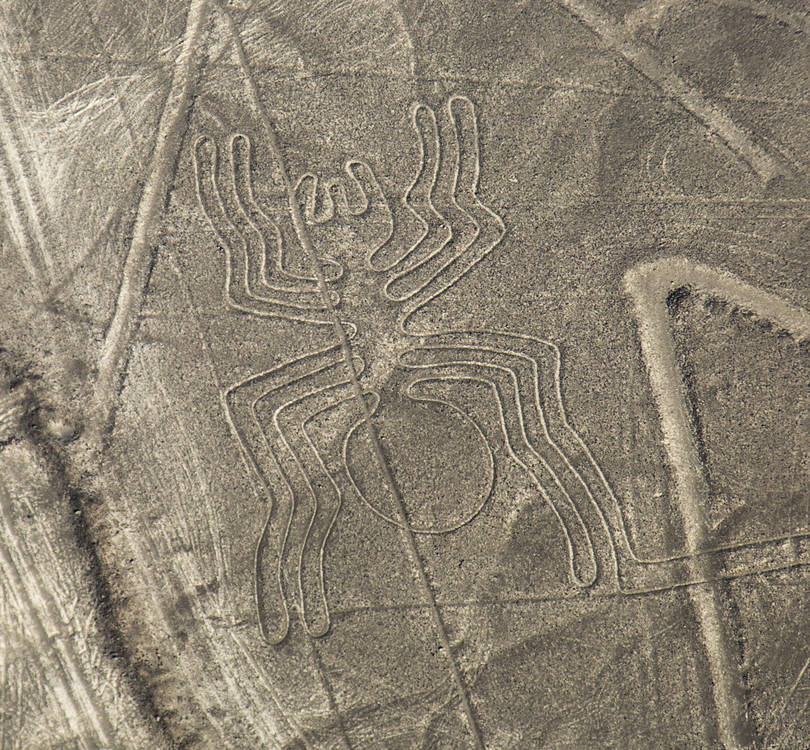
Located in the Peruvian desert, the Nazca lines are virtually undetectable by land, but from the air they are very clear figures of animals and plants made from geometric designs.
The lines are drawings on the ground made by removing the top layer of rocks and earth, which have become oxidised and turned red, to reveal a striking white layer underneath.
Made by the Nazca people in AD 1-700, no one knows for certain why the lines were made but there are a few theories. National geographic explorers Johan Reinhard and Anthony Aveni agreed that the glyphs are related to water, as the region only receives about 20 minutes of rain each year. The explorers agreed that they were used in connection to rituals hoping to obtain water or boost the fertility of crops.
2. Teotihuacan, Mexico
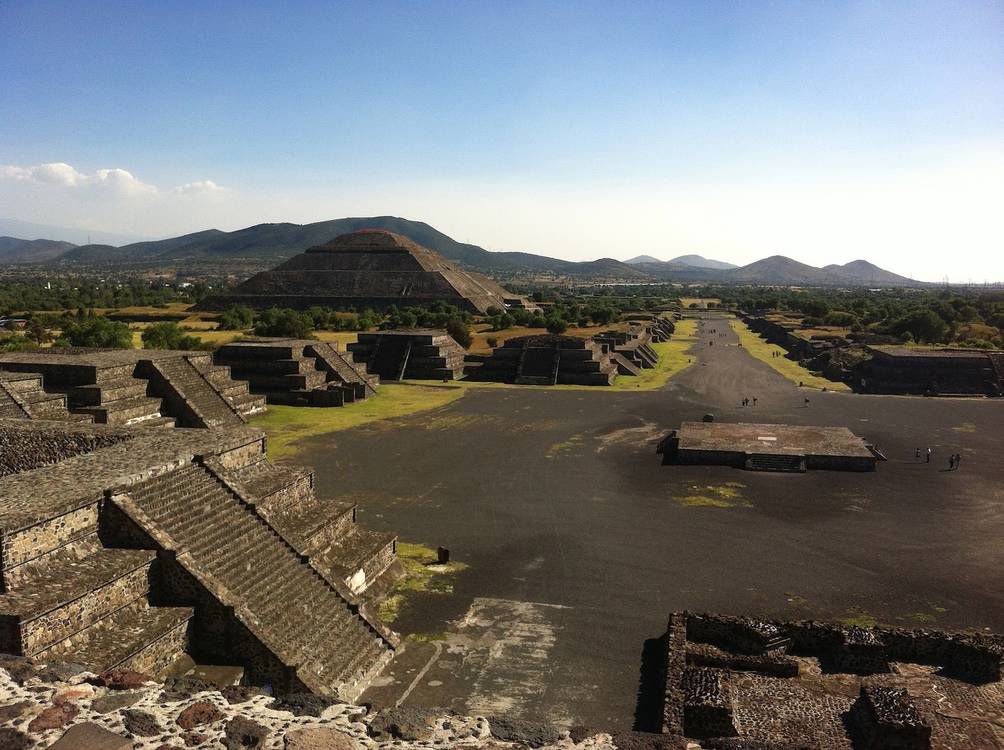
Teotihuacan, an ancient Mayan site about an hour from Mexico City, is perhaps one of the most significant in the country.
While archaeologists and historians have pieced together quite a lot about the ancient civilisation, there is still much more to be uncovered, with many questions still to be answered.
Teotihuacan was one of the busiest cities in ancient Mayan times, thought to be established around AD 50. It attracted people from as far as the Yucatan and Chiapas regions of Mexico before being abandoned completely in AD 750.
These people had their own type of hieroglyphic language that has never been cracked and it’s unclear what language they spoke within the city, or even what they called the city.
Religion was at the forefront of everyday life, but little is known about the priestly and ruling classes. Under the main temples in Teotihuacan are elaborate tunnel systems, with some possibly still yet to be discovered.
One such tunnel was discovered in 2003 by local archaeologists after heavy rains revealed a sinkhole to the tunnel. While the tunnels have been looted in past centuries, there have been discoveries such as headless bodies, animals, shells, pottery and more.
3. Uffington White Horse, England
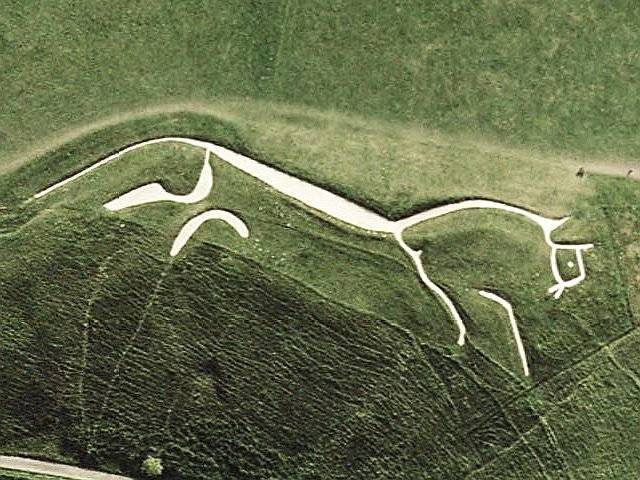
It’s unknown exactly how old the Uffington White Horse is, with experts estimating it dates to the Iron Age (800 BCE to AD 100) or the late Bronze Age (1000-700 BCE).
The horse is 110m long, formed from deep trenches that were then filled with crushed white chalk. The horse is thought to represent a Celtic tribal symbol associated with Uffington Castle, and images of the horse appearing on coins in the Iron Age.
Some believe the horse represents a horse goddess, others believe it is a representation of a protector of horses, and some believe it’s not a horse at all, but a dragon. To deepen the mystery, there are many white horse figures in surrounding hillsides, smaller in size to the Uffington White Horse.
The true meaning of the horses etched into the earth are perhaps lost to history.
4. Plain of Jars, Laos
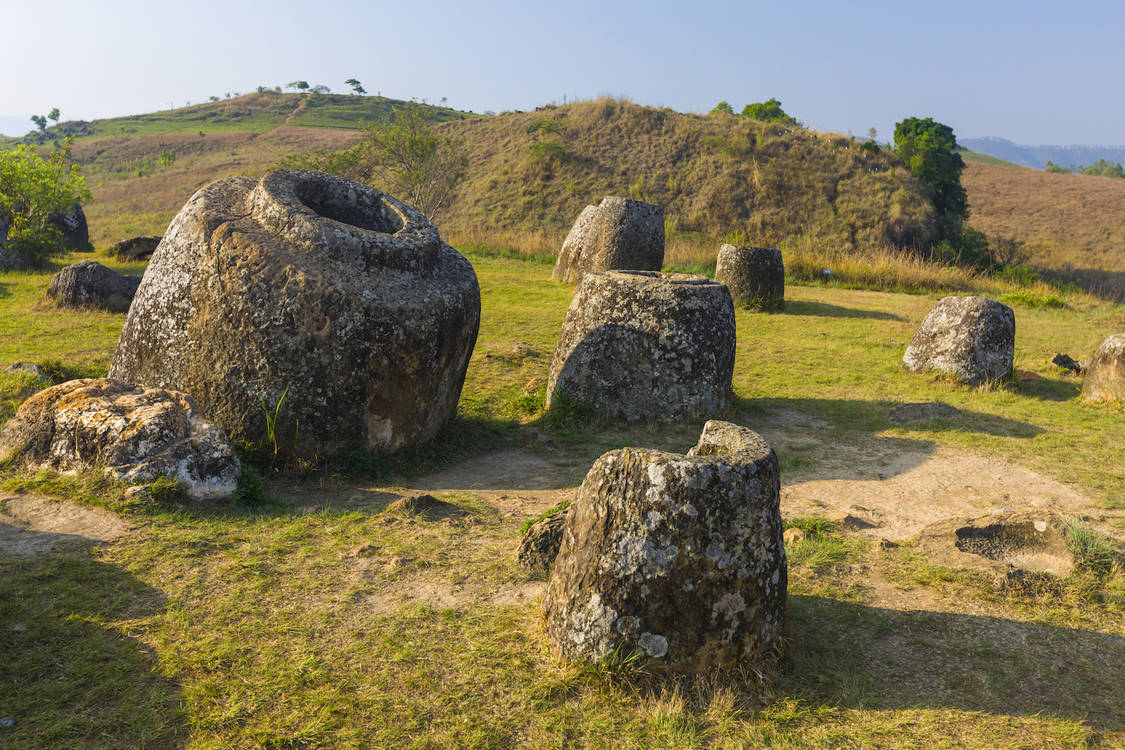
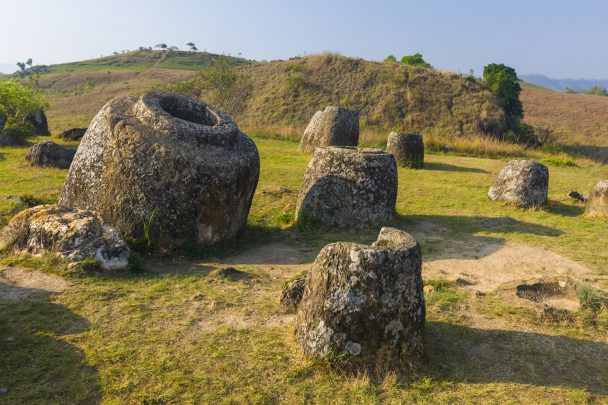
On the central plain of the Xiangkhoang Plateau are thousands of stone jars scattered in clusters all over the landscape.
There are more than 90 of these clusters, each containing up to 400 jars, some being as large as 3m tall and 1m wide.
The Plain of Jars is dated to 500 BCE to AD 500 and while no one knows what they were really used for, perhaps the most popular theory is that they were used as distilling vessels during the early stages of funeral rites.
A body would be put in the jars to decompose before being moved to a secondary location to decay further. After the corpse was completely decayed, the remains would be returned to the urn, with another fresh body joining it.
The rims on the jars are thought to have supported lids, which were also found on the plain.
Another theory is that the jars were used to brew rice wine to celebrate victories over their enemies and mythical creatures.
5. Puma Punku, Bolivia
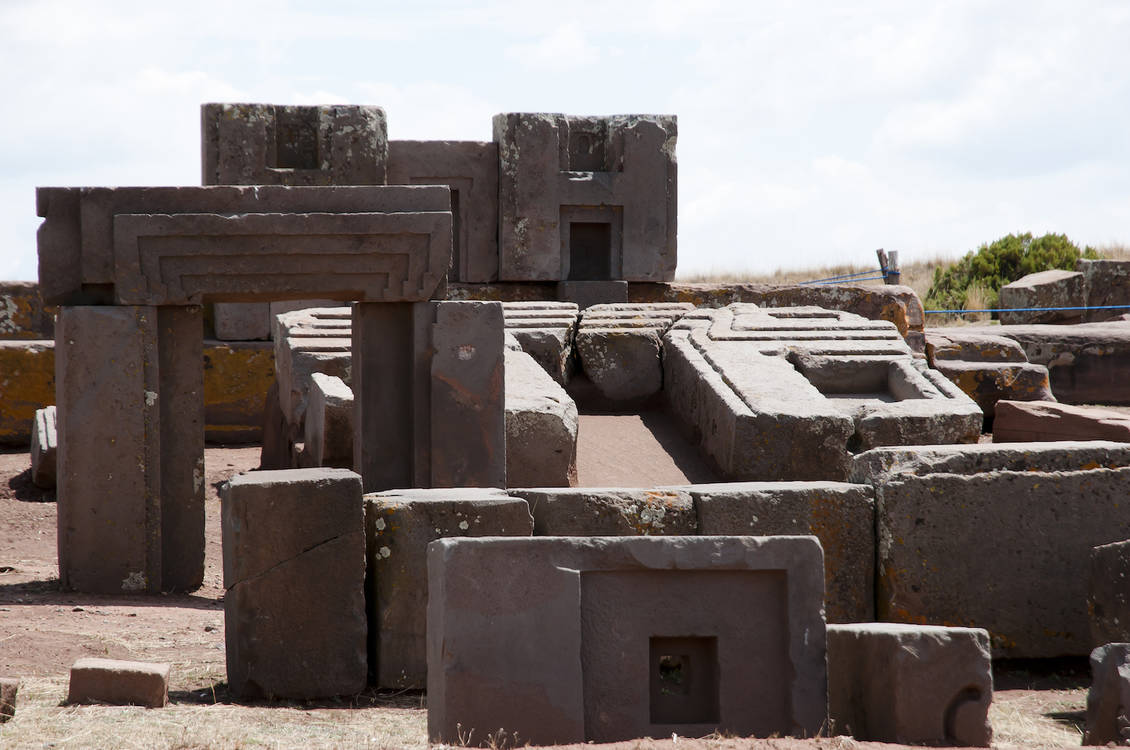
Puma Punku is part of a large temple complex in Western Bolivia, unique to any other structure built by ancient civilisations.
Constructed around AD 500, the structure is made of massive stones that are cut and placed together with extraordinary precision. It’s this precision and placement that has modern scientists baffled – some of the stones are so precisely cut they look as though they have been cut by a laser or diamond cutter.
The structures are a mystery because some weigh more than 10 tonnes and are cut so sharply that there’s no real explanation how, considering the primitive culture, limited tools and absence of trees in the area to create rollers to transport the stones on.
To deepen the mystery of the site, an inscribed dish named the Fuente Magna was found here with inscriptions in the language Proto-Sumerian, or modern-day Iraq. How it made its way to South America is unknown.





 Proudly Australian owned and operated