
Recognition is a daily blessing for Simon Burke


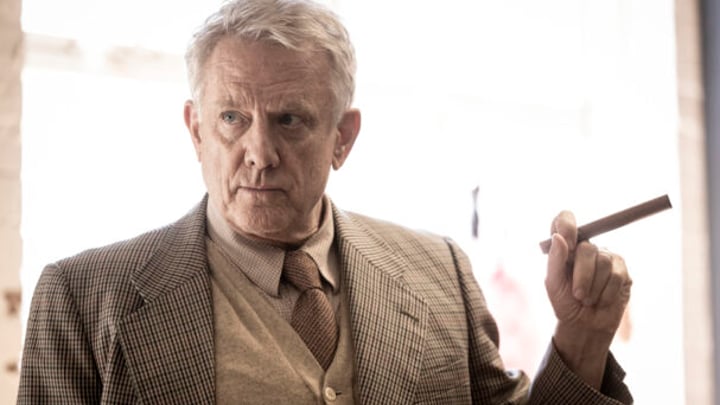
The BIG interview, with Matt Lennon
When those red and blue lights flash in your rear-view mirror, your heart instantly sinks. Sometimes, you might know what you’ve done wrong, but most people spend the next few minutes envisioning what will happen next – will an excuse do? A profuse apology? What if the officer asks you to get out of the car and somebody you know drives past?
For cherished Australian actor Simon Burke, what happened next after he sneakily U-turned over some double white lines could probably only ever happen to him.
Pulled over, the officer got out of the car, approached Burke’s window and began writing out the ticket.
“Wait, you’re Simon from Play School, aren’t you?”
Sheepishly, but like a shark smelling blood in the water, Burke saw his opportunity, flashed a grin and acknowledged the accurate association.
While he can’t remember whether the officer completed and issued the ticket, Burke not only learned his road rules lesson for the day but also learned that you’ll never know where somebody might recognise his famous face. The children he entertained on Play School over nearly 20 years on the iconic ABC show between 1988 and 2007 are now fully grown adults and functioning members of society.
“Being recognized as having been on Play School is something that happens at least once a day, which is great, I love it,” Burke happily tells Starts at 60.
“And it happens in the weirdest places, in the weirdest situations, and all over the world.”
Play School remains an icon of Australian entertainment and 60 years after it debuted, continues its role as a proving ground for aspiring actors, performers and musicians. It’s a gold standard on an entertainer’s CV that can help land them work anywhere. If you’ve been on Play School, you must be good.
Burke recalled another time, on a flight, when the flight attendant struck up a conversation about Play School.
“My 16-year-old daughter would absolutely kill me if I told you this,” she said “but when she was three years old, you were her imaginary friend. She had an imaginary friend called Simon from Play School, and they had to do everything together. They had to set the table for me every night, and there was a place where I sat to watch TV.”
“I love people liking my work,” Burke said. “In fact, it’s really pleasurable when someone comes up, and I think they’re going to say Play School, and [instead] they say ‘I thought you were great in Moulin Rouge’ or ‘I saw you on TV’ and I’m like ‘Oh my God, there’s something else’.
“But being recognised for Play School is different because it’s an acknowledgement that you were there for their formative years, that you were part of somebody growing up, and that’s a massive responsibility and it’s a real honour. You never get sick of hearing that. It’s just really nice.”
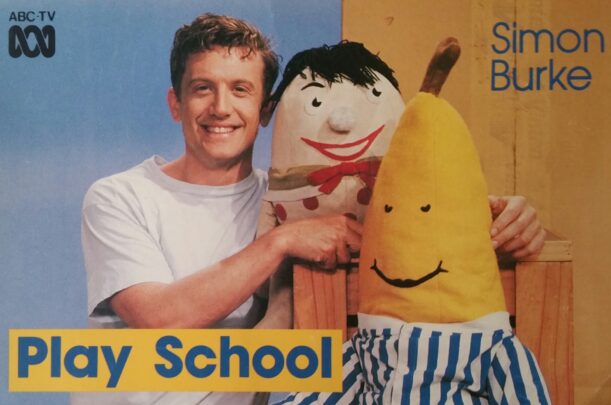
“Any young actor in their twenties you meet, they’ll say their ambition is to be on Play School,” Burke said.
“It’s one of the most coveted jobs, and it’s also probably the hardest one to get because there’s only four or five male and female presenters at any time. And the audition is notoriously hard.
“The thing most people don’t realize about Play School is that if you’re doing the maximum number of episodes per year, it’s no more than four weeks of shooting, because they only make about 70 [episodes] a year at the most, and everything else is in the system and a repeat.”
Amusingly, Burke says he occupies rarified territory in Play School lore, which he calls “the missing link” in that he was possibly the first presenter on Play School young enough to have also watched it as a child. Those who preceded him grew up before it, and now every presenter since has also watched it as a child. But it’s nothing but good memories for Burke.
“I was extremely fortunate. I started in the late 80s, the absolute sweet years because it was still shot as if it was live,” Burke remembers.
“The thing with Play School – you don’t just learn your lines. You have to learn every single camera angle, so you’re never caught looking for the camera that has the close up.
“We used to rehearse it for three hours, and then we’d do a dress rehearsal, and then crew, cast, makeup, everyone – it was like a Top Gun exercise – ‘I’m ready to go and off you go, and the aim was not to stop shooting at all, even if things went wrong, even if we’ve got a line wrong, even if a leg fell off one of the toys, you would just find a way to keep on going, and I think that was the beauty of it.
“It’s the things that go wrong that make it fun.”
At the age of 64, Burke has already chalked up more than half a century working in entertainment. There’s a slight irony in the fact that, while he got his start at the age of 12 and spent his first years playing extremely serious, high-pressure roles, being selected to join the cast of Play School at 27 allowed him to have more of the childhood he missed – though Burke emphatically denies that interpretation.
Before he became a teenager, Burke was on stage, starring in Kookaburra, a production of the former Nimrod Theatre Company which told the story of a dysfunctional family with an autistic son. That baptism of fire set the early bar extremely high, but as Burke attests, it helped him develop his work ethic – one that, to this day, sees him set a high bar for himself and maintain a desire to always say yes to a new challenge.
Burke is currently five weeks into rehearsals for his first-ever one-man show, Griffin Theatre Company’s The Elocution of Benjamin Franklin, which will play at the Belvoir Street Theatre in Sydney, in the 80-seat ‘Downstairs Theatre’ from 21 February until 29 March. Tickets are available now.
Particularly poignant is that the play subtly celebrates 50 years since legendary Australian actor and Gold Logie winner Gordon Chater performed the same role, in the same play, in the exact same theatre, back in 1976 in arguably the crowning achievement of his 50-year career.
For Burke, it’s also a homecoming of sorts. The Belvoir Street Theatre, albeit in the larger ‘Upstairs Theatre’ was where he made his acting debut in Kookaburra in the mid-1970s. Back then, it was the Nimrod Theatre Company. The name on the door has since changed, but the roof remains the same.
The Downstairs Theatre has seen Burke once before. Back in 1983, a teenage Burke starred in Are You Lonesome Tonight alongside fellow teenager Baz Luhrmann – perhaps a long precursor to his 2022 movie epic Elvis. While the two went on very different theatrical paths, there have also been plenty of intertwining circumstances.
Asking a performer to choose their favourite role is a bit like asking a parent to choose their favourite child, but for Burke, his time as Harold Zidler in Moulin Rouge stands out. The same role was played by Academy Award-winning actor Jim Broadbent in Luhrmann’s much-acclaimed 2001 film of the same name.
“I played Harold Zidler in Moulin Rouge around Australia for three years. It was maybe one of the highlights of my life doing that show. Baz and [wife] Catherine finally got to see it at the Brisbane opening, and Baz and I caught up. The first thing he said to me was to remind me at that stage it was exactly 40 years ago we were in that tiny little theatre when we were like 19 or 20, so it was really cool.

Photo: Alex Vaughan
With such a broad range of roles in his repertoire, Burke said he was given some great advice by fellow Play School presenters, such as Noni Hazlehurst, who also juggled more serious parts in TV or movies.
“I remember Noni saying this once and I totally agree with it. Of everything Play School taught me, it taught me how to act as myself.
“So often you dive into a character and invest yourself, you never ever look at the camera, you never ever engage in the camera. But with Play School, you learn that the camera is not a bunch of kids, the camera is one four-year-old person that you are talking one-to-one with.
“That requires an awful lot of integrity, openness and friendliness, and in order to do that, you have to be yourself. You can’t talk down to the camera, and you can’t talk up to the camera, you just talk to the camera as if it is a four-year-old person that you are not patronising.
“I’ve been doing plays where I realised I’m literally doing something from Play School. There were a few moments in Moulin Rouge where I found myself jumping around the stage like a kangaroo. I thought ‘I literally wouldn’t be able to have this freedom if I hadn’t had 25 years of Play School to play.
“I don’t think anything has given me as much absolute pleasure as doing Moulin Rouge and playing Harold Zidler. I mean, the show is absolutely fantastically conceived and the way that Alex Timbers, who directed it, took Baz’s film and then, with Baz’s blessing, made it into this incredibly satisfying theatrical experience. And my role as Harold Zidler was to pop through the curtain at the top of the show, invite the audience in, and basically connect with 2,000 people every single performance, flirt with them, shock them, make them laugh and make them cry.
“It felt like it was every single role I’ve ever done in my life from when I was 12 to this moment, including Play School, has set me up to have the abandon of that character. It was my job just to kind of ride the wave of the audience, gee them up and just make them go further, and it was just a magnificent experience.”
Even now, after more than five decades on stage and screen, Burke seems both amused and quietly humbled by the endurance of a career built on connection. Whether he is stopped in the street by adults who once set an imaginary place for “Simon,” revisiting the theatre where he first found his footing, or stepping alone into the spotlight for a deeply personal new work, recognition is not something he chases – it simply follows.





 Proudly Australian owned and operated
Comments 0
Join the conversation. Comments are reviewed before they appear.
Be the first to comment.
Join the conversation
Tell us who you are to post a comment. We'll remember you next time.