
Should travel insurance be able to cover acts of war?


OPINION
On the surface, you would think a major international crisis is exactly the sort of moment travel insurance is meant for. I mean, isn’t that the point?
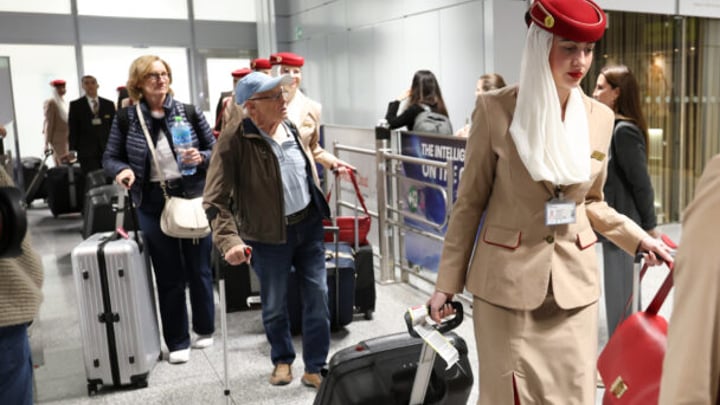
The images we’ve seen from the latest conflict in the Middle East – crowded airports, grounded and diverted flights, travellers stranded thousands of kilometres from home, even actual strikes on civilian infrastructure such as airports and hotels – are a stark reminder of how quickly carefully planned trips can unravel. Hotels cancelled. Tours and cruises scrapped. Work commitments missed. Families separated. The ripple effects of conflict in the Middle East have reached far beyond the region itself.
Yet for many Australians caught in the chaos, there has been an added shock: discovering their travel insurance policies won’t cover any of it. War, as it turns out, is often written out of the deal entirely.
This feels counter intuitive. Insurance is something we buy precisely because life is unpredictable. We accept the cost of premiums in exchange for protection against the big and unexpected shocks. A medical emergency overseas. A stolen bag. A last-minute flight cancellation. These are the kinds of scenarios that justify the purchase, don’t they?
A geopolitical crisis seems like the ultimate unforeseen event, even with a renegade wrecking ball like Donald Trump occupying the White House.
However, insurance has always been about probabilities – and unfortunately, limits.
At its core, the industry works by pooling risk. Insurers calculate, with impressive statistical precision, how many customers are likely to make claims and how much those claims might cost. Premiums are then priced so that the company can pay out what it expects to owe while still making a profit.
War does not fit neatly into that model
Unlike a delayed flight or a bout of gastro in Bali, conflict has the potential to trigger massive, simultaneous losses. When entire regions shut down, millions of travellers could theoretically claim compensation at once. The scale of the risk becomes almost impossible to price. In those circumstances, insurers tend to do what businesses have always done with uncertainty they cannot control – exclude it.
That exclusion sits quietly in the fine print of most travel insurance policies, rarely noticed until it suddenly matters.
It is easy, and tempting, to respond by saying consumers simply need to read their contracts more carefully. There is truth in that. Standard form policies are not hidden documents. They are provided before purchase. And exclusions for war or civil unrest are hardly new.
But that response also glosses over a deeper issue about fairness.
Travel insurance contracts are, by design, one-sided. The insurer drafts the terms. The consumer either accepts them or walks away. There is no negotiation over which risks are covered or excluded. In practical terms, travellers must trust that the policy they are buying will provide meaningful protection when things go wrong.
When a major global event leaves thousands stranded and facing significant financial losses – only to discover they are on their own – it inevitably raises questions about whether the balance has tilted too far.
Australian consumer law has begun grappling with this tension. In recent years, insurance contracts have been brought under unfair contract terms protections. A clause may be deemed unfair if it creates a significant imbalance between the rights of the parties, is not reasonably necessary to protect legitimate business interests, and causes harm if enforced.
On paper, that sounds promising for travellers.
In reality though, challenging a war exclusion might be as difficult as fighting the war itself. These clauses are well established across the industry. Insurers would argue they are essential to keeping premiums affordable and the business viable. Courts and tribunals are generally cautious about interfering with widespread commercial practices unless there is clear evidence of exploitation or unconscionable conduct.
For travellers currently caught up in disrupted plans, legal relief may feel like a distant prospect.
That does not mean they are entirely without options.
Airlines themselves are often the first port of call. When disruptions are widespread and beyond passengers’ control, many carriers introduce flexible rebooking arrangements or offer refunds. Importantly, cancelling a flight independently – before speaking with the airline – can sometimes jeopardise access to these remedies under consumer law.
Insurers too should not be written off without a conversation. Policies are complex documents, and not every loss connected to conflict will necessarily fall under a war exclusion. In some cases, partial coverage may still apply, or even full coverage for certain matters that may apply specifically to you rather than to masses in one affected region.
There are also formal pathways for complaints. The Australian Financial Complaints Authority provides a relatively accessible avenue for disputing financial product decisions, while community legal centres can offer guidance at little or no cost.
None of these steps guarantee a favourable outcome. But they highlight an important point: insurance is only one piece of the safety net.
Ultimately, the war exclusion debate forces us to confront an uncomfortable reality about modern travel. We have grown accustomed to a world where international movement feels routine, almost frictionless. Cheap flights and online bookings create an illusion of control – the sense that every risk can be managed with the right purchase.
Conflict shatters that illusion.
No policy can fully shield travellers from the consequences of geopolitical upheaval. Insurance can spread risk, but it cannot eliminate it. At some point, individuals, airlines, governments and insurers must all share the burden of navigating crises that defy prediction.
Whether the current turmoil leads to policy changes or even class actions remains to be seen. What seems certain is that more Australians will now pay closer attention to the terms they sign and perhaps think more carefully about how much protection travel insurance can realistically provide.
War, after all, is one of the few disruptions that reminds us just how limited our safeguards can be.
After all, as Edwin Starr sang in 1970 “War, what is it good for?”





 Proudly Australian owned and operated
Comments 0
Join the conversation. Comments are reviewed before they appear.
Be the first to comment.
Join the conversation
Tell us who you are to post a comment. We'll remember you next time.