
Crossword Puzzles


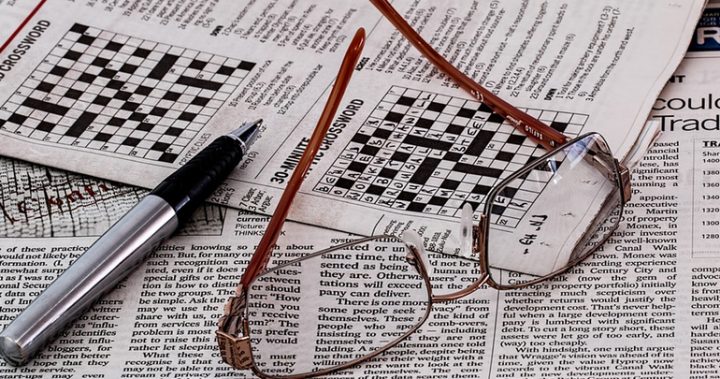
Every morning without fail, my dear hubby puts on his tracksuit and goes down to the front of our block of units to collect the daily local newspaper. If there is none there for any reason, he comes back with a frown and immediately goes online to download a copy. What for? For the crossword of course! He then flips through the articles, ads and classifieds and, while eating his breakfast he does the crossword. Occasionally he calls out to me with a clue he can’t find the answer to but by his side sits a dictionary, a thesaurus and an electronic ‘crossword solver’. A little obsessive I often wonder. Maybe, but it is just ones of his ways of keeping his mind alert driving me a little crazy at times.
I occasionally wondered where and how crosswords came into being. What was the history? So I did a bit of research and came up with this:
The earliest crossword apparently appeared during the nineteenth century but was a fairly simple one in the form of a word square, where words appear the same whether written vertically or horizontally. These can still be found in a lot of the puzzle books I come across in newsagencies. In 1913, however, Arthur Wynne, an English journalist published a ‘word cross’ puzzle in a magazine that has since been identified as the first crossword puzzle as we know it today. Later the name of this type of puzzle was changed to ‘crossword’.
The first book of crossword puzzles appeared in 1924, published by Simon and Schuster and it is from this time that crosswords have gradually become so popular that they seem to appear in just about all newspapers and magazines on the market today. The term ‘crossword puzzle’ first appeared in the dictionary in 1930.
So, what is it about crossword puzzles that make them so appealing to so many people? My mother in her eighties spent hours and hours every day in a nursing home, up until the very day she died, doing as many crossword puzzles (many of them cryptic) as she could get her hands on. At least crossword books made good Christmas, Birthday and Mother’s Day presents!
A daily dose of puzzles of all kinds, like crosswords and the now popular Sudoku are recommended to keep your brain healthy, stimulated and challenged. Hubby and I often compete with a Sudoku puzzle to see who can finish it first – me using only my brain and him tearing off to the computer for help (he has even created a computer programme to assist him). However, most of the time with crossword puzzles we share the challenge. He asks questions, and I give him the answers (of course!). At times there are a few cross words between us but most of the time, it is smooth-sailing, and I am glad to have learned a few new words and their meanings in the process.
Do you like Crosswords Puzzles? What is your favourite type of brain teasers?

To write for Starts at 60 and potentially win a $20 voucher, send your articles to our Community Editor here.





 Proudly Australian owned and operated
Comments 0
Join the conversation. Comments are reviewed before they appear.
Be the first to comment.
Join the conversation
Tell us who you are to post a comment. We'll remember you next time.