


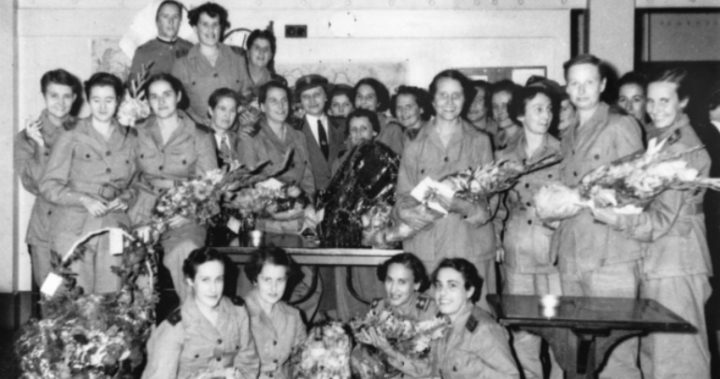
As the Anzac day parade came through Martin Place in Sydney, I thought my heart would burst with pride to see women leading the march. Although at heart I’m a feminist, this is not a jingoistic, feminist rant. Rather, I want to tell you why I feel such pride in our Aussie women.
As a young girl, I read with a mixture of horror and fascination White Coolies by Betty Jeffrey and the story never left me. I could only wish that under such circumstances I might show the same strength, grace and dignity.
My sister is a multi-certificated nurse and one day I took a photo of her being presented with a prize (for outstanding patient care) by a tall, imposing straight-backed woman, Matron Stratham. I showed it to my boss who said, “That’s Vivian Bullwinkel!”. Max, you see, had been a POW as a very young man on the tobacco fields in Indonesia, a camp not far from where many Australian nurses were also POWs. He spoke of Vivian Bullwinkel with such love and respect, and of other nurses also, that I felt compelled to learn about the involvement of Australian women in the various wars.
I searched for but found so few books about our amazing women, one exception being Australian Women at War by the late Patsy Adam-Smith. When Patsy wrote this history, her aim was to honour the “brave, modest, forgotten women” and to capture their memories whilst they were still alive.
In the early 2000s, I directed Shoehorn Sonata by Australian playwright John Misto. This play still has a very special place in my heart, not only for the story it tells but for the people I met throughout the production. All at once my reading about our nurses came to life and I even met a number of civilian POWs, one of whom was in Belalau. The ultimate privilege was to meet my girlhood hero, Betty Jeffrey. I say ‘meet’ but in fact, I shared a few telephone conversations with this truly inspirational lady. She was as strong, gentle and dignified as her younger self in White Coolies.
Around the 50th anniversary of the end of WWII, it was amazing how many more books about the POW experience became available – it was as if the memories many people held inside needed to come out. One book by a nurse mentioned Max, but he didn’t live to see it published. Patsy Adam Smith also published an excellent book Prisoners of War which was about both men and women who were imprisoned.
Another truly inspirational book is Song of Survival by Helen Colijn, which together with White Coolies was the basis of the movie Paradise Road.
I know many people objected to women leading this year’s Anzac Day marches because, even in these enlightened times, many thought the women were only wearing the medals of their male forebears.
Despite their sterling service in so many theatres of war, it was not until 1999 that the Australian Service Nurses National Memorial was opened on Anzac Avenue in Canberra. The dedication reads “In memory of Australian Service Nurses whose supreme sacrifice, courage and devotion were inspiring to those for whom they so willingly risked their lives. Their memory will also be our sacred trust.”
These days, of course, the defence forces are no longer a men-only zone and many of those in the march are decorated soldiers.
As far as I am aware, none of the nurses who survived Belalau are still alive. As I watched the women leading the ranks of service personnel, however, there were Vivian Bullwinkel, Betty Jeffrey and their nursing comrades, proud and strong as the women they were, their service, sacrifice and courage recognised at last.
Lest we Forget
(In this blog I’ve mentioned some non-fiction titles, but if you prefer your fact mixed with fiction, there are many authors such as Jackie French (A Rose for the Anzac Boys, To Love a Sunburnt Country, Miss Lily’s Lovely Ladies) Mary-Anne O’Connor (Gallipoli Street, Worth Fighting for War Flowers) and Tom Keneally (Daughters of Mars) who write very accessible novels around the various conflicts.)





 Proudly Australian owned and operated