
Age and gender counted against me until I turned the tables



I was told my age and gender were working against me: they became my greatest assets.
THERE is a unique type of vulnerability that comes with admitting that the path you spent decades building has suddenly hit an invisible, unyielding wall.
For a long time, I operated under the assumption that extensive experience, a proven track record and deep professional commitment were the definitive currencies of leadership success.
I had already completed a doctorate in Educational Sociology, consulted for the OECD and the World Bank, and successfully held three Chief Executive roles.
I expected that entering the executive market in my 50s would mean being surrounded by opportunities, allowing me to carefully select my next corporate chapter.
Instead, I found myself repeatedly losing CEO roles to men.
It did not happen just once or twice.
Over a gruelling six-month period, I was named the runner-up candidate for four separate CEO positions.
When I asked an executive recruiter for honest feedback to break the pattern, the truth I received was sharp and unfiltered: my age, my gender and my established reputation as a structural challenger were working against me.
Boards were not looking for a visionary to disrupt the status quo; they were looking for a “safe option”. And that safe option most often looked like a man in a suit.
The American Psychological Association calls ageism “one of the last socially acceptable prejudices”.
It is a bias that can be particularly acute for older women. Research indicates that age discrimination can begin affecting workers as early as their 40s, with some studies finding that women face a steeper decline in employment opportunities as they age.
Societal expectations also link a woman’s professional value to physical appearance and the male gaze. As women grow older, they can go from being undermined to feeling entirely invisible, while their older male peers maintain their visibility and status.
Facing this systemic headwind, I had to choose: do I keep exhausting my energy and confidence trying to convince traditional organisations to let me fit inside a broken system, or do I step back and pause?
I decided to start by stopping.
Pausing is not an act of surrender; it is a conscious, strategic decision to pull yourself out of the immediate storm so you can evaluate the environment with clarity.
In that space of reflection, I stopped taking the barriers personally. I realised that the closed doors were a reflection of a rigid corporate culture caught in a “spider’s web” of gendered assumptions, not a measure of my capabilities.
It was during this pause that I chose to alter my narrative. I stopped viewing my age, gender and challenger mindset as liabilities and began recognising them as my greatest assets.
My decades of navigating workplace politics, balancing high-stakes operational demands and surviving systemic exclusion had uniquely prepared me to offer something traditional structures could not teach.
If traditional boards wanted a safe supporter of the status quo, I would stop asking for their permission to lead.
I decided to design my own path and build an organisation aligned with my values and purpose: Connected Leadership.
I realised that my extensive career was exactly what I needed to support other senior women swimming against the same systemic tide.
By putting my real-life journey front and centre, my age and gender became the foundation of my credibility.
To thrive sustainably without distorting who you are, you must turn your history into a defined sense of purpose. Everything you have experienced, from your childhood and education to your professional triumphs, your age and your complex personal battles, has uniquely prepared you to lead right here, right now.
There are no standard, universal qualities of leadership. The traits we have been told are mandatory are frequently remnants of outdated, male-dominated environments.
Shifting your perspective from reactivity to strategy allows you to regain your agency. Age did not end my leadership journey; it fundamentally transformed where I chose to invest it.
When we stop measuring our worth by titles or promotions defined by others, we reclaim the power to shape our own legacy.
Your story is not a liability. It is your ultimate superpower.
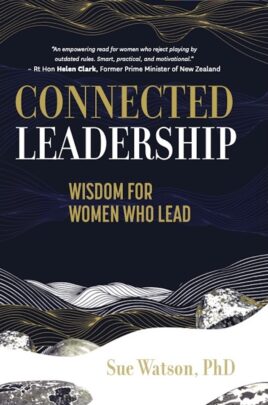
Sue Watson PhD is the author of Connected Leadership: Wisdom for Women Who Lead.





 Proudly Australian owned and operated
Comments 0
Join the conversation. Comments are reviewed before they appear.
Be the first to comment.
Join the conversation
Tell us who you are to post a comment. We'll remember you next time.