
On This Day: April 22


The day the world got serious about the planet, Jake and Elwood hit the stage, and 50,000 people ran for free land
Pour yourself something warm. April 22 turns out to be rather a remarkable day in history – and one with an unusually satisfying mix of the important, the unexpected and the downright joyful.
1970 — The day 20 million people said enough
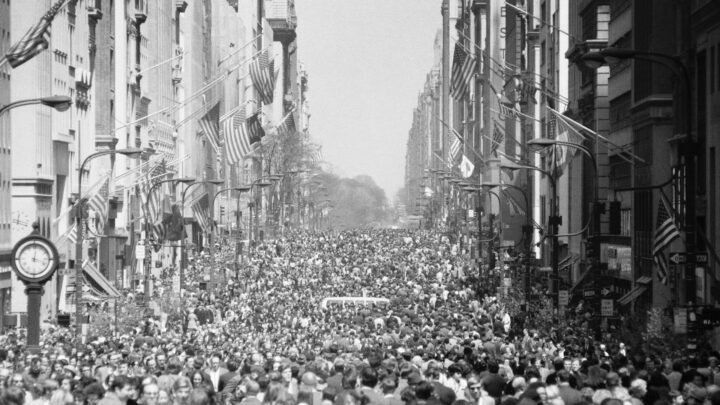
Earth Day has been observed in the United States on April 22 since 1970, and it was the work of one man: Gaylord Nelson, US Senator from Wisconsin, who called for a nationwide teach-in on the environment. Nelson had been horrified by a massive oil spill off the California coast and was convinced that Americans were ready to demand action – they just needed a focal point.
On April 22, 1970, an estimated 20 million Americans gathered to confront the ecological troubles in their cities, states and planet – and to demand action from themselves and their elected officials. That is roughly 10 per cent of the entire US population, turning out on a single day in thousands of cities, towns and campuses. It remains one of the largest single-day civic actions in American history.
It worked. In December 1970, Congress authorised the creation of a new federal agency to tackle environmental issues – the US Environmental Protection Agency. Not bad for a teach-in. Today, Earth Day is observed in more than 190 countries. It all started with one senator and an oil spill.
1978 — Two blokes in black suits change television forever
On the same date, eight years later, something considerably less serious – but no less memorable – happened on American television. On April 22, 1978, Saturday Night Live showcased the worldwide television debut of the Blues Brothers – the not-quite-real, not-quite-fake musical creation of SNL cast members Dan Aykroyd and John Belushi.
The act debuted on the April 22, 1978 episode of Saturday Night Live, hosted by comedian Steve Martin. Two men in matching black suits, black hats and Ray-Ban sunglasses launched into a cover of “Hey Bartender” with a full backing band – and the crowd, according to everyone who was there, went absolutely berserk. The audience didn’t entirely know what they were watching. Was it comedy? Was it music? The answer, gloriously, was both. The Blues Brothers went on to become the first SNL characters to get a feature film adaptation, and the only characters from the show to have a number one album or a string of top 40 hits.
1873 — The expedition that found Uluru
On April 22, 1873, English-born explorer William Gosse departed Alice Springs on an expedition into Central Australia. He had been sent by the South Australian Government to find a route from the newly completed Overland Telegraph Line at Alice Springs all the way to Perth – a journey of extraordinary ambition across largely unmapped country.
Three months into that trek, on a July morning, something stopped him in his tracks. He wrote: “What was my astonishment to find it was one immense rock rising abruptly from the plain… it appears more wonderful every time I look at it, and I may say it is a sight worth riding over 84 miles of spinifex sandhills to see.” He named it Ayers Rock, after the Premier of South Australia. The Anangu people of course had known it as Uluru for tens of thousands of years before Gosse arrived, and that is the name it carries today. But the expedition that began on this day in 1873 produced what became one of the most iconic images in the Australian imagination.
1917 — The birth of a painter who changed how we see Australia
On April 22, 1917, Sidney Nolan was born — the Melbourne boy who would go on to become one of Australia’s most celebrated painters of the twentieth century. His Ned Kelly series, begun in 1946, gave Australia an image of itself that has never quite gone away: the bushranger in his iconic square helmet, standing in the blazing outback landscape, defiant and mythological. Nolan painted not just what Australia looked like, but what it felt like – the heat, the space, the strangeness, the loneliness and the beauty of it all.
1889 — The most extraordinary land race in history
Travel back a little further, and April 22 was the date of one of the most extraordinary scenes in American history. At precisely noon on April 22, 1889, the starting gun fired on the Oklahoma Land Rush – and some 50,000 people on horseback, in wagons and on foot stampeded into two million acres of newly opened territory to claim a piece of land as their own. First one there planted a flag. Last one there slept in a tent. It was, by any measure, organised chaos on a spectacular scale – and the towns that sprang up overnight became some of the fastest-growing settlements in American history.
Also on this day…
Richard Nixon the only US President to resign from office – died on April 22, 1994, four days after suffering a stroke, aged 81. And in 1977, optical fibre was used to carry telephone transmissions for the very first time. A technology that now carries virtually all of the world’s internet traffic made its quiet debut on this day – and nobody paid much attention at the time.
Some days have a bit of everything.
Come back tomorrow for another spin through the calendar.





 Proudly Australian owned and operated
Comments 0
Join the conversation. Comments are reviewed before they appear.
Be the first to comment.
Join the conversation
Tell us who you are to post a comment. We'll remember you next time.