


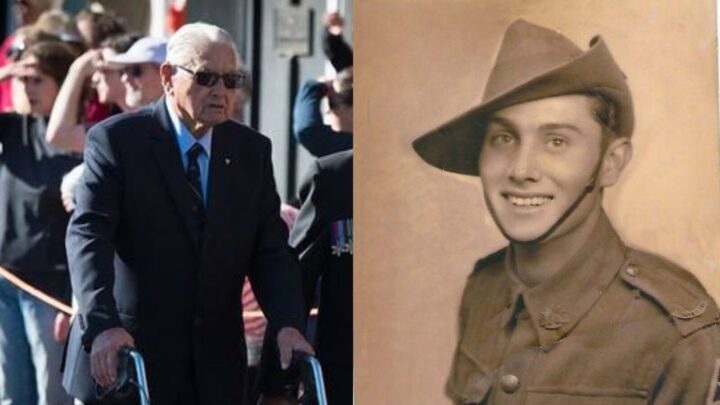
As the prisoners were called to line up in front of a Japanese general, 22-year-old Keith Fowler knew it wasn’t going to be good news. The men were told that if the soldier guilty of lighting a campfire didn’t step forward, they would begin shooting. Bravely stepping out of the line to claim his punishment, Keith was beaten before having a rifle shoved into his mouth, and says to this day he doesn’t know how he made it out of the World War II Japanese prison camp alive.
Keith Fowler, 100, told Starts at 60 that he stood dumbfounded and “punch drunk” as he watched the Japanese general walk away and spare his life. The Adelaide-born veteran says he can’t quite explain the feeling.
“It’s a funny feeling you know because you’re not frightened,” he says. “You just don’t think, you don’t think anything.”
Enlisting in the army at the age of 18, Keith served as a machine gunner in the Syrian campaign of 1941, before being taken prisoner by the Japanese in 1942 and sent to the Burma Railway as a slave labourer. Keith was one of 13,000 Australians who worked on the so-called Death Railway, which stretched between Ban Pong, Thailand, and Thanbyuzayat, Burma, and is infamous for its horrific conditions.
Anzac Day has long marked a day of memorial for those who didn’t survive the world wars, and Keith says he’s forever grateful that “somehow, someone was watching over him” during his time of service. While Keith told Starts at 60 that he will always mark the commemorative day, he says our veterans should be remembered for their bravery and sacrifice every day of the year.
The campfire incident was one of many during his time as a prisoner of war that Keith found himself fatefully out of harm’s way. While he says he was young and didn’t realise at the time, he looks back now and is baffled by his lucky escapes in so many near-death experiences. Keith said it started when he lost all his money in a two-up game in the prison camp, which meant he needed to rely on the little food the Japanese gave them. Keith said it ended up being a blessing as it acclimatised him slowly to the starvation the men would soon be subjected to. Keith said those who had money brought their food, but when the “starvation diet” began their bodies were shocked and their health suffered in a more serious way.
“Somebody, somewhere along the line was looking after me. I had so many instances that weren’t just a coincidence,” he said. “One of the strangest of all, was when we were all on our last legs and as usual, I was behind because I didn’t have any boots on and you’re walking in about 8 inches of slush, mud, and this chappy came along. I never knew him at all and he just said ‘follow me’ and pulled me out of the ranks where we were all going out to work,” he said.
“It’s hard to explain the state of mind you’re in because you just do what you’re told without even thinking anything. So I followed him, we went up behind this hillside and there was a cave and he just says ‘lay down and sleep’ so that’s what I did. He lit a fire and that’s where I stayed all day up until about 7 o’clock when he said ‘ok they’re coming in now’ and he got me down and I just fell back into the ranks.
“That day was the only day the Japanese never had a roll call. Nobody knew that I hadn’t been out there at work – nobody. And I never saw [the man] from that day on. There was a lot of men like me, in my condition. Why did he pick me? I didn’t know him and he didn’t know me at all. Three days later three men went out, two were bashed to death and one would never walk again.
“So many of these little things happened, I have to take it that somewhere there is a sort of thing as an afterlife where someone will look after you.”

Keith said the reality of war was never what they could have imagined, but it was what they’d trained for.
“I did [know what to expect] to a certain degree but you didn’t realise the reality of it. You’re there to kill other people who want to take your country. It’s a stupid idea really when you think of it now but that’s what you trained for,” he said.
“Like everybody else, in those days we were very patriotic. I remember going to school and saluting the flag and all that, which they don’t do anything at all like that anymore. It’s a shame. And I mean you just felt like it was your duty and I suppose adventure played another part of it as well but mostly they told you they wanted men to fight and protect the country and of course you were young and that’s the way you looked at it, so you enlisted.”
Despite the horrors and near-misses Keith faced, almost 80 years on he says the experience of the war made him who he is, and he wouldn’t change any of it.
“Put it this way, I was glad,” he said. “It was a thing that made a man out of me. I am not a bit sorry that I did that. POW, it sounds a horrible thing to say but it was something I think I had to do.”
Keith did admit that he’d shut out a lot of the memories when he returned home to Adelaide, saying that after the war they were all “fruitcakes” with “jungle stares”. “When I came home, I had no feelings whatsoever, the only thing I felt like was like I’d been away for a fortnight’s holiday. [The war] was completely out of mind.”
Before the war, Keith had met and proposed to Hazel Rosser, who had spent five years waiting faithfully for his return. Keith joked that he thought she might not have waited, or regretted her decision when she saw the state he was in after the POW camp.
“We were engaged for five years, that was five years before she saw me again, but she was still there,” he said. “They never knew whether we were alive or dead. I must of looked a hell of a sight when I came home because my head was shaved and I had a white towel around my neck – they’d thought the Japanese had cut my throat – but it was only a sweat towel. She must of thought ‘what the hell have I gotten into’.
“She was a lovely pianist and she used to play at the airforce association. When I came home, I said ‘how could you wait for me with all those blue boys around, all those high ranks and that’. She had a great philosophy, she said ‘I met a lot of airforce blokes and other people as well, but I was still engaged and if I got myself married to somebody else and you were still alive and I was still in love with you – my life would not be the same’.
“She was a very, very good mother, a good wife and not a bad little dancer. I was a very fortunate man.”
After the war, Keith worked for the Department of Veteran Affairs for 30 years. He and Hazel had one son and were happily married until Hazel’s death, aged 89, in 2007. Keith says the experiences they went through during their lives were different from the challenges young people face today, and believes the world is “losing the human touch” and companionship.
“It’s a different world altogether now, the world has moved on,” he said. “People my age, while we went through the bad times, I don’t think anything is as bad as what it is now. Those days, people helped one another, it brought people together, through the Depression, you know. It’s different now, you’ve got television, our phones now – people don’t need other people they’re on their phones and computers all day long. So consequently, you don’t have the companionship you had in the old days.”
Set to turn 101 on November 19, Keith’s good humour and warmth is contagious. Revealing the true secret to living to a ripe old age, he said “just keep living, don’t die!” before adding “have a keen sense of humour, never lose your sense of humour. I’ve got to 100 now, and I think they’re arguing upstairs, no one wants me!”.





 Proudly Australian owned and operated