
Why making your own butter might be the most satisfying 15 minutes you’ll spend all week


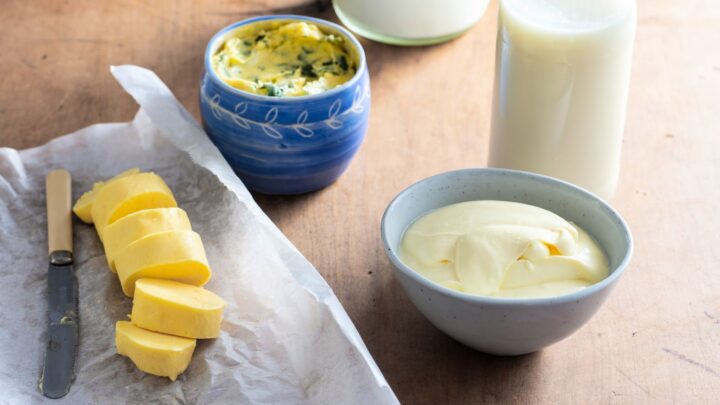
Ever made your own butter? Perhaps by accident when whipping cream? And is there a universe in which making your own butter makes sense?
I think I just heard my sister, maybe both sisters, slapping their foreheads with the palms of their hands. There was a muttered, “will you just BUY the damn butter?” along with the head-slapping.
They’re probably right. It’s ridiculous.
I have a farm and a business and a clean washing pile that takes up a double-seater sofa and some of the floor. A walk-in pantry that no one can actually walk into unless I do some organising sometime soon.
Washing that’s been on the line for more days than I can remember. There are large and unstable piles of paper on the kitchen bench, my desk and my bedside table, the latter topped by two dresses requiring repair by a kid who doesn’t even live at home anymore. I should have taught her how to sew.
And yet, here I am. It’s late at night and all I want to do is make butter.
Because on a day that felt a bit like hell in a handbasket, the fifteen minutes it takes to make butter may just be the highlight.
How to make Butter
There’s something about the science of it that is terribly attractive.
You take cream, you whip it until it splits magically into solids and buttermilk, you squish it, you salt it, and you have creamy and delicious butter.
A note on cream: use the best-quality fresh cream you can find. Not thickened (whipping) cream as it tends to have various stabilisers and gums added to it (although it will work and if that’s all you have, no hard feelings.)
I buy fresh cream in bulk from our local dairy supplier because I like to make butter, sour cream, ice cream, etc. all in one big dairy extravaganza (some days, not always, and mostly in a happy fifteen-minute window).
Makes approx. 500 g
Ingredients
1 litre (4 cups) fresh (pouring) cream
1/2 teaspoon salt
Method
Whip the cream in a food processor until it separates into solids and liquid.
It will go right through the whipped cream stage and out the other side. Once it splits into liquid and solid you’ll see yellow butter sloshing in the cream buttermilk. It takes about 4 minutes in my food processor depending on the freshness of the cream.
Take out the butter solids and let them stand in a sieve for about 5 minutes to drain out the buttermilk. Strain the buttermilk again and save for another use.
Put the butter into a bowl and run water over it until the water runs clear.
Drain off the water and mash the butter with a wooden spoon (or with paddles) to press out as much of the liquid as possible. Keep kneading until it’s dense and creamy, then knead in the salt and, hey presto, you’ve got amazing-tasting butter.
And at least when I get up in the morning and that mending is still there, I’ll have gorgeous fresh butter to spread on toast.
Fifteen minutes. Day saved.
Cultured Butter
Cultured butter is made using the same recipe and process as above, just using cream that has been cultured.
In the old days, all butter was cultured, because raw cream left to its own devices at room temperature contains naturally occurring lactic acid-producing bacteria and will perfectly enculturate over time.
You can make your own cultured cream a number of different ways, and then churn it to make cultured butter.
In an acidic environment like cultured cream, potentially harmful microorganisms are discouraged, so the shelf life of the cream, and the butter, is increased.
With all cultured cream, you can use it immediately to make cultured butter, or stir to blend and refrigerate for 24 hours before using as sour cream. Cultured cream keeps for 2–3 weeks, refrigerated. Cultured butter keeps for 3-4 weeks, refrigerated.
Culturing cream using yoghurt
Add 1 tablespoon plain yoghurt per 250 ml (1 cup) pouring cream in a glass jug or bowl. Mix well and cover with plastic wrap or a wax wrap. Culture for 12–24 hours at room temperature until thick and tangy.
Culturing cream using buttermilk
Add 1 tablespoon cultured buttermilk per 250 ml (1 cup) cream in a glass jug or bowl. Mix well and cover with plastic wrap or a wax wrap. Culture for 12–24 hours at room temperature until thick and tangy.
Culturing cream using milk kefir
Add 1 teaspoon milk kefir grains to 250 ml (1 cup) cream in a glass jug or bowl. Mix well and cover with plastic wrap or a wax wrap. Culture for 12–24 hours at room temperature. Remove the grains from the cream before agitating the cream to make butter. If using finished milk kefir, add 1 tablespoon finished milk kefir per 250 ml (1 cup) cream.
And the kid that can’t sew? She can make her own butter from scratch. Priorities.
Recipe adapted from Fiona’s book “From Scratch” published by Hardie Grant 2022, photography by Alan Benson





 Proudly Australian owned and operated
Comments 0
Join the conversation. Comments are reviewed before they appear.
Be the first to comment.
Join the conversation
Tell us who you are to post a comment. We'll remember you next time.