
Victoria’s political earthquake: What happens now?


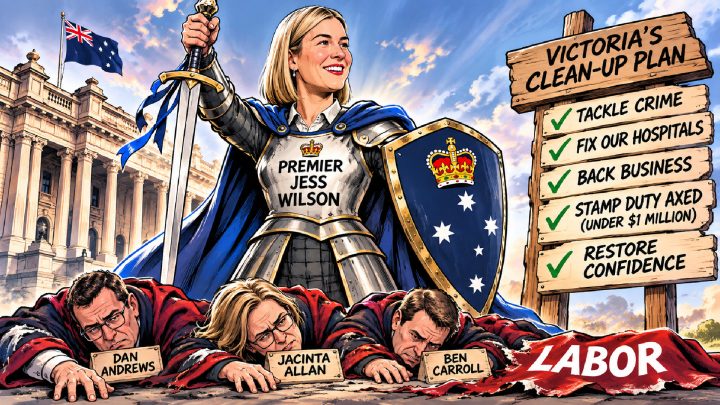
In one of Victoria’s most consequential elections in half a century, Labor has been swept from power, the Greens and One Nation have made significant gains, and Jess Wilson faces a monumental task to restore the state’s fortunes.
Victorians have woken up this morning to a very different state.
A 36-year-old Liberal leader is preparing to take office, an outgoing premier has lost his own seat, Labor’s traditional heartland has fractured and two parties from opposite ends of the political spectrum have emerged as significant parliamentary forces.
After 12 years of Labor government under Daniel Andrews, Jacinta Allan and Ben Carroll, Victorians have voted overwhelmingly for a change of direction.
Wilson becomes Victoria’s first popularly elected female premier, having united a Liberal Party that, until relatively recently, was beset by internal divisions.
But winning an election and repairing a state are two entirely different propositions.
No Christmas honeymoon
Wilson has projected confidence throughout the campaign and appears determined to waste little time implementing her agenda. There will be no leisurely wind-down to Christmas and Victorian MPs can expect lengthy meetings and an early return to parliament as the incoming premier begins tackling her legislative priorities.
Tougher bail and sentencing laws and the abolition of the emergency services tax are among the measures she wants addressed before Christmas.
Wilson inherits a state grappling with mounting debt, community concerns about violent crime, a sluggish property market, pressure on hospitals and widespread dissatisfaction among business owners.
Victoria’s debt is projected to approach $200 billion by 2030, with annual interest repayments running into billions of dollars.
There may well be more economic pain before the benefits of any reforms are felt. There is no quick fix.
Victoria back open for business?
Few sectors will be watching Wilson’s first months more closely than the business community.
Research reported by the Australian Financial Review during the election campaign revealed that one in four medium-sized Victorian businesses had considered moving their operations interstate. From discussions I’ve had with many business owners, closing down is more to the point.
From suburban cafes and family-run shops to manufacturers and major employers, businesses have been wrestling with rising costs, taxation, regulation and subdued consumer spending. Wilson has pledged to make Victoria Australia’s most competitive state in which to establish and grow a business.
Her commitments include:
-
No new or increased state taxes.
-
Abolishing the emergency services tax and restoring the previous levy.
-
Simplifying business permits, licensing and registration.
-
Faster approvals for hospitality venues and outdoor events.
-
Progressively restoring the $300,000 land tax-free threshold.
-
A $50 weekly road toll cap for eligible small businesses and motorists for two years from July 2027.
-
Reopening conventional gas exploration.
For small business owners, particularly those operating on wafer-thin margins, reducing overheads could make a meaningful difference. For larger companies, the question is whether Victoria can become an attractive destination for investment, expansion and job creation again.
Business confidence will be one of the earliest indicators of how the new government is performing.
A shake-up for the property market
Among the Coalition’s most significant housing promises is the abolition of stamp duty for eligible first-home buyers purchasing properties worth up to $1 million.
That could save buyers as much as $55,000 in upfront costs, although the existing first-home owner grant would be removed.
For parents and grandparents helping younger family members into the property market, it could also ease some of the financial burden.
Property investors stand to benefit from the progressive restoration of the land tax-free threshold from $50,000 to $300,000 over five years, with potential annual savings of up to $975.
Real estate agents, builders, mortgage brokers and tradespeople could benefit from increased property activity.
However, encouraging more buyers into the market without increasing housing supply could also place upward pressure on prices.
Who stands to benefit?
Small business owners: Lower operating costs, simpler regulations and greater certainty around taxation.
First-home buyers: Substantial stamp duty savings on eligible properties.
Property investors: Gradual reductions in land tax liabilities.
Farmers: Changes to emergency services charges and energy infrastructure policies.
Motorists and tradies: A $5 billion road maintenance commitment and temporary toll relief.
Holiday accommodation operators: The proposed abolition of the 7.5 per cent short-stay accommodation levy.
Patients: A $1.27 billion commitment to reducing elective surgery waiting lists and the removal of payroll tax on GP clinics.
Regional Victorians: A commitment to direct 25 per cent of infrastructure spending into regional Victoria.
There are difficult decisions ahead, too. Public servants face hiring restrictions, infrastructure projects are under review and proposed asset privatisations raise questions about long-term costs and public accountability.
The Greens: Labor’s problem on the left
One of the most interesting subplots of yesterday’s election was the emergence of the Greens as a substantially larger parliamentary force. Early projections suggest the party could secure eight lower house seats, having entered the election with just three.
Its performance in traditionally safe Labor territory demonstrates how dramatically old political loyalties have shifted.
Housing affordability, environmental protection, renters’ rights and opposition to privatisation will be central to its parliamentary agenda.
Labor now faces the difficult task of rebuilding support among progressive metropolitan voters while reconnecting with working families in the suburbs and regions.
One Nation is no longer a sideshow
Pauline Hanson’s party has made a remarkable breakthrough in Victoria, attracting a statewide primary vote that, during counting, exceeded Labor’s.
While the preferential voting system has limited its ability to convert that support into lower house seats, its influence in the Legislative Council could be substantial.
Wilson may find herself negotiating with One Nation to get key legislation through parliament.
That relationship will not necessarily be straightforward. One Nation has already opposed the Coalition’s proposed long-term lease of Melbourne’s sewerage business.
The party’s support also highlights the extent of voter dissatisfaction with the established political parties, particularly over immigration, housing, living costs and government spending.
Australia’s traditional two-party political system is facing increasing competition.
Why Albanese should be paying attention
There are lessons in Victoria’s election result for Anthony Albanese and his federal Labor government.
State and federal elections are different contests, but many of the issues that dominated the Victorian campaign are national concerns. Housing affordability, immigration, grocery bills, business failures, government debt and community safety are being debated across Australia.
Federal Labor must contend with electoral competition in two directions – from the Greens in metropolitan seats and One Nation in suburban and regional communities. Make no mistake, One Nation is coming, whether you like it or not. Whether it’s a statement for change by many voters or genuine faith in what they stand for, the Orange tsunami is real.
For the federal Coalition, Victoria demonstrates that a prolonged period in opposition need not prevent a return to government.
Neither major party can afford to take its traditional voters for granted.
The real test starts now
Yesterday’s election could ultimately be remembered alongside Victoria’s landmark elections of 1982 and 1992 as a defining moment in the state’s political history.
But Victorians will judge their new premier on whether their streets feel safer, businesses can keep their doors open, hospitals can treat patients sooner and the state can attract investment again.
They will also want to know whether Victoria can bring its finances under control without sacrificing essential services.
The election has delivered a decisive change of government, but delivering a change in Victoria’s fortunes is the next challenge.





 Proudly Australian owned and operated
Comments 0
Join the conversation. Comments are reviewed before they appear.
Be the first to comment.
Join the conversation
Tell us who you are to post a comment. We'll remember you next time.