


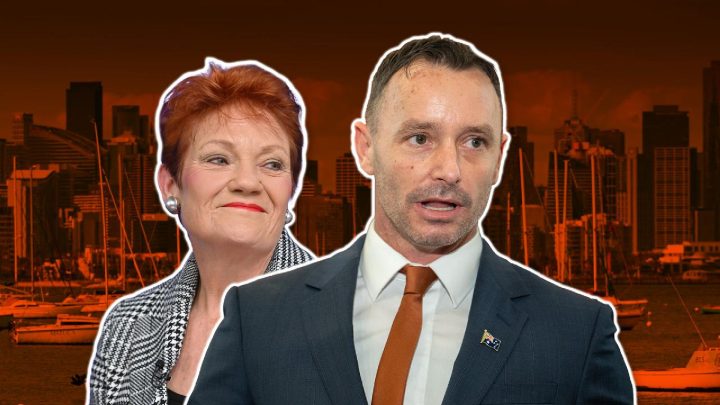
One Nation’s hopes of a lower-house breakthrough may be fading, but the party could still wield significant power over Victoria’s next government.
By Duncan Murray in Melbourne
Regardless of whether One Nation’s lower-house ambitions come to fruition, the party could still hold major sway over how a new government passes legislation.
As support for the Coalition under Liberal leader Jess Wilson firms at the expense of One Nation’s primary vote, the upper house could be where the party exerts its influence.
One Nation deputy leader and upper-house candidate Colleen Harkin identified excessive government spending, emissions reductions and First Nations recognition as areas where the party could dig in its heels.
“People are going to be relying on One Nation to do the difficult things that are going to need to be done in order to restore Victoria to a safe and a prosperous place,” she told AAP.
‘We’re nobody’s patsy’
Ms Harkin made clear One Nation was not interested in aligning itself with the Coalition, saying the party had its own agenda to pursue.
“We’re not the Liberal Party’s patsy,” she said.
“We’re nobody’s patsy.”
Voting for the upper house will look vastly different this election, following reforms that prioritise primary votes and could significantly disadvantage smaller parties.
The changes introduced in August mean voters can no longer vote for just one party above the line, and must number at least five parties above the line or five candidates below the line.
Previously, parties provided a group ticket with their preferences. The system was scrapped because it enabled “preference harvesting”, which allowed candidates to win seats with a tiny portion of the primary vote.
Where One Nation could gain power
The new system is widely expected to benefit the major parties and could help One Nation pick up at least one seat in each of Victoria’s eight upper-house electorates.
Polling around 20 per cent of the primary vote was unlikely to deliver One Nation many lower-house seats, Monash University political commentator Zareh Ghazarian said.
“I think One Nation is destined to have a fairly disappointing or sombre election night,” he told AAP.
However, 20 per cent support could see the party pick up six to eight of the 40 upper-house seats – if not more – giving it significant voting power.
Smaller parties fear extinction
The shift could come at the expense of candidates such as Georgie Purcell from the Animal Justice Party, who was elected in 2022 with just 1.5 per cent of the primary vote.
Ms Purcell and other minor-party candidates now face a slim chance of being elected, with their seats potentially falling to One Nation or larger parties with more primary support.
“Because this benefits the major parties, and One Nation is polling so high, they will ultimately be the benefactors of this,” she told AAP.
“It will be potentially diabolical for any leader and any government because there’s no room to negotiate if they operate as a block.”
Ms Purcell did not support the old system of allowing handshake deals to determine preferences either, but said the Labor government had failed to consider an alternative proportional model before making the change.
“It really will make the cross bench extinct in Victoria, and I don’t think Victorians realise how bad that is,” she said.





 Proudly Australian owned and operated
Comments 0
Join the conversation. Comments are reviewed before they appear.
Be the first to comment.
Join the conversation
Tell us who you are to post a comment. We'll remember you next time.