
The forgotten Australian breakfast treat that flips itself over in the oil — and tastes like a golden childhood Sunday


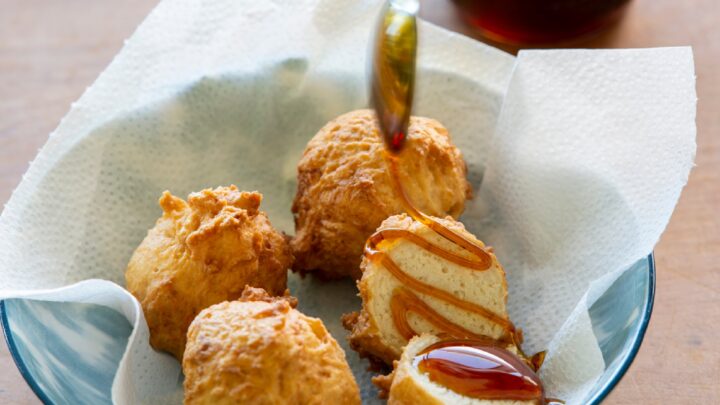
Oh, my goodness, fried scones. If you didn’t grow up with them, they are probably like Vegemite to Americans: unappetising to the point of being completely unapproachable.
I grew up with them. They were our Sunday morning breakfast treat, the way you might have pancakes or bacon and eggs or French toast. We had them smothered in golden syrup and we adored them. We’d gobble them up with their crisp brown outsides and fluffy soft insides and sticky golden syrup. My mum would deep-fry batch after batch and even though we knew she hadn’t eaten even one herself, my brother and sisters and I would wait for the next plateful to come from the kitchen and fall on them like small desperate people. No one stood between the Weirs and their fried scones.
If you dunked them in cinnamon sugar they would be very close to a donut. (We never did.) With nothing resembling a thermometer in my mum’s kitchen, sometimes they were very, very dark on the outside and sometimes they were perfect and golden. Usually they were fluffy all the way through, sometimes they weren’t quite cooked. We children were good at spooning out any uncooked middles and just filling them up with golden syrup. Sticky smiling happy Sundays.
And then, one day, after many, many years of fried scone goodness, Mum made one bad scone. No one is quite sure what happened. I wasn’t there – I think it was just after I’d left home. She thinks the outside cooked too rapidly, or maybe there was some water in the oil. One minute she was cooking fried scones, the next minute a scone exploded in the boiling oil, splashing it all over the underside of her arm, causing a pretty awful burn. (She’s fine, everyone.)
This was many, many years ago now, but it left a scar. And that was the end of fried scones, she never ever made them again. I’d occasionally ask, or suggest I might make them, but no one had the appetite and my own family developed a Sunday morning bakery pastries tradition, which gave me a morning off brekky prep and so I didn’t argue.
At some stage I decided to get back on the horse, but after however many hundreds of batches of fried scones the woman must have made, Mum for the life of her could not remember her recipe and had not written it down anywhere. I rang my Auntie Margie and thankfully she remembered it off the top of her head. It’s basically damper. Flour and milk. Of course, as it turns out, it’s an old colonial Australian recipe that was originally called ‘Puftaloons’. After a bit of hunting, we found a version of it in the original The Commonsense Cookery Book with measurements in pounds and gills!
Anyway, I made the recipe according to Margie and there they were: fried scones. With fluffy insides and crispy golden outsides, smothered in golden syrup. The original Puftaloon recipe tells you to shallow-fry these. I tried it, but you don’t get the hilariously satisfying moment of the bottom of spherical fried scones cooking and then turning themselves over in the oil to cook the other side. I HAD FORGOTTEN THEY DID THAT!
Look, shallow-frying (please beware of any water near your oil) mitigates the risk of an exploding scone, but honestly, isn’t life meant to be lived? I have no fear of it. I spoon balls of scone dough into boiling oil with complete confidence, I really do, and you should too. Be careful – test your oil with a small piece, if it’s too hot and they’re cooking too fast on the outside and the centre is raw, turn the oil down.
Do not walk away from oil on the stove. If it ever starts to smoke it’s way too hot, so turn it off. Let it cool. You can test the oil’s readiness by dropping a tiny bit of scone mix in and if it sizzles it’s good to go. Getting the heat right is a bit of a trick – if it’s not hot enough your scone will absorb too much oil, too hot and the outside will cook faster than the inside (and you’ll be making scooped-out golden syrup bombs a la small Weir children).
It’s no harder than getting the pan temperature right for pancakes though. Make one scone and you’ll know if it browns too fast and the middle is uncooked. You want it to turn golden on the underside in about 2 minutes, then if it flips itself over to cook the other side in about 2 minutes, you’ve nailed it.
Nothing will shift my family’s great attachment to bought pastries on Sunday mornings, but Fried Scones appear here on rare and special occasions to remind me of my own golden childhood and sticky plates and happy days.
Makes about 12
Ingredients
1 litre (4 cups) canola or vegetable oil
300 g (2 cups) plain
1 tablespoon baking powder
250 ml (1 cup) milk
golden syrup, to serve
Method
Preheat a large, heavy-based saucepan with approximately 1 litre (4 cups) neutral oil such as canola or vegetable.
In a bowl, mix together the flour and baking powder until well combined. Stir in the milk and keep stirring until it’s mixed very well.
You should be able to tear off a piece the size of a golf ball – if it’s too wet, add more flour by the tablespoon until you can.
Roll a golf ball-sized piece together in wet hands and quickly and carefully put it into the hot oil. Use a spoon if you’re more comfortable. Put in as many as will fit with a bit of space for them to move. Once the bottoms are cooked, if they’re spherical they should roll over. If not, you haven’t failed, everything is fine, just carefully turn them over with a fork until the underside is also golden – another 2 minutes or so.
Carefully lift out with a slotted metal spoon. (Do not accidentally use a plastic slotted spoon in boiling oil! It will melt. I have done this because I am an idiot, and I’m here to save your plastic slotted spoons.)
Drain on a piece of paper towel or a clean tea towel and serve immediately with golden syrup.
Recipe adapted from Fiona Weir’s book “From Scratch” published by Hardie Grant 2022, photography by Alan Benson





 Proudly Australian owned and operated
Comments 3
Join the conversation. Comments are reviewed before they appear.
We loved these as kids and I still occasionally make them for a Sunday night snack. The family loves them.
Thank you! I'd forgotten about these little darlings....back to the good ole Commonsense Recipe Book? Back to basics...
Last time I had fried scones my sister and I were pregnant, her last and my first, sitting at the table at mum's, both keeping count to see who could down the most, what memories.
Join the conversation
Tell us who you are to post a comment. We'll remember you next time.