
The booing won’t stop – and ignoring that won’t make it go away. It’s time for an honest national conversation about Welcome to Country


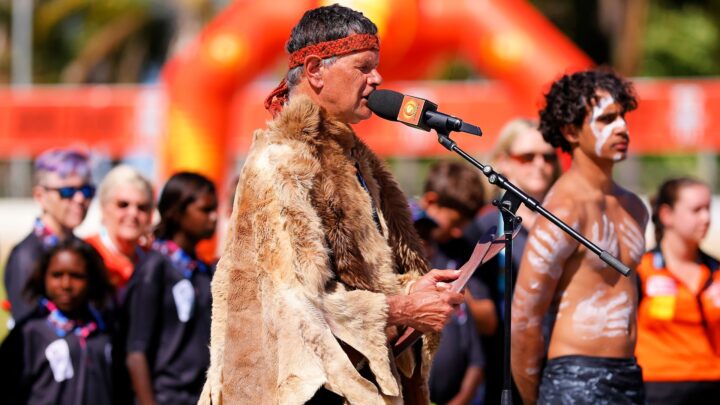
I want to be clear about something before I write another word: the booing at Anzac Day dawn services last week was wrong. It was disrespectful to the Elders who were performing a ceremony as part of the official proceedings. It was particularly wrong when directed at Uncle Ray Minniecon in Sydney – an ADF veteran whose family has served this country across generations. RSL NSW acting president, retired brigadier Vincent Williams, said it was “the most appalling act I’ve ever seen at a dawn service.” He was right.
That said.
The fact that it was wrong does not make the underlying question go away. And the underlying question – whether Welcome to Country ceremonies have expanded beyond their original purpose and intent, are being applied in contexts where they create division rather than connection, and deserve a proper national conversation – is not going away either.
More than $450,000 was spent by 21 Commonwealth government departments alone on Welcome to Country ceremonies in a recent two-year period, at an average cost of $1,266 per ceremony. The federal government has budgeted $450,000 over three years on Welcome to Country ceremonies. Individual ceremony fees – set by Land Councils, community organisations or Elders – typically run between $200 and $700 for a standard ceremony, more when smoking ceremonies or dance performances are included.
When you add state and local government spending, the figure runs into the millions annually. That is not an argument for or against the ceremonies. It is context for why the question of how, where and when they are used is a legitimate public policy matter – not just a culture war flashpoint.
A genuine and ancient tradition
It is important to be factual about the history, because the debate is often muddied by misrepresentation on both sides.
Welcome to Country ceremonies are not, as some critics claim, a modern political invention. Before European settlement, when Aboriginal people travelled onto another tribe’s land, a ceremony was performed to show that travellers were welcome. The protocols of welcoming visitors from other lands have been practiced within Aboriginal and Torres Strait Islander communities for thousands of years.
The first contemporary Welcome to Country – adapted for a non-Indigenous audience – is thought to have been performed by Richard Walley and Ernie Dingo in 1976 at the Perth International Arts Festival, when Maori and Cook Islander dancers refused to perform without being formally welcomed onto Whadjuk Noongar land. Before long, Walley and Dingo were performing ceremonies for the Northern Territory Tourism Board, the Australian Tourism Board and a Miss Universe pageant broadcast around the world.
It was not until after the Mabo decision in the early 1990s that the practice began spreading into government, business and civic life. In 2010, the Federal Parliament made opening the session with an Acknowledgement of Country a permanent feature.
So the tradition has deep roots. What is relatively new is its universal application – school assemblies, corporate meetings, sporting events, academic conferences, Zoom calls. As one industry commentator noted, Welcome to Country has become “as ubiquitous as it is inescapable.”
That expansion is where the tension lives. And it is legitimate to ask whether that tension is serving anyone well.
The question that needs asking
I am not arguing that Welcome to Country should be abolished. I am arguing that Australia has never had a proper, calm, respectful national conversation about how it should work – about which events warrant a formal ceremony, which warrant an Acknowledgement, and which might not require either.
The debate has been hijacked at both ends. On one side, anyone who raises a question about frequency or context is immediately branded a racist. On the other, the ceremonies have been weaponised as symbols of a broader culture war by people whose interest is grievance rather than genuine engagement. Both extremes are making the conversation we need to have harder rather than easier.
In Melbourne, the booing at the Shrine of Remembrance was drowned out by cheers from the crowd of more than 50,000. In Sydney, the crowd applauded Uncle Ray Minniecon after the boos. Those responses tell us something important: most Australians are not on either extreme. Most Australians are somewhere in the thoughtful middle – respectful of Indigenous culture and its significance, but also quietly uncertain about where the boundaries should be.
Those people deserve a real conversation – not to be shouted down by either side.
What a proper conversation might look like
At a minimum, Australia needs clearer, consistent national guidance on where Welcome to Country ceremonies are appropriate and where an Acknowledgement of Country is sufficient. It needs transparency about costs in the public sector. And it needs an honest acknowledgment that applying a ceremony designed to welcome strangers onto Country to a context where people have lived there for their entire lives – or died defending it – creates a tension that cannot simply be condemned away.
The RSL had already indicated some ambivalence about Welcome to Country at Anzac Day services before Friday. That is not fringe sentiment. It is a genuine institutional question about the appropriate context for a ceremony that carries real cultural weight when it is used well and loses that weight when it is applied reflexively.
The booing will not stop. History shows us clearly that these tensions, when left unaddressed and undiscussed, do not diminish. They accumulate. They find new outlets. They get louder, not quieter.
The answer is not to shout at the people who are booing and go back to business as usual. The answer is to have the conversation that makes the booing unnecessary – a genuine, respectful, nationally honest discussion about how Australia honours its Indigenous heritage in a way that brings people together rather than driving them apart.
That conversation is long overdue. Anzac Day 2026 has made it urgent.
Brian Crisp is Starts at 60’s editor and a keen observer of Australian culture and community life. The views expressed are his own. Starts at 60 welcomes responses from readers at [email protected]





 Proudly Australian owned and operated
Comments 0
Join the conversation. Comments are reviewed before they appear.
Be the first to comment.
Join the conversation
Tell us who you are to post a comment. We'll remember you next time.