
The 14-Year Itch: Why Aussies can’t let go


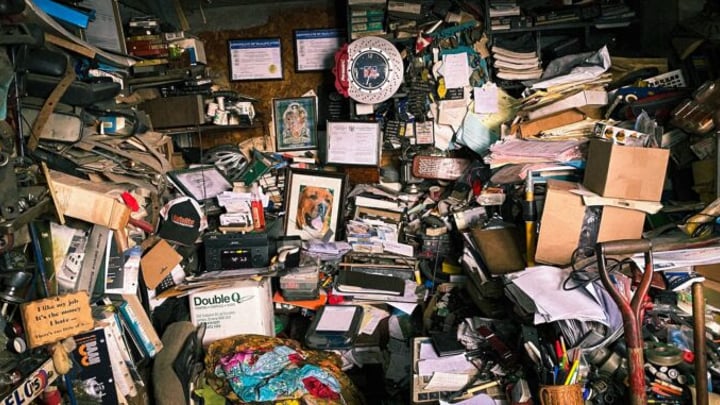
The old saying claims relationships hit turbulence after seven years, but Australian households, apparently, take twice that long before finally confronting the growing pile of “perfectly useful” nonsense in the garage.
A new Mobile Skips report has found most Australians wait around 14 years before properly decluttering their homes — a slow-motion accumulation of forgotten hobbies, tangled cables, inherited furniture, mystery boxes and appliances nobody has had the courage to throw out since the Howard era.
And it tracks!
Australians do not throw things away easily. We store them, relocate them, shift them from one cupboard to another and quietly convince ourselves there is logic behind it all.
The bread maker might come back into fashion.
Those old concert T-shirts could become collectors’ items.
The Nokia charger may yet reveal what it belongs to… and all those other cords/chargers in the fourth drawer might suddenly reveal what they belong to.
Because clutter is rarely just clutter. It is sentiment. Insurance against waste. A strange optimism that objects still have another chapter left in them.
Let’s face it, but sometimes they do.
Vinyl records returned from the dead. Mid-century furniture went from hard rubbish to boutique showroom. One man in Britain reportedly sold an old Chinese bowl he had casually kept on a shelf for years for more than half a million pounds. And let’s not get started on that Pokémon card that sold for millions.
Mostly, though, the garage just becomes a monument to deferred decisions.
The Mobile Skips report found Australians often reach a tipping point in their 50s, after years of quietly accumulating not only their own possessions but belongings inherited from parents and grandparents too. Spare rooms become archives of unfinished intentions. Kids’ bedrooms preserve sporting equipment from three growth spurts ago. Even the drawers evolve into archaeological digs of dead batteries and takeaway soy sauce packets.
Then something snaps. Not gradually, either. Fast.
The report found two-thirds of skip bookings happen within 48 hours of people deciding to declutter, with nearly a third happening the same day.
That feels familiar, too. Decluttering tends to arrive with the energy of an intervention rather than a lifestyle choice. One minute you are calmly sorting paperwork, then three hours later you are standing in the driveway asking why you own 12 extension cords and a broken pedestal fan from 2004.
The funny part is most Australians already know exactly where the clutter lives. The garage. The spare room. The cupboard under the stairs. The box labelled “miscellaneous” that nobody has opened in a decade because its contents have become emotionally radioactive.
The frightening part is how quickly ordinary clutter can slide into something darker.
Around the world there have been stories of homes so overcrowded emergency crews could barely enter them – and yep, it happens here at home in Australia. Entire rooms swallowed by newspapers, containers, clothing and forgotten purchases. Hoarding experts often say the issue has less to do with mess and more to do with memory, anxiety and control.
Which perhaps explains why throwing things away can feel strangely personal.
Still, there comes a moment in every Australian household when somebody finally says the words that change everything:
“We really need to clean this place up.”
Usually right before opening a box full of those obsolete chargers they are still absolutely convinced might be useful one day.





 Proudly Australian owned and operated
Comments 0
Join the conversation. Comments are reviewed before they appear.
Be the first to comment.
Join the conversation
Tell us who you are to post a comment. We'll remember you next time.